A gas seeping from cracks on a giant Mars volcano hints the planet may not be volcanically dead
- ESA's Trace Gas Orbiter found hydrogen chloride, about 2 parts per billion, above fresh cracks on Alba Mons, a huge Mars volcano.
- The gas shows up in the same place each early northern summer. The team thinks it may come from magma deep underground.
- No eruptions or lava flows have been seen, so the paper calls it a hint of volcanic activity, not proof.
- ~2 ppbHydrogen chloride above the cracksParts per billion, per ESA
- Under 1 mWidth of the fresh cracksSome hundreds of metres long
- 2021TGO first finds this gas on MarsReported by ESA
- 0Eruptions or lava flows seenWhy it's a hint, not proof
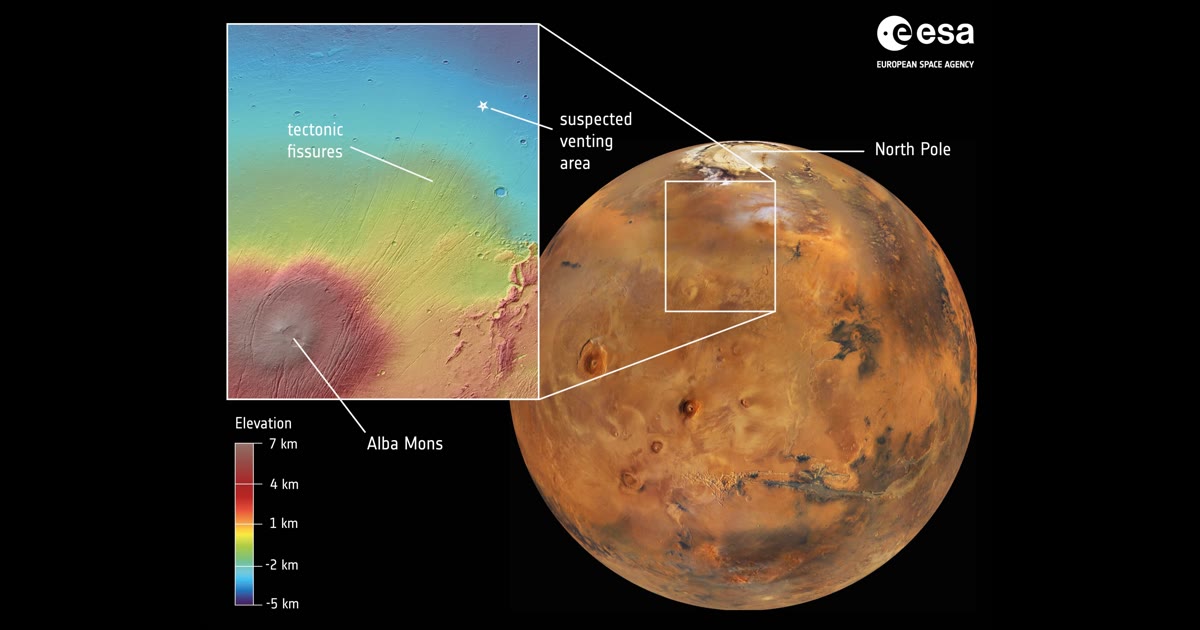
On the northern slopes of Alba Mons, one of the largest volcanoes on Mars, there are thin, fresh cracks in the ground. Each early northern summer, a European spacecraft keeps smelling the same gas above them.
On 4 November, scientists reported in the journal Science Advances that ESA’s ExoMars Trace Gas Orbiter (TGO) found hydrogen chloride over those cracks. They think it may rise from magma deep below. If they are right, Mars volcanic activity is not only ancient history. The planet may still hold some heat inside.
That matters beyond one volcano. Heat underground can mean warm, wet places, and those shape where future missions will look for signs of life.
A faint gas, always in the same place and season
The orbiter’s Atmospheric Chemistry Suite, an infrared spectrometer, measured about 2 parts per billion of hydrogen chloride in the air, ESA says. That is tiny, but more than expected.
The gas appeared in early northern summer, the cold “aphelion” season when Mars is farthest from the Sun. In that season this gas is normally absent from Mars’s air, according to the University of Oxford. Yet it kept returning to the same spot, at the same time of year.
The orbiter’s CaSSIS camera photographed the area on 3 February 2023. The pictures show narrow fissures, less than a metre wide and some hundreds of metres long, with colour changes around them.
How a frozen lid could let a volcano breathe
The team’s idea is simple to picture. A dormant body of magma sits deep under Alba Mons and slowly gives off gas. In winter, ice seals the cracks like a lid. In early summer, the ice turns to vapour and the trapped gas escapes. The coloured ground may be mineral deposits, like those around fumaroles, the gas vents on volcanoes on Earth.
“The Trace Gas Orbiter was able to find the smoking gun,” said co-lead author Daniel Mège of the Space Research Centre of the Polish Academy of Sciences and the University of Bern, in the Oxford release. Colin Wilson, ESA’s TGO project scientist, said in the same release that the findings “may prove to be TGO’s greatest success yet.”
The lead author is Alexander Trokhimovskiy of the Space Research Institute (IKI) of the Russian Academy of Sciences. Co-authors include Oleg Korablev and Kevin Olsen, who has moved from Oxford to the Canadian Space Agency.
Is Mars still volcanically active? Not proven yet
Here the scientists are careful. No lava flows or eruptions have been seen. The orbiter found no sulphur dioxide, a gas usually linked to eruptions. The paper says the results “hint at” a volcanic origin. It also discusses another idea: frozen ground, or permafrost, could trap the gas and release it later.
The hint fits a wider picture of Mars volcanic activity in the recent past. NASA’s InSight lander recorded marsquakes, and some lava plains look young. Neither proves an active volcano today. Together, they suggest Mars is quiet, not completely dead.
TGO first found this gas on Mars in 2021, and ESA linked it then to salty dust lifted from the surface. The new paper argues that, at Alba Mons, there may be a deeper source.
What a sleeping volcano could mean for the search for life
For students and space fans, this is a clear lesson in how science works: a strange signal, years of checking, then a careful “hint”, not a headline claim. It also comes from a wide team: an ESA spacecraft, with scientists from Russia, Poland, Switzerland, the UK and Canada.
For everyone, the bigger question is water. Where hot rock meets underground water, warm and possibly habitable pockets could form, Oxford notes. Mège is clear, though, that the conditions for life may never have been met there.
Why a careful “maybe” is worth more than a big claim
On balance, this is a meaningful step, and the team deserves credit for its restraint. A gas that returns to the same cracks every early summer is hard to explain away. The fresh fissures make the volcanic reading more likely.
Still, one gas at a few parts per billion is thin evidence. Without sulphur dioxide or a visible eruption, the permafrost idea stays alive. In practice, results like this usually need several more seasons of watching before they settle. It also fits what we keep learning about the planet’s past: one of the oldest Mars meteorites shows water once moved through its crust. Further out, Webb is studying a lava planet far beyond our Solar System.
The likelier outcome is patience, not a quick answer.
Next northern summer, the orbiter will look again. If the gas returns to Alba Mons on schedule, Mars may be telling us it is only sleeping.
Prefer to watch? Follow us on YouTube
The tech stories that matter, explained in plain words. Subscribe so you never miss one.
Quick answers
Is Mars still volcanically active?
Maybe. A gas found above fresh cracks on Alba Mons hints at magma underground, but no eruptions or lava flows have been seen, so scientists call it a hint, not proof.
Does Mars have active volcanoes?
None has been seen erupting. The new study suggests Alba Mons may still have a dormant body of magma deep below it.
What gas was found on Mars?
Hydrogen chloride, at about 2 parts per billion, measured by the Atmospheric Chemistry Suite on ESA's ExoMars Trace Gas Orbiter.
Where is Alba Mons?
In the Tharsis region of northern Mars, north-east of the giant volcano Olympus Mons.
Words to know
- Hydrogen chloride
- A sharp-smelling gas of hydrogen and chlorine. On Earth, volcanoes release it.
- Magma
- Melted rock under a planet's surface. Above ground it is called lava.
- Fumarole
- An opening in the ground where volcanic gas escapes, often leaving coloured mineral deposits.
- Spectrometer
- An instrument that splits light into colours to tell which gases are present.
- Parts per billion
- A tiny amount: here, about 2 gas molecules in every billion molecules of air.
Sources (7): every key fact checked against at least two
- Science Advances: Enigmatic HCl detections as a potential signature of igneous activity on Mars (Trokhimovskiy et al., 4 November 2026)
- ESA To Mars and back blog: Geological intuition for Mars (4 November 2026)
- University of Oxford, Department of Physics: European orbiter detects hints of volcanic activity on Mars (4 November 2026)
- EurekAlert (AAAS): Noxious gas discovered above cracks in the Martian surface suggests volcanic activity (4 November 2026)
- ESA: ExoMars discovers new gas and traces water loss on Mars (2021)
- Space.com: Mars isn't dead — recent volcanic activity reveals it's just sleeping
- EarthSky: Active volcanoes on Mars? Noxious gas discovery says — maybe
Related stories
Hayabusa2's next asteroid, 1998 KY26, is too warm to hide ice, a new study finds
Is 1998 KY26 a dark comet? A new study says the tiny asteroid Hayabusa2 will visit in 2031 is too warm to keep ice. What it means, and what's next.
Solar panels that 'almost double' output? What a Barcelona lab really showed, and why it still matters
A solar panel efficiency breakthrough that almost doubles output? What ICFO's study really showed, why 43% is a ceiling, and why the idea still matters.
The 2026 ozone hole is the seventh largest on record, but scientists say the ozone layer is still healing
The ozone hole 2026 was the seventh largest in 48 years, NASA and NOAA say. Why a strong polar vortex made it big, and why recovery is still on track.