Hayabusa2's next asteroid, 1998 KY26, is too warm to hide ice, a new study finds
- A new study in the journal Icarus finds that asteroid 1998 KY26, Hayabusa2's 2031 target, is too warm inside and out to keep ice.
- That makes the 'dark comet' idea, hidden ice turning to gas and pushing the rock, very unlikely, though the small drift is still unexplained.
- The 11-metre asteroid may simply be dry. Sunlight is one possible cause of its push, and the spacecraft's visit should settle it.
- 11 mWidth of asteroid 1998 KY26Almost 3 times smaller than thought
- 5.35 minTime for one full spinPer Nature Communications, 2025
- 13Heat models testedAll too warm to keep ice
- July 2031Hayabusa2 arrivesFinal stop of its extended mission
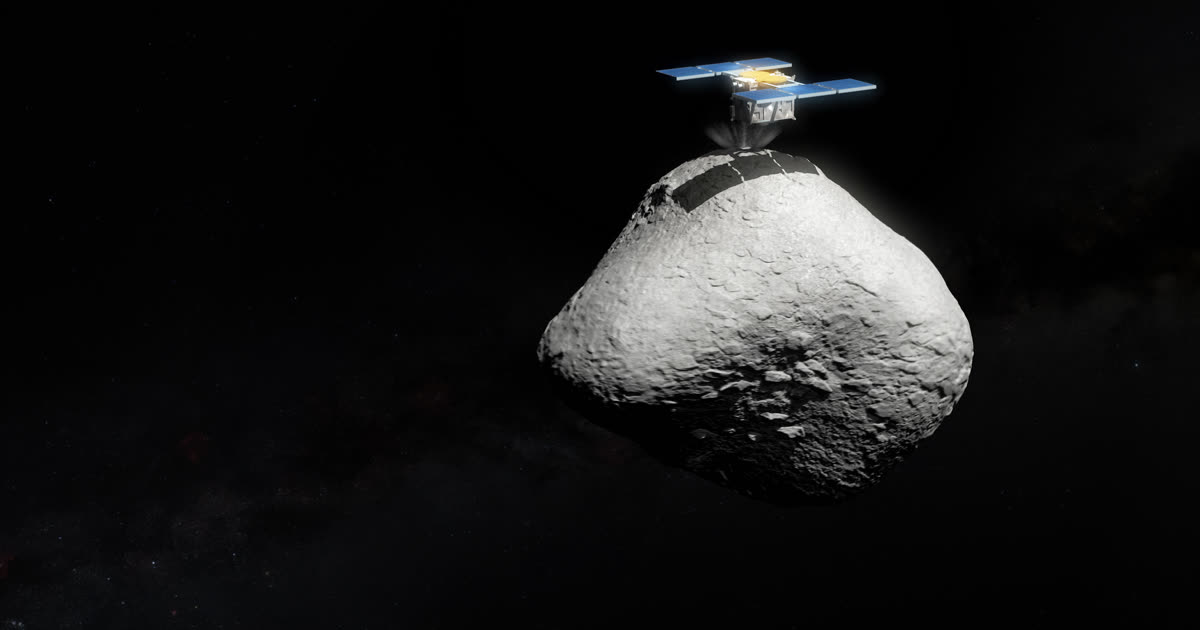
A rock about as wide as a house travels near Earth’s orbit, and a Japanese spacecraft is on its way to meet it. Some scientists have wondered whether this asteroid, 1998 KY26, is secretly a “dark comet”. That would mean it hides ice that slowly turns to gas and gives it a tiny push.
A new study says that is very unlikely. In a paper published online in the journal Icarus on 28 October, Korbin Hansen and Masatoshi Hirabayashi of the Georgia Institute of Technology report that it is too warm to keep ice, on the surface or deep inside.
That matters because JAXA’s Hayabusa2 spacecraft is due to reach 1998 KY26 in July 2031. Knowing what the rock is likely made of helps scientists plan. (The picture at the top is an artist’s illustration from ESO; nobody has yet seen the asteroid up close.)
1998 KY26: a house-sized rock with a small, odd drift
Hayabusa2 has done this before: it explored the 900-metre asteroid Ryugu in 2018 and brought samples back to Earth in 2020, ESO notes. With fuel to spare, JAXA sent it on an extended Hayabusa2 mission, with 1998 KY26 as the final stop.
In September 2025, a team led by Toni Santana-Ros of the University of Alicante reported in Nature Communications that the asteroid is only about 11 metres wide. That is almost three times smaller than earlier estimates of around 30 metres. It spins once every 5.35 minutes. No spacecraft has ever visited an asteroid this small.
Tracking also shows something odd. The asteroid is pushed slightly out of the plane of its orbit, in a way gravity alone does not explain. A 2023 study in the Planetary Science Journal by Seligman and colleagues listed it among small asteroids with pushes like this. It raised the dark-comet idea: invisible jets of gas, with no visible tail, steering the rock.
Thirteen heat models, one answer
Hansen and Hirabayashi tested that idea with physics. They modelled how sunlight warms the asteroid as it travels around the Sun. Many details are still unknown, so they ran 13 versions with different settings. These covered its size, how well it carries and stores heat, how much light it reflects and which way its spin axis points.
Every version gave the same result. Averaged over a full orbit, every point on the surface and inside stays well above the temperature at which ice turns straight into gas in space. The researchers calculated, as reported by ScienceAlert, that ice must stay below about 145 kelvin (−128 °C) to last. Even the asteroid’s coldest spots average at least 212 K (−61 °C).
So water would escape too fast for buried ice to survive, the authors conclude.
What the heat model cannot tell us yet
The study removes one explanation, not every one. Sunlight itself can nudge a small rock, because light carries a very small pressure. ScienceAlert notes this remains a possible cause. The paper adds that 1998 KY26 may belong to a largely dry type of asteroid, which fits the bright colours seen in the 2025 observations.
There are honest limits. Nobody knows how long the asteroid has been in its current orbit. And this is a careful model, but a calculation, not a sample. The paper’s title calls conditions for ice “thermally unfavorable”: very unlikely, not impossible in every case.
Why a tiny rock is worth your attention
For students and space fans, this is a clear lesson in testing an idea. The dark-comet theory predicted ice. Physics checked, and the rock is too warm.
For planetary defence, small details matter. Predicting where small near-Earth asteroids go depends on understanding even tiny pushes like this one. A close look helps, as Europe’s Hera mission showed when it saw the asteroid pair NASA’s DART hit. JAXA is busy elsewhere too, with its MMX mission to Mars’ moon Phobos.
Ruling one idea out is quiet progress
On balance, this is a modest but useful result. It does not solve the drift, and it does not claim to. It removes a tempting explanation with clear physics, helping the mission team prepare for what is most likely a dry, warm rock.
The caution is that models depend on their inputs, and some, like the asteroid’s real shape and spin axis, are still uncertain. Thirteen runs reduce that risk; they cannot remove it.
Headlines about a mysterious asteroid accelerating in space oversell it a little. The odd push was noticed years ago. What is new is a firmer reason to doubt the ice. In practice, puzzles about small bodies are often settled by a close look rather than by more models.
That close look is coming. In July 2031, Hayabusa2 should arrive, and a rock the size of a house can finally answer for itself.
Prefer to watch? Follow us on YouTube
The tech stories that matter, explained in plain words. Subscribe so you never miss one.
Quick answers
What is a dark comet?
An object that looks like an asteroid, with no visible tail, but moves as if gas escaping from it were giving it a small push.
Is 1998 KY26 a dark comet?
Very unlikely, according to a 2026 study in Icarus. It found the asteroid too warm, on the surface and inside, for buried ice to survive.
How big is 1998 KY26?
About 11 metres wide, give or take 2 metres, roughly the size of a house. It spins once every 5.35 minutes.
When will Hayabusa2 reach 1998 KY26?
The spacecraft is due to meet the asteroid in July 2031, as the last stop of its extended mission.
Words to know
- Dark comet
- An asteroid-like body thought to release gas that pushes it, without the bright tail of a normal comet.
- Non-gravitational acceleration
- A change in an object's path that gravity alone does not explain.
- Sublimation
- When ice turns straight into gas without melting first, as it does in the vacuum of space.
- Radiation pressure
- The very small push that sunlight gives to anything it shines on.
- Kelvin
- A temperature scale used in science. 0 kelvin is the coldest possible; 273 K is 0 °C.
Sources (5): every key fact checked against at least two
- Icarus: Thermally unfavorable conditions of volatile existence in near-Earth asteroid 1998 KY26, the Hayabusa extended mission's target (Hansen and Hirabayashi, online 28 October 2026)
- Nature Communications: Hayabusa2 extended mission target asteroid 1998 KY26 is smaller and rotating faster than previously known (Santana-Ros et al., 18 September 2025)
- ESO press release eso2515: Can Hayabusa2 touchdown? (18 September 2025)
- Planetary Science Journal: Dark Comets? Unexpectedly large nongravitational accelerations on a sample of small asteroids (Seligman et al., 2023)
- ScienceAlert: A Mysterious Asteroid Is Accelerating in Space (Michelle Starr, 7 November 2026)
Related stories
A gas seeping from cracks on a giant Mars volcano hints the planet may not be volcanically dead
Is there still Mars volcanic activity? ESA's orbiter found hydrogen chloride above fresh cracks on Alba Mons. Why it is a hint, not proof, and what's next.
Solar panels that 'almost double' output? What a Barcelona lab really showed, and why it still matters
A solar panel efficiency breakthrough that almost doubles output? What ICFO's study really showed, why 43% is a ceiling, and why the idea still matters.
The 2026 ozone hole is the seventh largest on record, but scientists say the ozone layer is still healing
The ozone hole 2026 was the seventh largest in 48 years, NASA and NOAA say. Why a strong polar vortex made it big, and why recovery is still on track.