Solar panels that 'almost double' output? What a Barcelona lab really showed, and why it still matters
- Researchers at ICFO in Barcelona made an organic solar cell work better by letting it give off light in fewer directions.
- In principle, ICFO says, the idea could take single-layer cells towards about 43%, above the standard 33.16% limit.
- The study came out on 5 October. The gain measured in the lab was small, and no 43% cell exists yet.
- 33.16%Standard limit for one-layer cellsShockley–Queisser limit, per ICFO
- ~43%Possible in principle, ICFO saysIf emission matches sunlight
- 20–23%Typical panels you can buyPer Engadget
- 5 OctWhen ICFO announced the studyEnergy & Environmental Science
If you have ever priced a rooftop or balcony solar kit, this week’s headlines may have made you pause. Panels that could “almost double” their output, as Engadget put it on 7 November, sound like a reason to wait.
The research behind this solar panel efficiency breakthrough is real, and it is clever. But it is not new this week, and it is not a panel. Scientists at ICFO, the Institute of Photonic Sciences in Barcelona, announced the study on 5 October. They showed a small, measured gain in a lab cell, and a path that, in principle, could lead much higher.
That gap between “in principle” and “in your shop” is the whole story. The idea itself is a good one.
The energy a solar cell quietly gives away
Sunlight reaches a solar cell from a small patch of sky, because the Sun looks small from Earth. But a working cell also gives off a little light of its own, and it sends that light out in almost every direction above it.
That mismatch has a name: Boltzmann loss. ICFO explains that it wastes energy the cell could otherwise use. Most efforts to beat the limits of solar cells look elsewhere, so this loss gets less attention.
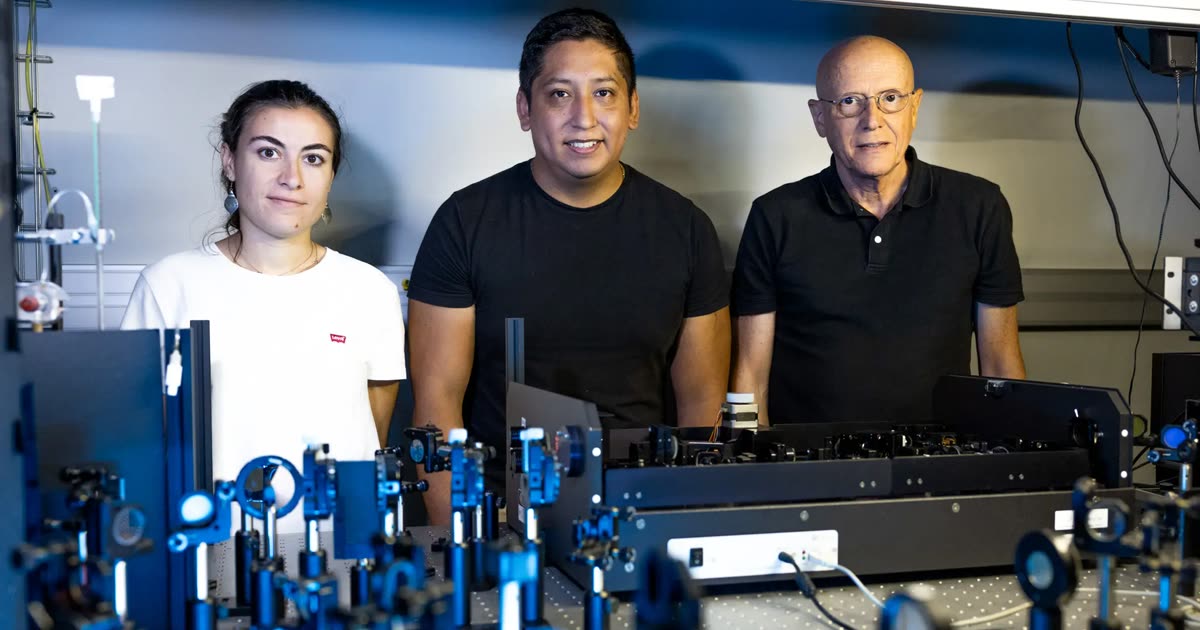
The team, led by Professor Jordi Martorell of ICFO and the Polytechnic University of Catalonia (UPC), tried to shrink it. First author Francisco Bernal Texca worked with Chiara Cortese, Mariia Kramarenko and Quan Liu. The paper appears in the journal Energy & Environmental Science.
A thin silver layer that narrows the glow
The team built an organic solar cell, made from a carbon-based blend called PM6:Y6. Usually, the front electrode in such a cell is indium tin oxide, a clear conductor. They replaced it with a thin silver-based layer.
Together with the silver electrode at the back, that layer forms an “optical cavity”. It lets sunlight in but blocks light from leaving at wide angles. With fewer escape routes for light, the cell’s open-circuit voltage went up, the paper’s summary says. That is the highest voltage a cell can give.
How big was the gain? ICFO’s release does not give a number. Engadget reports efficiency rose by “around 0.85 percent”. It is a real effect, but a modest one.
Where the 43% in this solar panel efficiency breakthrough comes from
Today’s single-layer cells face a ceiling called the Shockley–Queisser limit: 33.16%, according to ICFO. In principle, Bernal Texca says in the release, matching a cell’s light emission to the narrow cone of sunlight could let cells approach about 43%.
The “almost double” headlines compare that theoretical 43% with the 20–23% typical of panels people buy today, a range Engadget gives. As Interesting Engineering said plainly, the work “does not mean the researchers have produced a 43-percent-efficient solar cell”.
Two points make the study more than a curiosity. Martorell says the principle is not specific to organic materials, so it could in principle apply to other solar technologies. And Bernal Texca notes it adds no extra manufacturing complexity, unlike many other ways of beating the limit.
If you are planning to buy solar panels
Please don’t wait for this. It is a lab route, with no product or date announced. The panels on sale now are what will lower your bills in the next few years.
What to watch instead is whether other teams show the same effect in other kinds of cells. Higher efficiency matters because, as Martorell points out, it means a lower cost per watt and less land and material for the same power. For a small roof, that could one day mean more power from the same space. Solar technology is also a strategic industry now, as China’s proposed export curbs on solar technology show.
Why a small gain can still be a big idea
On balance, the headlines got the direction right and the distance wrong. A figure like 43% is exciting, and the release does use it.
The good is real. The team found a fresh angle on a loss most research ignores, used a simple design, and measured an effect in a real device. The limits are real too. The gain shown is small. It is one organic lab cell, and organic cells today are generally less efficient and less durable than the silicon in most panels (our analysis). And 43% is an “in principle” number, not a result.
In practice, ideas like this usually take years to move from one lab cell to a factory, if they make it at all. The likelier outcome is steady, quiet progress.
Today’s best solar breakthroughs rarely arrive as a doubling. They arrive as one less wasted ray of light, measured carefully, and then tested again.
Prefer to watch? Follow us on YouTube
The tech stories that matter, explained in plain words. Subscribe so you never miss one.
Quick answers
Is there a solar panel that is twice as efficient?
Not yet. The about 43% figure is what ICFO says is possible in principle. The lab cell in the study showed a small gain, not a doubling.
What is the Shockley–Queisser limit?
It is the standard ceiling for how much sunlight a solar cell with one light-absorbing layer can turn into electricity: 33.16%, according to ICFO.
What is Boltzmann loss in a solar cell?
Sunlight arrives from a small patch of sky, but a cell gives off light in almost every direction above it. That mismatch wastes useful energy.
Can I buy these new solar cells?
No. This is a lab demonstration in an organic solar cell. No product or date has been announced.
Words to know
- Shockley–Queisser limit
- The standard maximum efficiency for a solar cell with one light-absorbing layer: 33.16%, per ICFO.
- Single-junction cell
- A solar cell with one light-absorbing layer, like most panels sold today.
- Boltzmann loss
- Energy lost because a cell gives off light in many more directions than sunlight comes from.
- Organic solar cell
- A solar cell that uses carbon-based materials, here a blend called PM6:Y6, to absorb light.
- Optical cavity
- Two mirror-like layers that control which directions light can travel in or out.
- Open-circuit voltage
- The highest voltage a solar cell can give. Higher usually means more power.
Sources (6): every key fact checked against at least two
- ICFO: Solar cells gain efficiency by emitting light in fewer directions (5 October 2026)
- Energy & Environmental Science: Inhibited photon emission to overcome Boltzmann losses in an organic solar cell with a cavity configuration (Bernal-Texca et al., 2026)
- Interesting Engineering (7 October 2026)
- pv Europe: Narrowing the angle, a simple fix for solar cell losses (14 October 2026)
- optics.org: ICFO boosts efficiency of organic solar cells by restricting emission angles
- Engadget (7 November 2026)
Related stories

Hayabusa2's next asteroid, 1998 KY26, is too warm to hide ice, a new study finds
Is 1998 KY26 a dark comet? A new study says the tiny asteroid Hayabusa2 will visit in 2031 is too warm to keep ice. What it means, and what's next.

A gas seeping from cracks on a giant Mars volcano hints the planet may not be volcanically dead
Is there still Mars volcanic activity? ESA's orbiter found hydrogen chloride above fresh cracks on Alba Mons. Why it is a hint, not proof, and what's next.

The 2026 ozone hole is the seventh largest on record, but scientists say the ozone layer is still healing
The ozone hole 2026 was the seventh largest in 48 years, NASA and NOAA say. Why a strong polar vortex made it big, and why recovery is still on track.