Webb finds lava planet TOI-561 b reflects about 75% of its starlight, possibly off mineral clouds
- Webb watched the lava planet TOI-561 b for 37 hours, nearly four of its orbits, and found it reflects about 75% of its starlight, close to Venus.
- Computer models suggest clouds of rock-forming minerals float over its magma ocean and act like sunscreen. The clouds are a model fit, not a direct sighting.
- A rocky planet this close to its star should have lost its air long ago. Which gases it holds, and how it keeps them, is still open.
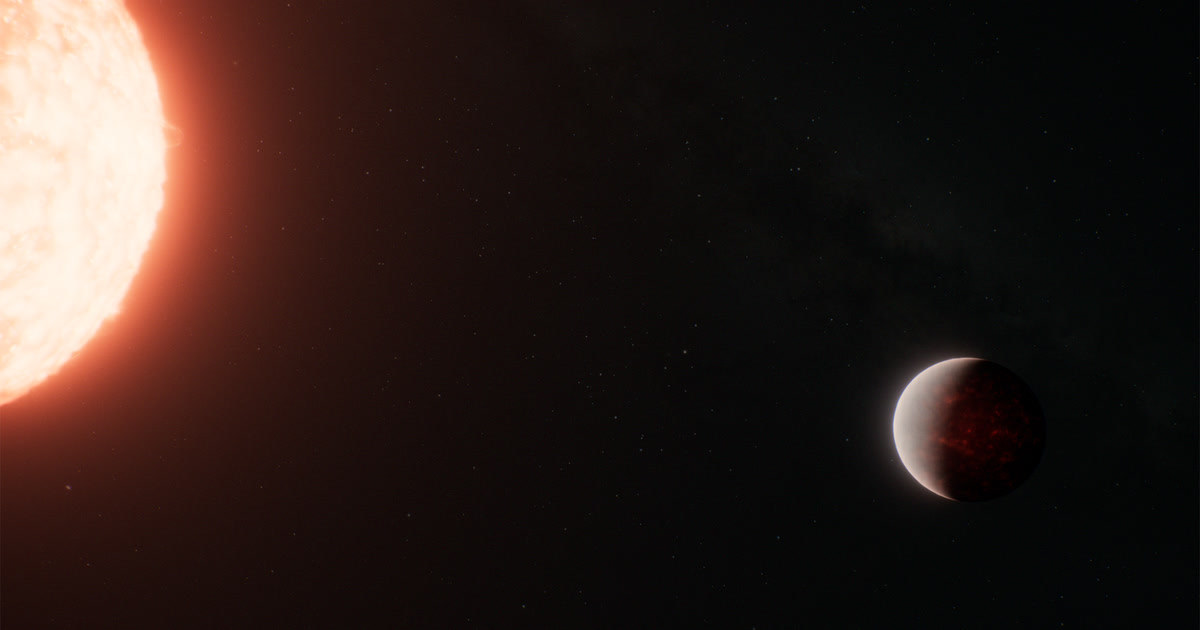
On TOI-561 b, a year lasts just over 10 hours. The planet sits so close to its star that its surface is probably an ocean of molten rock. By the usual rules, a world like this should have lost its air billions of years ago.
New results from the James Webb Space Telescope (JWST) suggest it hasn’t. The planet reflects about three-quarters of the starlight that hits it, roughly as much as Venus. One possible reason: bright clouds made of rock-forming minerals.
The work, led by Professor Lisa Dang at the University of Waterloo in Canada, is published in The Astronomical Journal and was announced by the University of Birmingham on 27 October 2026. It tests a big idea in planet science: can small, rocky planets that hug their stars keep an atmosphere at all?
Watching TOI-561 b through four of its short years
TOI-561 b is about 280 light-years away, in the constellation Sextans. It is about 1.4 times wider than Earth. It orbits less than 1 million miles (1.6 million km) from a star that is roughly 10 billion years old. One side always faces the star; the other is in endless night.
In December 2025, NASA reported strong signs of a thick atmosphere. That study, led by Johanna Teske of Carnegie Science, found a cooler dayside than expected. A bare rock there would reach about 2,700 °C (4,900 °F). Webb measured closer to 1,800 °C (3,200 °F). That gap is the TOI-561 b temperature puzzle.
For the new paper, Webb watched the planet without a break for 37 hours, nearly four full orbits, and saw the night side for the first time. This is called a “phase curve”: tracking how a planet’s light and heat change as it circles its star.
The phase curve “revealed that the planet reflects a significant amount of light from its star, and that heat is being redistributed around the planet instead of only on the sunlit side,” Dang said.
The night side turned out too cool to account for all the missing heat. So a large share of the starlight must bounce back into space. Climate models suggest clouds of silicon dioxide (the stuff of quartz) and magnesium silicate could form on the dayside, near the line between day and night. They would work like a planet-sized sunscreen.
An atmosphere that should have vanished
“Our discovery challenges current theories,” said Dr Anjali Piette, an Assistant Professor in Astronomy at the University of Birmingham and a co-author. “We would expect a heavily irradiated rocky planet like TOI-561 b to have lost its atmosphere billions of years ago.”
Two big questions remain. First, what is the TOI-561 b atmosphere made of? It could be thick carbon dioxide, like a much hotter Venus. Or it could be mostly sulfur dioxide, the gas that pours from the volcanoes of Io, Jupiter’s moon.
Second, how does it survive? The authors suggest gas moves between the air and the molten interior, with the magma ocean acting like a planet-wide volcano that keeps refilling the sky. That is still an idea, not a measurement. The silicate clouds, too, come from models that fit the data; Webb did not see them directly.
Why a planet we can never visit still matters
Nothing lives on this lava planet; it is far too hot. But it speaks to a wider question: which rocky worlds can hold air at all. Our reading, not the paper’s claim: if rocky planets this close to their stars can keep an atmosphere, more of them may earn a place on Webb’s busy schedule.
It is also a lesson in method. The TOI-561 b JWST data gave no dramatic photo, just patient light-counting and careful models. Space telescopes do not last forever, as NASA’s Swift observatory showed when its long mission ended this month, and every hour of Webb’s time is spent with care.
A strong case for air, but not yet the last word
On the good side, the case for an atmosphere looks much stronger. Three clues now point the same way: the planet’s low density, its cool dayside, and its bright reflection with heat reaching the night side. The long watch also helped separate the star’s own flicker from the planet’s signal.
The limits are real, though. This is one planet. The reflectivity is worked out from an energy balance, not seen in a photo, and the gases are unknown. On balance, this is a careful, meaningful step, not proof of how rocky worlds keep their air.
Next, the team wants Webb to watch it at longer wavelengths. That could show whether TOI-561 b is a hotter Venus or an extreme Io. Either answer would tell us something new about how a world made of fire holds on to its sky.
Sources (5): every key fact checked against at least two
- The Astronomical Journal: A Highly Reflective Atmosphere on the Lava World TOI-561b Revealed by JWST/NIRSpec Phase Curves (Boucher, Dang et al., 2026)
- arXiv: preprint of the same paper (August 2026)
- University of Birmingham release via ScienceDaily (27 October 2026)
- Sci.News: Lava world TOI-561b may have a reflective, cloudy atmosphere (27 October 2026)
- NASA: NASA's Webb detects thick atmosphere around broiling lava world (11 December 2025)
Related stories

Wind turbines have killed about 18.7 million US bats since 1981, USGS-led study estimates
Wind turbines killing bats: a USGS-led study estimates 18.7 million US bat deaths since 1981, and shows how design, siting and slower blades can cut them.
Iceberg A-81, a slab of Antarctic ice the size of a city, slows at the edge of South Georgia
A city-sized iceberg, A-81, has slowed off South Georgia after a 2,300 km drift. What satellites show, why sizes differ, and what is still unknown.

OpenAI says its AI disproved the Exponential Time Hypothesis, and two of the rule's authors will check it
Exponential Time Hypothesis: OpenAI says its AI proved the famous computing rule false. Experts, two of them its authors, are checking. What it means.