The 2026 ozone hole is the seventh largest on record, but scientists say the ozone layer is still healing
- NASA and NOAA say the 2026 Antarctic ozone hole was the seventh largest by area in 48 years, averaging about 25 million km² at its peak season.
- Scientists blame an unusually large, strong polar vortex, a weather pattern, and note the hole was not as deep as other big years.
- Ozone-harming chlorine is down about a third from the 1980s, and the hole is still expected to recover by the 2070s.
- 25M km²Average size, peak season7 Sep to 13 Oct
- 27.1M km²Biggest single day18 September
- 7thLargest in 48 years
- 2070sExpected full recovery
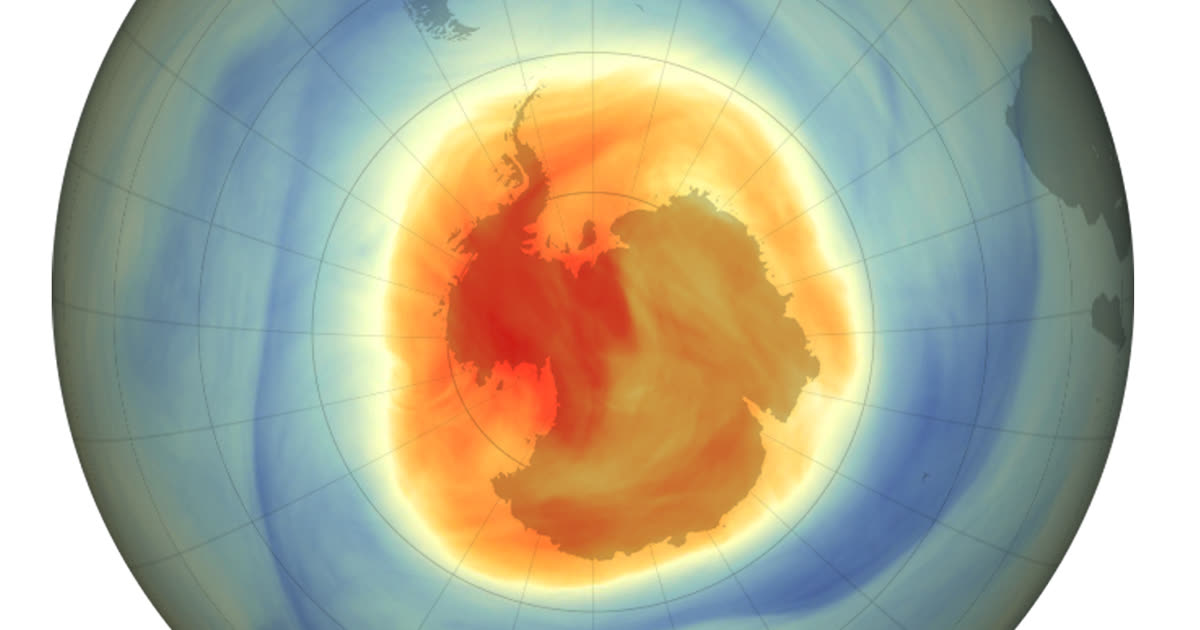
Last year, the ozone hole over Antarctica was one of the smallest in three decades. This year, it was one of the biggest. On 4 November, NASA and NOAA, the US weather and oceans agency, said the ozone hole 2026 season produced the seventh largest hole by area in 48 years of records.
That sounds worrying, and it is fair to feel uneasy. But the scientists who measured it tell a calmer story. The hole was big because of the weather above the South Pole, not because the repair work has stopped.
Ozone hole 2026 in numbers: wide, but not as deep
The ozone layer works like Earth’s sunscreen, blocking much of the Sun’s harmful ultraviolet (UV) light. Each southern spring, cold air and old pollution thin it over Antarctica. Scientists call it a “hole” where ozone drops below 220 Dobson units, the standard measure.
- Average size: about 9.6 million square miles (25 million km²) from 7 September to 13 October, the peak season. That is more than twice the area of the United States.
- Biggest single day: 10.5 million square miles (27.1 million km²) on 18 September. Europe’s Sentinel-5P satellite saw a similar peak, says the German Aerospace Center (DLR).
- Thinnest point: 105 Dobson units over the South Pole on 17 October, measured by balloons. The record low was 92 in October 2006. The largest hole on record came in 2000.
So the hole was wide, but not as deep as other large holes.
NASA Goddard shared its official video on this year’s ozone hole:

A spinning wall of wind did most of the damage
The main cause was the polar vortex, a ring of strong, cold winds that circles Antarctica in winter and spring. This year’s was unusually large and powerful.
Amy Butler, a research scientist at the NOAA Chemical Sciences Laboratory, said the weather waves that usually travel up from below and break the vortex apart stayed unusually weak in August and September. So the strongest winds stayed several degrees farther from the pole, and more air stayed cold enough for ozone loss.
Paul Newman, a senior scientist at the University of Maryland, Baltimore County, and longtime leader of NASA’s ozone team, gave the other half. “The annual ozone hole has been forming later in the season in recent years, which tells us the ozone layer is healing,” he said. He added that it “could have been 1 to 2 million square miles” larger if ozone-harming chemicals were still at their 2000 peak.
Is the ozone hole getting bigger or smaller?
Over the long run, smaller. Year to year, it swings. In 2025, NASA and NOAA ranked the hole the fifth smallest since 1992. Weather drives most of that jump.
The chemistry keeps moving one way. Chlorine from ozone-harming chemicals over Antarctica is down about a third from 1980s levels, says Stephen Montzka of the NOAA Global Monitoring Laboratory. That is the slow work of the 1987 Montreal Protocol, the treaty that phased these chemicals out. Scientists expect ozone layer recovery over Antarctica by the 2070s.
The agencies did not say how much years like this could slow that timeline. That is the open question to watch.
If you live under the southern spring sun, or own an old fridge
If you live in Australia, New Zealand or southern South America, this report gives no new UV figures for your city. Your local weather service’s daily UV index is still the best guide. The hole usually closes in early December, DLR notes.
The old chemicals came from fridges, air conditioners and insulation, and they can leak from old products and landfills for decades. When you replace an old fridge or AC unit, ask your council or seller about safe disposal.
Why one big year does not undo a 1987 promise
On balance, this is a story about patience, not alarm. The concern is real: a hole this wide shows the layer is still fragile, and that weather can hide progress for a season. It also shows why steady measurement by satellites such as NASA’s Aura and by South Pole balloons matters: it is how scientists tell weather from a real reversal.
The good news is stronger. Countries agreed in 1987 to stop using a class of chemicals, and almost 40 years later the chlorine is falling and the hole forms later. Like Brazil’s record-low Amazon deforestation, it suggests steady policy can move a planet-sized number. Not every polar story is this hopeful, as the Thwaites Glacier shows.
The hole will close again within weeks. Next spring, watch not just its size, but how late it forms and how deep it gets.
Prefer to watch? Follow us on YouTube
The tech stories that matter, explained in plain words. Subscribe so you never miss one.
Quick answers
Is the ozone hole getting bigger or smaller?
Over the long run it is healing. The 2026 hole was large because of a strong polar vortex, but ozone-harming chlorine over Antarctica is down about a third from the 1980s, NOAA says.
When will the ozone layer recover?
NASA and NOAA scientists still expect the Antarctic ozone hole to recover by the 2070s.
Words to know
- Dobson unit
- The standard measure of how much ozone is in the air above a spot. Below 220 counts as an ozone hole.
- Polar vortex
- A ring of strong, cold winds that spins around the South Pole each winter and spring.
Sources (6): every key fact checked against at least two
- NASA: NASA, NOAA Track 2026 Antarctic Ozone Hole (Sally Younger, 4 November 2026)
- NOAA: NOAA, NASA release measurements of 2026 ozone hole (4 November 2026)
- NASA Scientific Visualization Studio: 2026 Ozone Hole Update (4 November 2026)
- ABC News: Ozone hole in 2026 is largest in a decade, but long-term recovery remains on track (4 November 2026)
- German Aerospace Center (DLR): Ozone Hole 2026: One of the Largest in Years (26 October 2026)
- Good Morning America: Ozone hole ranked 5th smallest in 30 years (November 2025)
Related stories
Power grids dip slightly at the start of every minute. Batteries checking themselves are the reason
Power grid frequency dips slightly at the start of every minute, worldwide. A Nature Energy study traces it to backup batteries all checking at once.
The May 2024 solar storm broke through Earth's 'impenetrable barrier' in space, a new study finds
A new study finds the May 2024 solar storm made very fast electrons inside Earth's impenetrable barrier. What it means for satellites and space weather.
One dot becomes two: ESA's Hera sees the asteroid pair NASA's DART hit
The Hera mission has seen Didymos and Dimorphos as two separate asteroids for the first time. Here is what ESA found and what comes on 25 November.