One of the oldest Mars meteorites ever found shows water once moved through the planet's crust
- Teghaza 001, an 800-gram rock found in the Sahara in 2022, formed more than 4.1 billion years ago, a peer-reviewed Science paper confirms.
- Its minerals show underground water changed the rock about 4.1 billion years ago, pointing to a more active early water cycle on Mars.
- The find was first shared as a preprint in July. Where on Mars it came from is still unknown; 13 possible spots match its chemistry.
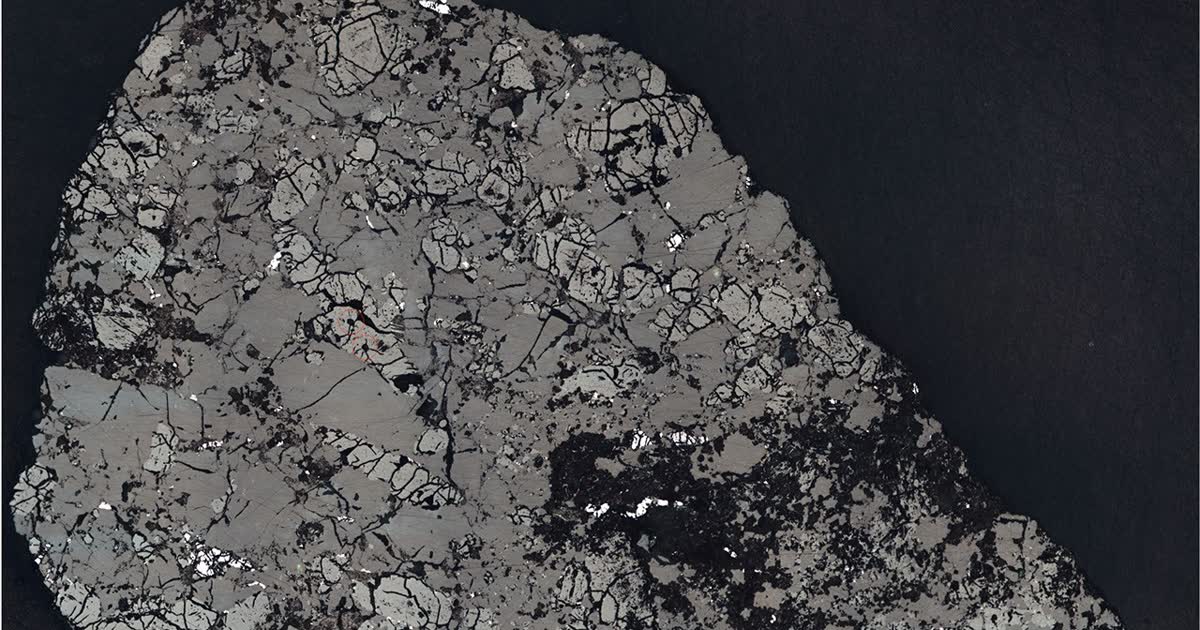
In 2022, prospectors crossing a salt plain in the Sahara picked up a rose-coloured rock that weighed less than a kilogram. Nobody knew then that it had come from Mars, or how old it was.
Now we know a lot more. The rock, called Teghaza 001, formed more than 4.1 billion years ago, which makes it one of the oldest Martian meteorites ever found on Earth. A study published on 29 October 2026 in the journal Science shows that water once moved through it, deep inside the young planet’s crust.
To be fair, the find itself is not new. A Caltech-led team announced it in July, based on a preprint: an early version of a paper that other scientists had not yet checked. What changed this week is that the work passed peer review. NASA, which funded it, also released new images and details.
How Teghaza 001 dates back more than 4.1 billion years
Teghaza 001 is named after the salt plain in Mali where it was found. It weighs about 800 grams (nearly 2 pounds). About 435 Mars meteorites on Earth have been identified so far, and most are much younger.
Scientists at the University of New Mexico first spotted it as Martian by its oxygen isotopes, a chemical fingerprint that matches other Mars rocks. Then the team found tiny zircon crystals, which work like natural clocks. A Caltech lab led by Francois Tissot dated single mineral grains from a chip smaller than a fingernail, so the rest of the rock was kept safe.
The results show that Martian water changed the rock about 4.1 billion years ago. The rock itself must be older still. “It was only after we started looking closely that we realized this meteorite is really unique,” said lead author Yang Liu of NASA’s Jet Propulsion Laboratory (JPL).
A Martian meteorite unlike ALH84001
Only a few rocks compete for the title of oldest Martian meteorite. The best known, ALH84001, is similar in age but made almost entirely of one mineral. Teghaza 001 holds a mix of volcanic minerals that record the crust cooling from magma and then being changed by underground water.
Its oxygen isotopes, texture and chemistry point to a more active water cycle on early Mars. “This is really our first piece of Martian crust from a part of Mars we’ve never had a sample of before,” said co-author Lee Saper. He did the work at JPL and is now at NASA’s Ames Research Center. He added that it may even hold an imprint of the Martian air as the planet was losing its water. That last idea is a possibility, not a finding.
The address on Mars is still missing
Every Mars meteorite was blasted off the planet by an impact. Nobody knows when this one landed in the Sahara, or exactly where it started. The team found 13 places on Mars that match its chemistry. Its minerals fit the old, cratered southern highlands seen by NASA’s Mars Reconnaissance Orbiter.
The age also comes with a caveat. Earlier coverage of the preprint noted that zircon clocks can be reset by heat or fluids, so the rock could be older still.
Why a small desert rock matters to the rest of us
Rocks from the first few hundred million years of a planet are rare. On Earth, almost all of them have been worn away. A meteorite like this is a natural delivery from early Mars, with no spacecraft needed.
It also feeds the biggest question about Mars: was it once wet enough, for long enough, to support life? Every clue about early water helps. Missions like Japan’s MMX trip to bring back soil from Phobos are trying to collect Mars-region samples on purpose. Until then, deserts keep delivering samples on their own.
One practical note: if this story makes you curious about buying a piece of Mars online, be careful. Ask for a recognised lab classification before you pay.
A careful step, and an honest one
There is a lot to like here. The dating method saves almost all of the sample. The work was checked by other scientists before it was published. One reviewer even called the rock a “Rosetta Stone for Mars,” NASA reports.
The limits are real too. This is one rock, from an unknown spot, and the researchers call this an initial examination. On balance, our reading is that Teghaza 001 is a meaningful piece of evidence for a watery early Mars, not the final answer.
“We’ve only scratched the surface,” Liu said. The next chapters will come from more slices of this rock, and perhaps one day from a rover in those southern highlands, checking which of the 13 places it once called home.
Sources (6): every key fact checked against at least two
- NASA: NASA-funded study details one of oldest Mars meteorites ever found (29 October 2026)
- Science: A Martian meteorite that formed ≳4.1 billion years ago samples Mars' early crust and mantle (Liu, Saper et al., 2026)
- WRAL: report on the Teghaza 001 Science study (29 October 2026)
- EarthSky: report on the Teghaza 001 preprint (24 July 2026)
- Live Science: report on the Teghaza 001 preprint (13 August 2026)
- NASA Photojournal: Map showing potential origins of Martian meteorite Teghaza 001
Related stories
NASA asks companies how to save Hubble: boost it higher, upgrade it, or bring it down safely
A Hubble reboost is back on the table. NASA asks companies to lift, upgrade or safely retire the telescope, with a mission needed by 2032. Here's why.
Webb finds lava planet TOI-561 b reflects about 75% of its starlight, possibly off mineral clouds
TOI-561 b, a lava planet 280 light-years away, reflects about 75% of its starlight, Webb data show. Why its air should be gone, and what may keep it.

Wind turbines have killed about 18.7 million US bats since 1981, USGS-led study estimates
Wind turbines killing bats: a USGS-led study estimates 18.7 million US bat deaths since 1981, and shows how design, siting and slower blades can cut them.