Voyager 1 will reach one light-day from Earth on 18 November, a distance light takes 24 hours to cross
- On Wednesday 18 November, Voyager 1 will reach one light-day from Earth: about 16 billion miles (26 billion km).
- That means a radio signal needs a full 24 hours to reach it, so a command and its answer take about two days.
- NASA invites people to flash messages toward the spacecraft after sunset on Tuesday 17 November.
- ~16bn milesDistance from EarthAbout 26 billion km
- ~38,000 mphVoyager 1 cruising speedAbout 61,000 kph, per NASA
- 49 yearsTime travelled by 18 NovTwo months and 11 days
- Nov 2035Voyager 2's one light-dayOn pace, per NASA
On Wednesday morning, a spacecraft launched in 1977 will cross a line that no other human-made object has reached. At 10:16:07 UTC on 18 November, Voyager 1 will reach one light-day from Earth, according to NASA.
The Voyager 1 light-day milestone is about distance, not time. Light, and the radio signals we use to talk to the spacecraft, will need a full 24 hours to cross the gap. It is a new Voyager 1 record for distance, and a good moment to see how far one small machine has gone and how little it takes to keep it talking.
One day for light to cross, about 16 billion miles
NASA defines a light-day as “the distance a particle of light can travel in 24 hours.” At the milestone, Voyager 1 will be about 16 billion miles (about 26 billion km) from Earth. NASA lists the exact figure as 16,094,799,096 miles.
Here is what we know from NASA’s page:
- Launch: 5 September 1977, two weeks before Voyager 2.
- Time travelled: 49 years, two months and 11 days at the milestone.
- Speed: “cruising at nearly 38,000 mph” (61,000 kph).
- Place: in interstellar space since August 2012, and still “returning data to us” as the most distant human-made object.
For scale, NASA’s page notes that light takes 1.3 seconds to reach the Moon and 8.3 minutes to reach the Sun.
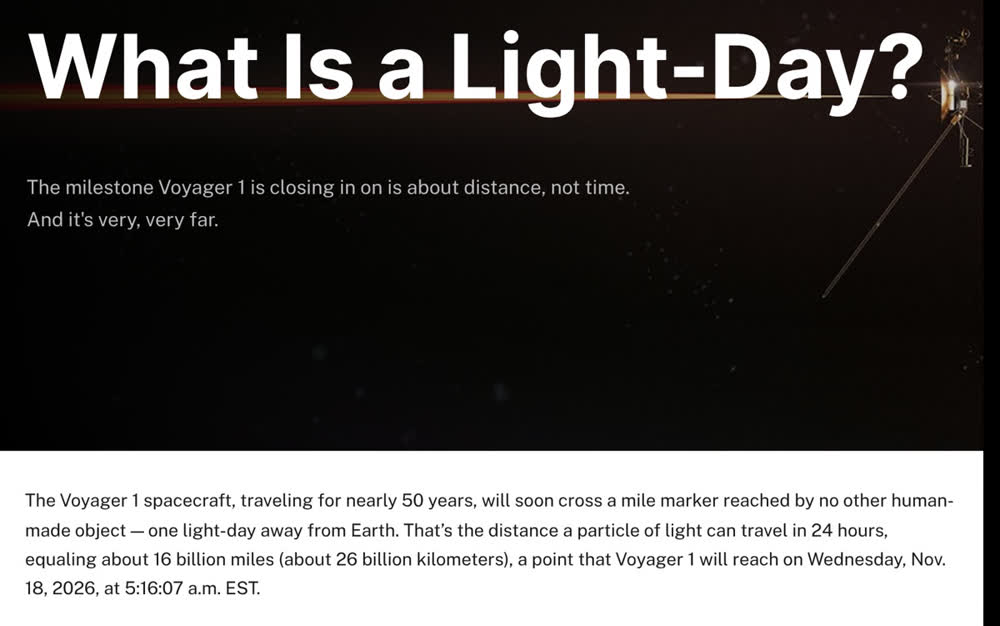 NASA’s explainer as published on NASA Science. Image: NASA
A conversation that now takes two days
Here is the part that stays with you. If a signal needs about a day to arrive, a command sent to Voyager 1 will take about a day to get there, and the reply another day to come back. That is simple arithmetic from the definition, not a figure NASA gives: about two days round trip.
Al Jazeera reports that a small NASA engineering team sends commands roughly once a week. The spacecraft is plutonium-powered and relays readings on the magnetic field, surrounding pressure, dust and galactic cosmic rays.
It has not been a calm few weeks. In October the team briefly lost contact, and the cause is still unknown, as we reported in our story on Voyager 1 going quiet for 48 hours. A longer wait for every answer makes the next problem harder to solve, though that is our reading, not NASA’s.
NASA Voyager 2026: how to join in without leaving your street
You do not need a telescope. NASA’s “Shine Bright” invitation asks people to flash messages toward the spacecraft after sunset on Tuesday 17 November. NASA’s page also gives the exact moment of the milestone, so readers in any time zone can mark it.
Perhaps the best way to read the numbers is as a sense of scale. Al Jazeera says it would take Voyager 1 about 18,000 years to travel one light-year. In 40,000 years, NASA says, it will pass within about 1.7 light-years of the star AC +79 3888, also known as Gliese 445.
Why a very old machine still matters
The good is easy to see. Voyager 1 is nearly 49 years into a mission planned long ago, and it is still sending science from interstellar space. Suzanne Dodd, the Voyager project manager, called it “a national treasure”. Bill Nye of the Planetary Society said: “All of us, everyone on Earth, have been touched by these missions.”
The caution is just as fair. A spacecraft this far away cannot be repaired, and the October silence showed how little room for error there is. The likelier outcome, on balance, is more milestones, each a little more fragile than the last. Voyager 2 is on pace to reach one light-day in November 2035.
The gap keeps growing
After the Voyager 1 light-day, every message to Voyager 1 will wait longer than a day on the way out. We will keep watching whether the team can keep that conversation going.
Prefer to watch? Follow us on YouTube
The tech stories that matter, explained in plain words. Subscribe so you never miss one.
Quick answers
What is a light-day?
It is the distance a particle of light can travel in 24 hours, according to NASA. It measures distance, not time.
When will Voyager 1 reach one light-day?
On Wednesday 18 November 2026 at 5:16:07 a.m. EST, which is 10:16:07 UTC.
How long does a signal take to reach Voyager 1?
About a day each way once it passes one light-day. That is simple arithmetic from the definition, so a command and its answer take about two days.
How far is one light-day in miles?
NASA gives about 16 billion miles (about 26 billion km). The exact figure it lists is 16,094,799,096 miles.
Words to know
- Light-day
- The distance light travels in 24 hours.
- Interstellar space
- The space between stars, outside the Sun's own region.
- Light-year
- The distance light travels in one year.
Sources (2): every key fact checked against at least two
Related stories

AlphaGenome 2 predicts what a DNA change does inside one type of cell, but it is for research only
AlphaGenome 2 from Google DeepMind predicts how a DNA change alters gene activity in one cell type. What it does, who can use it, and its limits.

51 Eridani b isn't a new planet, but the software that found it in old Webb data could find new ones
51 Eridani b isn't a new planet. New software called FLIP found it in older Webb data that the standard method missed, and it could search Webb's archive.
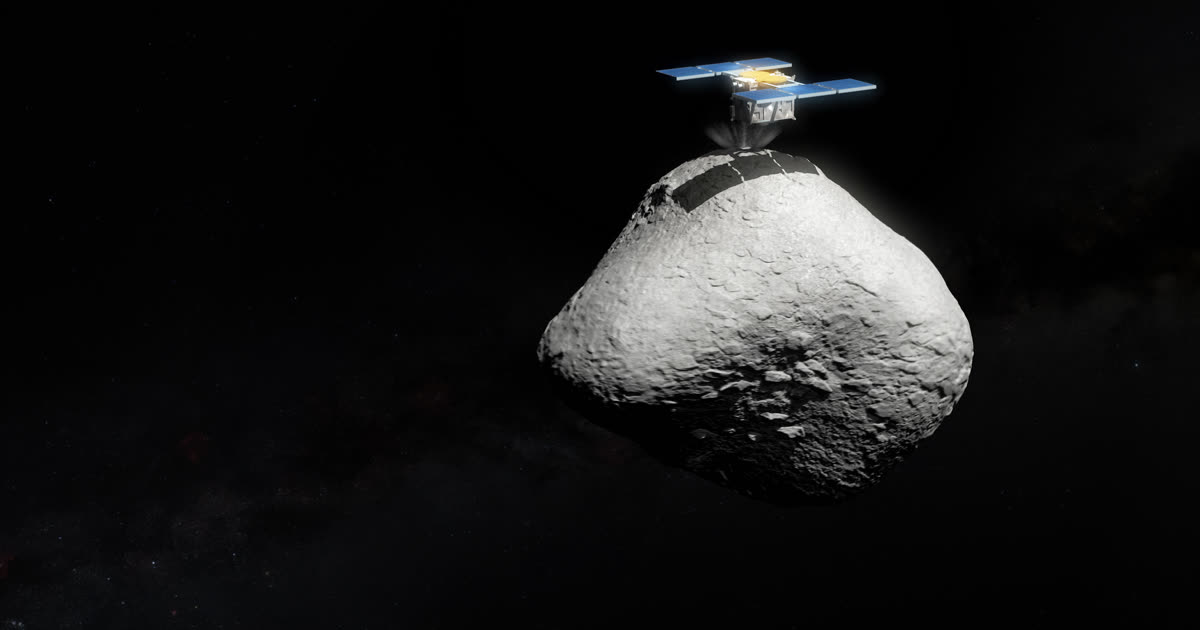
Hayabusa2's next asteroid, 1998 KY26, is too warm to hide ice, a new study finds
Is 1998 KY26 a dark comet? A new study says the tiny asteroid Hayabusa2 will visit in 2031 is too warm to keep ice. What it means, and what's next.