Developing story
AlphaGenome 2 predicts what a DNA change does inside one type of cell, but it is for research only
- Google DeepMind's AlphaGenome 2 predicts how a small DNA change alters gene activity in one specific cell type or cell state.
- On DeepMind's own immune-cell test it found 30% of causal variants, against 16% for the first AlphaGenome. No independent tests yet.
- Non-commercial researchers can use it now through an API. It is for research only, not for diagnosing patients.
- 100M+Cell profiles it learned fromFrom 68 tissues (Google DeepMind)
- 30% vs 16%Causal variants found, new vs old modelDeepMind's own immune-cell test
- 1 millionDNA letters read in one goGoogle DeepMind, Startup Fortune
- A few dozenCells needed to add a new cell stateNo retraining (Google DeepMind)

Every cell in your body carries the same DNA. Yet a heart cell and an immune cell switch on different genes. So one tiny DNA spelling change can matter greatly in one cell and do nothing in another.
On 11 November, Google DeepMind released AlphaGenome 2, an AI model built for that problem. It reads a stretch of 1 million DNA letters and predicts how a small change, called a variant, alters gene activity in one specific cell type or cell state. Non-commercial researchers can use it now. It is not a medical tool: DeepMind says it is for research only, not for clinical or diagnostic use.
Large genetic studies, called GWAS, link regions of DNA to traits from height to type 2 diabetes. They rarely say which exact letter causes the effect, or in which cell it acts. Drugs target specific proteins and cell types, DeepMind’s genomics lead Žiga Avsec told The Verge, so that missing detail matters.
How AlphaGenome 2 narrows the question to a single cell type
The first AlphaGenome, announced in June 2025, predicted thousands of results for broad tissues all at once. AlphaGenome 2 works differently. A scientist names the cell type or state they care about, and the model predicts for that one.
So what is AlphaGenome trained on? More than 100 million individual cell profiles from 68 tissues, DeepMind says; the body of its post puts the figure at over 107 million, from humans and mice. For a new cell state, such as cells after a vaccine, a snapshot of just a few dozen cells is enough, with no retraining.
What does AlphaGenome predict? Gene activity, how open the DNA is to be read, chemical marks on DNA and its packaging, and now DNA methylation. It can also fill in a missing measurement to help a lab pick its next experiment.
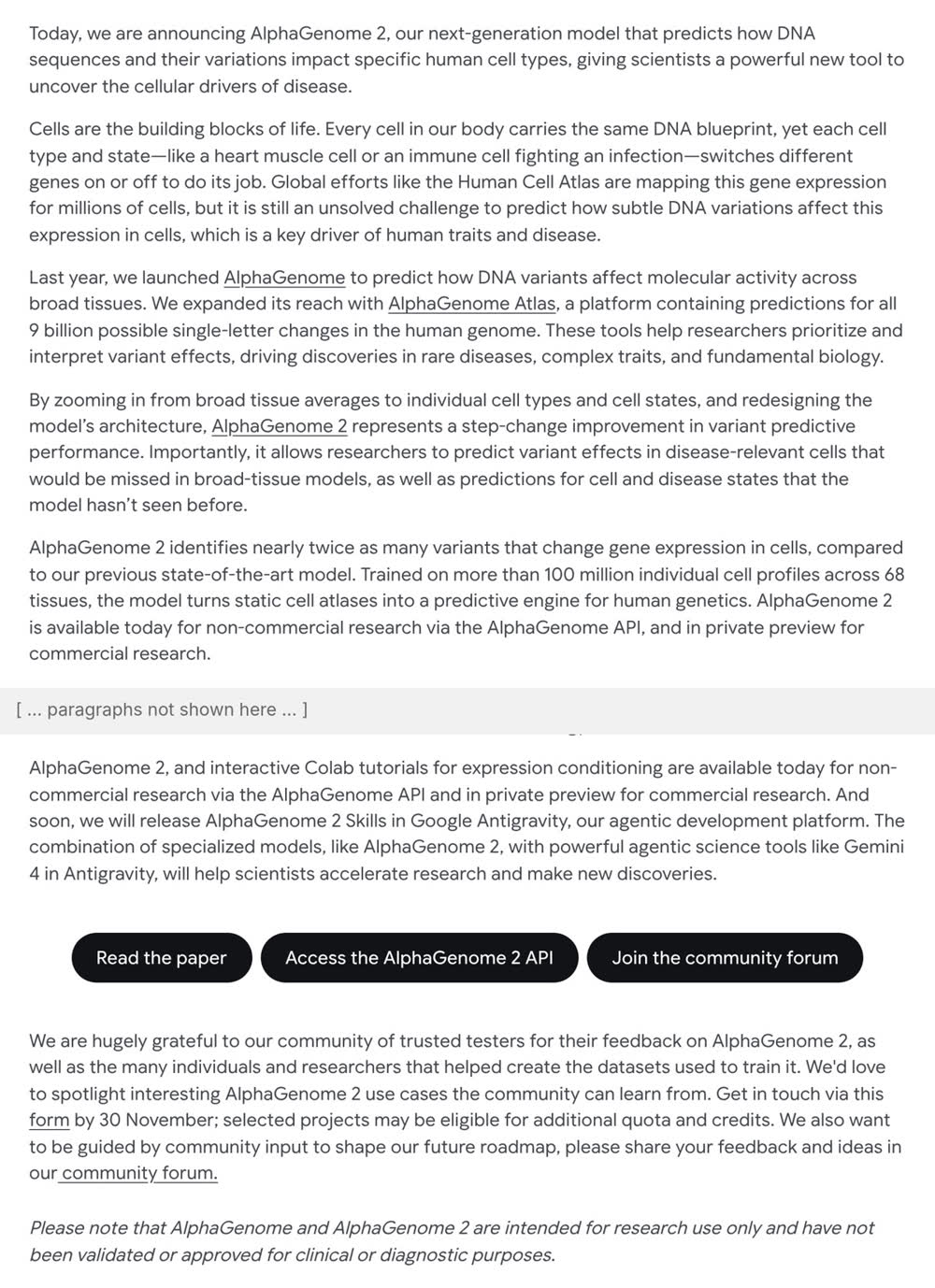 Excerpts from Google DeepMind’s announcement, as published on its blog on 11 November. Image: Google DeepMind
The model reproduced, on a computer, a known finding that a distant DNA switch boosts the ETS2 gene only in gut immune cells called macrophages, a link to inflammatory bowel disease. Using COVID-19 vaccine data, it told activated immune T cells from resting ones.
On DeepMind’s own test across 28 immune cell types, AlphaGenome 2 found 30% of the variants that cause changes, against 16% for a fine-tuned AlphaGenome 1 and other tools. It got the direction of the effect right 43% of the time, against 23%. Startup Fortune reported the same figures.
TenK10K test, 28 immune cell types. AlphaGenome 1 was fine-tuned on single-cell data. Not yet tested independently. Source: Google DeepMind, 11 November 2026
Strong results, but so far only DeepMind has checked them
All those numbers come from DeepMind’s own testing. The paper is a PDF on DeepMind’s site, and it does not say it has been peer reviewed. We found no public reaction yet from independent scientists.
The two outside voices in the post were chosen by DeepMind. Professor Sarah Teichmann, a co-founder of the Human Cell Atlas, praises how it adapts to new data; she also appears in the post’s thanks list. Peter Donnelly, CEO of Genomics Ltd, calls it “an impressive advance” and plans to add it to his company’s Mystra platform.
AlphaGenome 2 also costs more to run than the first model, according to The Verge and Startup Fortune. Both report that this is why the genome-wide Atlas still runs on AlphaGenome 1. An independent study of AlphaGenome 1 found real gains but “key limitations”.
If you study DNA, or just wonder about your own
For university and non-profit researchers, the AlphaGenome API is open now, with Colab tutorials and docs at alphagenomedocs.com. Commercial use is in private preview. No price has been published. DeepMind’s community spotlight form closes on 30 November, and chosen projects may get extra quota and credits.
For everyone else, this is not a DNA test. It cannot tell you your risk of a disease. Any benefit to patients is likely to come later, through better lab work.
People often confuse AlphaFold and AlphaGenome. AlphaFold predicts protein shapes. AlphaGenome predicts what DNA changes do to gene activity. AlphaGenome 2 Skills will also come “soon” to Google Antigravity, paired with the Gemini 4 models now reaching developers.

Why cell-level detail matters more than the headline numbers
The good is real. Biology happens in specific cells, and this Google DeepMind DNA model finally asks questions at that level. In our reading, needing only a few dozen cells could help smaller labs.
The caution is real too. The scores are self-reported, peer review is not mentioned, and the price is unknown. On balance, our reading is that this is a meaningful step for lab scientists choosing their next experiment, not a breakthrough for patients yet.
The real test starts now, as independent labs run AlphaGenome 2 on their own cells and publish what they find.
Prefer to watch? Follow us on YouTube
The tech stories that matter, explained in plain words. Subscribe so you never miss one.
Quick answers
What is AlphaGenome 2?
An AI model from Google DeepMind, released on 11 November 2026. It predicts how a small change in DNA alters gene activity in a specific cell type or cell state.
What does AlphaGenome predict?
Gene activity, how open the DNA is to be read, chemical marks on DNA and its packaging, and, new in version 2, DNA methylation, each for the cell type a scientist chooses.
Is there an AlphaGenome API?
Yes. Non-commercial researchers can use AlphaGenome 2 now through the AlphaGenome API, with Colab tutorials. Commercial use is in private preview. No price has been published.
Can doctors use AlphaGenome 2 to diagnose disease?
No. Google DeepMind says it is for research only and is not validated or approved for clinical or diagnostic use.
What is the difference between AlphaFold and AlphaGenome?
AlphaFold predicts the shapes of proteins. AlphaGenome predicts what changes in DNA do to gene activity.
Words to know
- DNA letters
- DNA is written in a chemical code of four letters. Their order is the 'spelling' of our genes.
- Genetic variant
- A small difference in DNA spelling between one person and another.
- Gene activity (gene expression)
- How strongly a gene is switched on inside a cell.
- Cell type and cell state
- What a cell is (heart, brain, immune) and what it is doing right now (resting, fighting infection).
- Single-cell data
- Measurements taken from individual cells, not an average of a whole ground-up tissue.
- DNA methylation
- Small chemical tags on DNA that help switch genes off.
Sources (9): every key fact checked against at least two
- Google DeepMind: AlphaGenome 2, deciphering how cells read DNA to better understand disease (11 November 2026)
- Google DeepMind: AlphaGenome 2 paper (PDF)
- AlphaGenome API documentation
- The Verge: Google DeepMind's AlphaGenome 2 (11 November 2026)
- Startup Fortune: Google DeepMind launches AlphaGenome 2 (11 November 2026)
- Google DeepMind: AlphaGenome, AI for better understanding the genome (June 2025)
- Google DeepMind: AlphaGenome Atlas (September 2026)
- Nature: the AlphaGenome paper (2026)
- bioRxiv: independent study of AlphaGenome 1's gene-activity predictions
Related stories

51 Eridani b isn't a new planet, but the software that found it in old Webb data could find new ones
51 Eridani b isn't a new planet. New software called FLIP found it in older Webb data that the standard method missed, and it could search Webb's archive.

Hayabusa2's next asteroid, 1998 KY26, is too warm to hide ice, a new study finds
Is 1998 KY26 a dark comet? A new study says the tiny asteroid Hayabusa2 will visit in 2031 is too warm to keep ice. What it means, and what's next.

NASA Moon Base: eight companies can bid for up to $10bn of lander work, and a rover reuses Mars parts
NASA Moon Base update: eight firms can now bid for up to $10bn in Moon deliveries, and JPL will build a nuclear-powered rover from spare Mars rover parts.