51 Eridani b isn't a new planet, but the software that found it in old Webb data could find new ones
- New software called FLIP found the known planet 51 Eridani b in older Webb data where the standard processing method had missed it.
- FLIP builds a digital twin of Webb's camera and subtracts the star's glare. On known planets it was 2 to 15 times more sensitive.
- No new planet has been found with it yet. The team now wants to search Webb's archive for worlds hidden in the glare.
- 2 to 15xMore sensitive than standard methodsOn known planets (Caltech, Northwestern)
- 97Light-years to 51 EridaniNASA, 2025
- 4.3 micronsWavelength of the Webb data usedNorthwestern
- 10 billionHow much fainter an Earth-like planet isThan its star (Caltech)
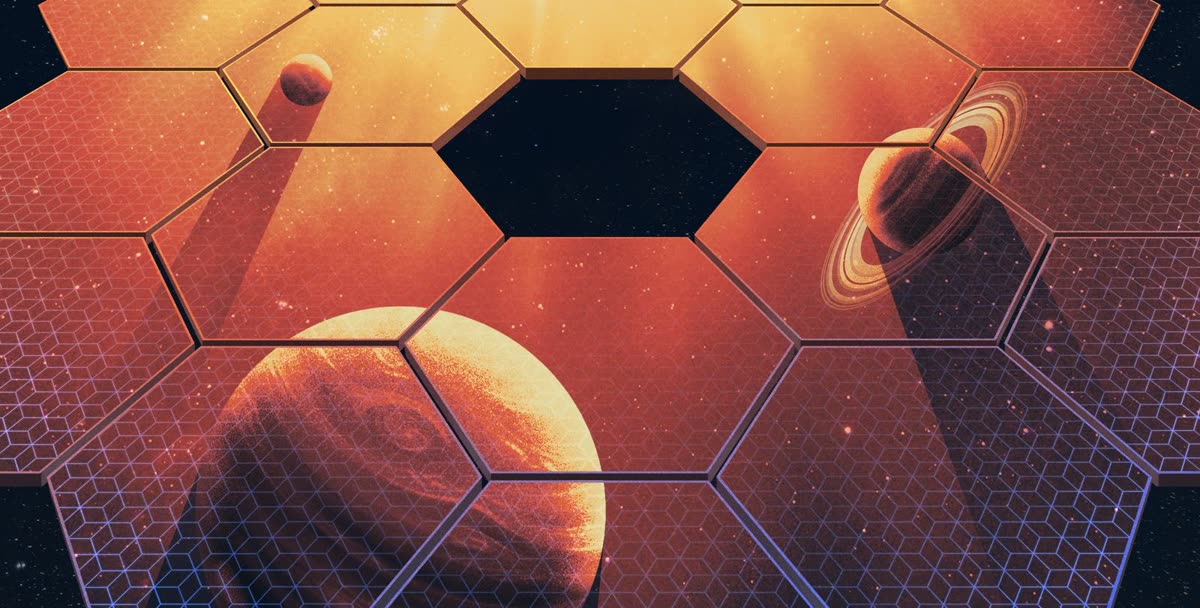
Photographing a planet around another star means beating a blinding glare. An Earth-like world can be about 10 billion times fainter than the star it circles, Caltech says. Even a young giant planet is roughly 100,000 times fainter, according to Northwestern University.
A team from Northwestern, Caltech, MIT and the Space Telescope Science Institute (STScI) has found a new way through it. Their software, called FLIP, found the planet 51 Eridani b in older data from the James Webb Space Telescope, where the standard processing method had missed it. The study was published in Nature on 4 November 2026.
To be clear, 51 Eridani b is not a new planet. The Gemini Planet Imager, an instrument on a ground-based telescope, first photographed it in 2014, and it was announced in 2015. Webb itself imaged it in 2025. The news is the method, and what it might find next.
That matters because Webb’s archive holds years of data. If FLIP is as sensitive as the team reports, some of those images may still hide planets nobody has seen. So far, that is a goal.
How a digital twin pulled 51 Eridani b out of the glare
FLIP is short for Physics-based Learning for Imaging Planets. It builds a detailed computer copy, a “digital twin”, of Webb’s Near Infrared Camera (NIRCam). The software works out millions of tiny flaws in the telescope’s optics, predicts how the star’s light spreads across the image, and then removes it. What is left can be a planet.
FLIP borrows optimisation tools used to train AI models, Northwestern explains, but it is a physics model of one camera, not an AI that “spots” planets.
The team tested it on three stars: HIP 65426 and 51 Eridani, which have known planets, and TYC 5899, which has none. On the known planets, both universities report sensitivity 2 to 15 times better than standard techniques.
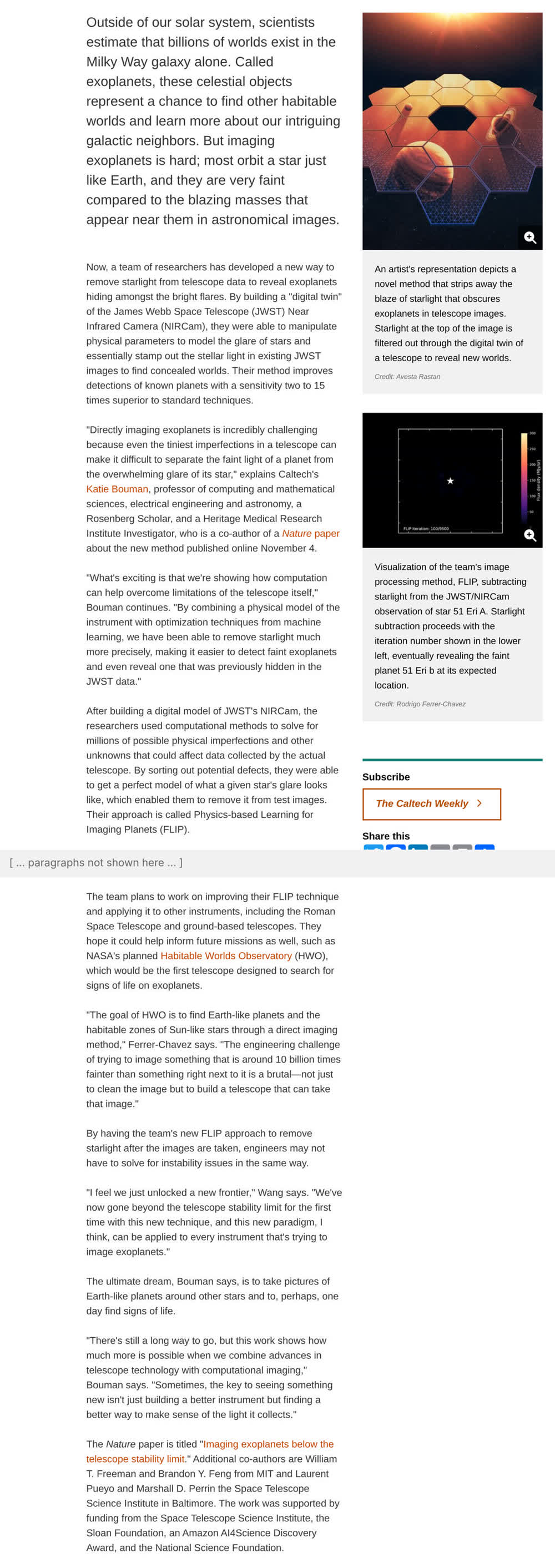 Excerpts from Caltech’s release, as published on Caltech’s newsroom on 4 November. Image: Caltech
For 51 Eridani b, Northwestern says the team used Webb NIRCam data about two years old, taken at a wavelength of 4.3 microns, where carbon dioxide absorbs light. The standard method, known as KLIP, did not detect the planet in that data. FLIP recovered it above 5 sigma, a level scientists treat as strong evidence that a signal is real.
The lead author is Rodrigo Ferrer-Chavez, a Northwestern PhD student, with Jason Wang (Northwestern) and Katherine Bouman (Caltech). NASA puts 51 Eridani about 97 light-years away, with its young gas giant orbiting roughly 890 million miles out, close to Saturn’s distance from the Sun.
Why even a steady telescope leaves starlight behind
Webb is stable to the nanometre, a millionth of a millimetre. Even so, tiny shifts leave starlight that standard subtraction cannot fully remove. That leftover glare is where faint planets hide.
Questions remain. Neither release explains exactly why the standard method missed, in this dataset, a planet Webb had already imaged in 2025. FLIP has not yet found a truly new world. And “2 to 15 times” is a wide range. In practice, a spread like that usually means the gain depends heavily on the target and the data.
What this changes about the James Webb planets you see
Webb’s pictures of planets are not simple snapshots. So how do astronomers find exoplanets this way? They take a real picture, called direct imaging, and then block or subtract the star’s light. Much of the work happens in software, after the telescope has done its part.
Some Webb results are not photos at all: its recent finding that the lava planet TOI-561 b reflects about 75% of its starlight came from patient light-counting, not a picture.
What to watch: whether the team’s archive search turns up anything new, and whether other groups test FLIP on their own data. The teams also want to use it on NASA’s Roman Space Telescope and on ground telescopes. Longer term, it could help plan NASA’s proposed Habitable Worlds Observatory, which needs about 100 to 1,000 times more stability than Webb, Northwestern says.
Better software could stretch Webb further than new hardware
The good news is real. FLIP gets more out of a telescope already in space, and testing it on a star with no known planets was a sensible check. Our reading: improving the software is far cheaper and faster than building a new observatory.
The limits matter too. This is one known planet, in one dataset. Some data details come from a single release. And headlines about a “James Webb hidden planet” oversell what happened.
On balance, this is a meaningful step in method, not a discovery.
The real test is Webb’s archive. If FLIP finds a planet nobody has seen before, and other teams confirm it, those headlines will finally be earned.
Prefer to watch? Follow us on YouTube
The tech stories that matter, explained in plain words. Subscribe so you never miss one.
Quick answers
Is 51 Eridani b a new planet?
No. It was first photographed from the ground in 2014 and announced in 2015, and Webb imaged it in 2025. What is new is FLIP, the software that found it in older Webb data where the standard method missed it.
How far away is 51 Eridani b?
Its star, 51 Eridani, is about 97 light-years from Earth, according to NASA.
Is FLIP artificial intelligence?
Not in the usual sense. It borrows optimisation tools similar to those used to train AI models, but it is a physics model of Webb's camera, not an AI that picks out planets.
How does the James Webb telescope take pictures of planets?
Its cameras capture infrared light, and the star's glare is then blocked with a mask or removed with software. FLIP removes it by predicting exactly how the starlight spreads across the image.
Words to know
- Exoplanet
- A planet that circles a star other than our Sun.
- Coronagraph
- A mask inside a telescope that blocks a star's light so nearby planets show up.
- Digital twin
- A detailed computer copy of a real machine, used to predict how it behaves.
- 5 sigma
- A measure of confidence: the signal is very unlikely to be random noise.
Sources (8): every key fact checked against at least two
- Caltech: Erasing the Stars to Find Exoplanets (4 November 2026)
- Northwestern University: Hidden planet emerges from the glare (4 November 2026)
- Nature: Imaging exoplanets below the telescope stability limit (Ferrer-Chavez et al., 2026)
- NASA: NASA's Webb images young giant exoplanets, detects carbon dioxide (17 March 2025)
- NASA Exoplanet Catalog: 51 Eridani b
- ScienceDaily: Northwestern and Caltech release (November 2026)
- Live Science: Scientists removed the glare from a James Webb telescope image
- BBC Sky at Night Magazine: 51 Eridani b detection with a new image-processing technique
Related stories

AlphaGenome 2 predicts what a DNA change does inside one type of cell, but it is for research only
AlphaGenome 2 from Google DeepMind predicts how a DNA change alters gene activity in one cell type. What it does, who can use it, and its limits.
Hayabusa2's next asteroid, 1998 KY26, is too warm to hide ice, a new study finds
Is 1998 KY26 a dark comet? A new study says the tiny asteroid Hayabusa2 will visit in 2031 is too warm to keep ice. What it means, and what's next.
NASA Moon Base: eight companies can bid for up to $10bn of lander work, and a rover reuses Mars parts
NASA Moon Base update: eight firms can now bid for up to $10bn in Moon deliveries, and JPL will build a nuclear-powered rover from spare Mars rover parts.