The May 2024 solar storm broke through Earth's 'impenetrable barrier' in space, a new study finds
- In the May 2024 solar superstorm, Japan's Arase probe found very fast electrons inside a zone of space long called an 'impenetrable barrier'.
- A Nagoya University-led study, published on 26 October, says natural radio waves called chorus waves sped the electrons up on the spot.
- Electron levels rose more than 5,000 times and stayed high for months. That matters for satellite design and space weather forecasts.
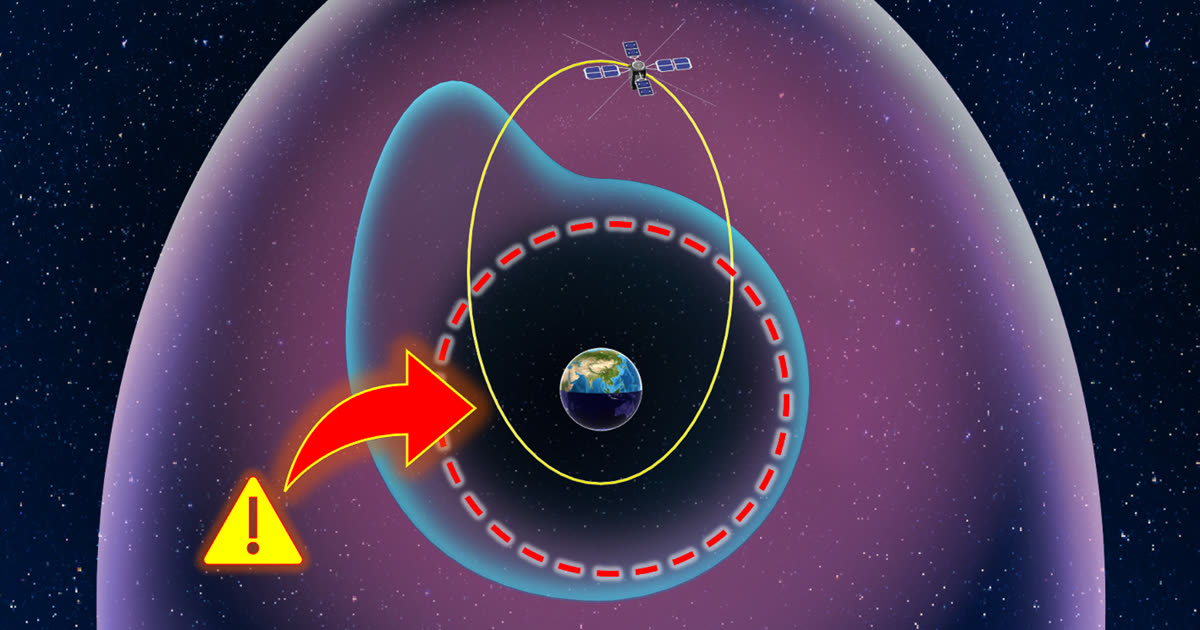
In May 2024, people from northern Japan to Florida looked up and saw the northern lights. High above them, a Japanese probe called Arase was recording something stranger. Electrons moving close to the speed of light had appeared inside a zone of space scientists had called an “impenetrable barrier”.
The storm happened two and a half years ago, but the full answer only arrived last week. A study led by Nagoya University, published online in the journal Geophysical Research Letters on 26 October 2026, says the storm did not push those electrons in from outside. It sped them up right where they were. For the thousands of satellites now circling Earth, a place thought to be calm turned out to have a weak spot.
How the impenetrable barrier was found, and then broken
Earth’s magnetic field traps charged particles in two doughnut-shaped rings, the Van Allen belts. This radiation belt around Earth is not even. In 2014, NASA’s Van Allen Probes found a sharp inner edge, about three Earth-radii from Earth’s centre. The fastest electrons seemed to stop there, as if they had hit a wall.
The May 2024 storm was rated G5, the top of the scale. Arase, run by Japan’s space agency JAXA and in orbit since 2017, saw electrons inside that wall. Some carried more than 3 megaelectronvolts of energy (MeV, a unit for the energy of tiny particles). Nagoya University says that is enough to pass through some satellite shields. The paper reports levels more than 5,000 times higher than before the storm.
Radio waves that “sound like a bird song” did the work
The team, led by Professor Yoshizumi Miyoshi of Nagoya’s Institute for Space-Earth Environmental Research, points to chorus waves. These are natural radio waves in space that rise in pitch. “When converted into audio, it sounds like a bird song,” Miyoshi said.
Close to Earth sits a layer of cool gas called the plasmasphere. The storm squeezed and drained it, so hotter electrons could reach further in and create chorus waves there. The layer usually recovers in about two days. This time it took about 4.3 to 4.7 days to get back to half its usual level, so the waves had days to work. The proof was a peak of fast electrons that grew near the old barrier edge over time.
The extra radiation then faded slowly for months, until another storm in October 2024 changed conditions again.
If your phone, map or weather app depends on satellites
Most of us never think about van allen belt radiation, but we use what flies through it every day: navigation, weather and internet satellites. Fast electrons like these can damage electronics and shorten a spacecraft’s life, ScienceAlert notes, and they add to the radiation risk for astronauts.
No satellite failure has been linked to this event in the sources. The practical point is quieter. Engineers plan shielding around maps of where radiation is expected. In our reading, most talk of solar storm satellite damage is about sudden, short shocks. This study adds a region once marked safe that stayed harsh for months. “This discovery highlights the need to understand and predict how energetic electrons behave,” Miyoshi said.
Patient, long-running probes keep paying off. Arase has been watching since 2017, and Voyager 1 recently recovered from a rare fault after nearly half a century in space. As companies put new hardware in orbit, such as Google’s Project Suncatcher test satellite, which faces radiation tests next, an honest radiation map matters more.
A barrier that bends is better news than it sounds
On balance, this is a careful, useful finding rather than a warning. The good: one well-placed probe caught a rare event, and the team explained it with a clear cause. Better maps lead to better space weather forecasts and smarter satellite design.
The open question is how often this happens. The study looks at one storm. Whether every big storm can break the barrier, or only rare ones like May 2024, is not known yet. In our reading, the likelier lesson is not “nowhere is safe” but “safe zones need watching”. That is a fair price for understanding the space we now depend on.
Europe’s space weather scientists meet in Florence this week, from 2 to 6 November. The next storm will show whether the barrier holds, or bends again.
Sources (5): every key fact checked against at least two
- Geophysical Research Letters: Local Acceleration of Multi-MeV Electrons Inside Earth's Impenetrable Barrier During the May 2024 Superstorm (Miyoshi et al., 26 Oct 2026)
- Nagoya University: 2024 solar storm triggered ultra-relativistic electrons inside Earth's 'impenetrable barrier' (28 Oct 2026)
- Universe Today: Earth's impenetrable space radiation shield was just breached from within (30 Oct 2026)
- ScienceAlert: Earth's supposedly impenetrable radiation barrier has been breached (31 Oct 2026)
- European Space Weather Week 2026, Florence, 2-6 November
Related stories
One dot becomes two: ESA's Hera sees the asteroid pair NASA's DART hit
The Hera mission has seen Didymos and Dimorphos as two separate asteroids for the first time. Here is what ESA found and what comes on 25 November.
India's NVS-03 satellite clears the step where its sister NVS-02 failed
ISRO's NVS-03 satellite fired its engine for 36 minutes and is healthy, passing the step where NVS-02 failed. Here is what it means for NavIC.
Voyager 1 went quiet for two days. NASA got it back, and still wants to know why
Voyager 1 lost contact with Earth for about 48 hours in October, then came back on its own. Here is what NASA knows, and why 18 November matters.