One dot becomes two: ESA's Hera sees the asteroid pair NASA's DART hit
- ESA said on 27 October that its Hera spacecraft has, for the first time, seen the asteroids Didymos and Dimorphos as two separate objects.
- The picture was taken on 18 October from 1,280 km away. Dimorphos, the small moon NASA's DART hit in 2022, is about one pixel wide.
- ESA plans to show the first detailed images of Dimorphos on 25 November, before Hera studies what the impact really did.
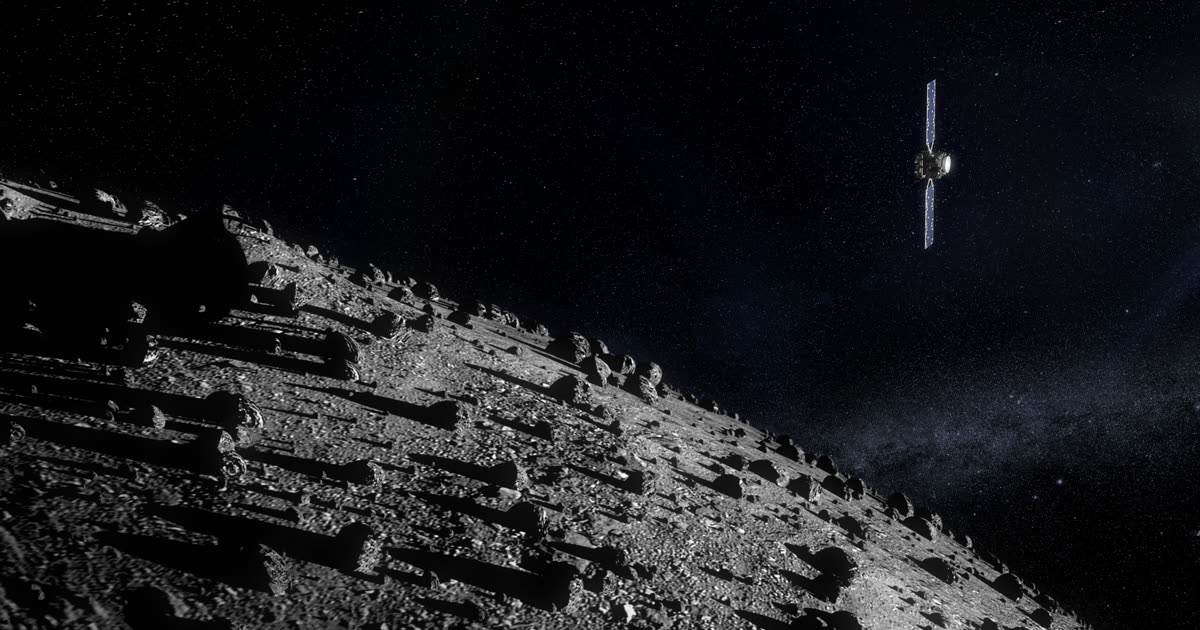
For two years, a European spacecraft has been flying towards a single point of light. On 18 October, from 1,280 km away, that point split in two. The bigger dot is the asteroid Didymos. The tiny one beside it, about one pixel wide, is Dimorphos: the rock NASA’s DART spacecraft hit on purpose in 2022.
The European Space Agency (ESA) shared the picture on 27 October. It is the Hera mission’s first real look at the target it was built for. The image is grey and small. But it marks the moment a planetary defence experiment moves from “we pushed it” to “now let’s see what we did”.
The Hera mission’s first look at Didymos and Dimorphos
Hera took the image with its Asteroid Framing Camera, which sees in black and white. ESA says the pair is currently about 197 million km from Earth.
“Before this acquisition the spacecraft was still resolving the Didymos system as a single dot,” said Michael Kueppers, Hera’s project scientist. Now Dimorphos shows up on its own, even if only as one pixel.
The view came after two braking burns a week apart earlier in October. They slowed the Hera spacecraft to about 20 metres per second relative to the asteroids, so it can creep closer in small, careful steps.
The sizes help to picture it. ESA says Dimorphos is about 151 m across, roughly the size of the Great Pyramid of Giza. Didymos is about 780 m wide, a little smaller than Dubai’s Burj Khalifa. The two sit about 1.15 km apart, and Dimorphos circles its parent at around 18 cm per second, slower than a person walking.
“For the very first time we are seeing through Hera’s own eyes the very double asteroid system that the mission was designed and built for,” said mission manager Ian Carnelli. ESA will unveil the first detailed images of Dimorphos on 25 November.
The DART asteroid impact worked better than the models said
On 26 September 2022, DART struck Dimorphos at 6.1 km per second. The crash threw a cloud of debris across 10,000 km of space and shortened the moon’s orbit around Didymos by about 33 minutes. Dimorphos became the first object in the Solar System whose orbit humans have measurably changed.
That success left a puzzle. ESA says the push was much bigger than impact simulations predicted. Nobody yet knows why. Did DART leave a crater, or reshape the whole asteroid? What is Dimorphos made of, how is it built inside, and how heavy is it? Without those answers, the “kinetic impact” method (hitting an asteroid to nudge it) is a result, not yet a reliable tool.
This is where Hera comes in. Over the coming months it will carry out what ESA calls a close-up “crash site investigation”, release two shoebox-sized CubeSats (small satellites) called Milani and Juventas, and finally try to land.
Why an asteroid you will never see still matters to you
Neither Didymos nor Dimorphos poses any threat to Earth, NASA says, before or after DART. So this is a rehearsal, not a rescue.
But rehearsals are how real emergencies go well. If astronomers ever find an asteroid heading our way, people everywhere would want to know one thing: can we move it, and how hard do we need to hit it? Hera’s job is to turn DART’s single push into numbers engineers can plan with.
The Hera mission timeline from here is simple. 25 November brings the first detailed images. The months after bring the close study, the CubeSats and the landing attempt. It joins other trips to small worlds, like Japan’s MMX mission to Mars’ moon Phobos.
A one-pixel picture that sets up the real test
It is fair to keep expectations calm. One pixel tells us almost nothing new about Dimorphos itself, and ESA’s announcement gives no exact date for when Hera settles in beside the pair. The meaningful science starts later.
Still, there is a lot to appreciate. This is Europe and the United States splitting one job across two missions: NASA hit the target, ESA measures the result. In practice, planetary defence will depend on that kind of patient teamwork. On balance, this image is less a discovery than a promise kept: the spacecraft is on course, its camera works, and the target is in sight.
The harder question is whether the close-up answers will make the method easier to trust, or reveal that every asteroid behaves differently. Both outcomes would be useful. Knowing the limits of a tool is part of being ready to use it.
On 25 November, the dot gets a face. That is when we start learning what DART’s push actually did to a small world.
Sources (6): every key fact checked against at least two
- ESA: First light: Hera resolves two asteroids instead of one (27 Oct 2026)
- heise online: ESA's Hera probe photographs the two asteroids separately for the first time (28 Oct 2026)
- Starlust: ESA's Hera finally sees Didymos and Dimorphos as two separate asteroids (29 Oct 2026)
- Universe Today: Hera probe sees asteroid pair separately for first time (31 Oct 2026)
- ESA: Hera's CubeSats
- NASA: DART planetary defense mission
Related stories
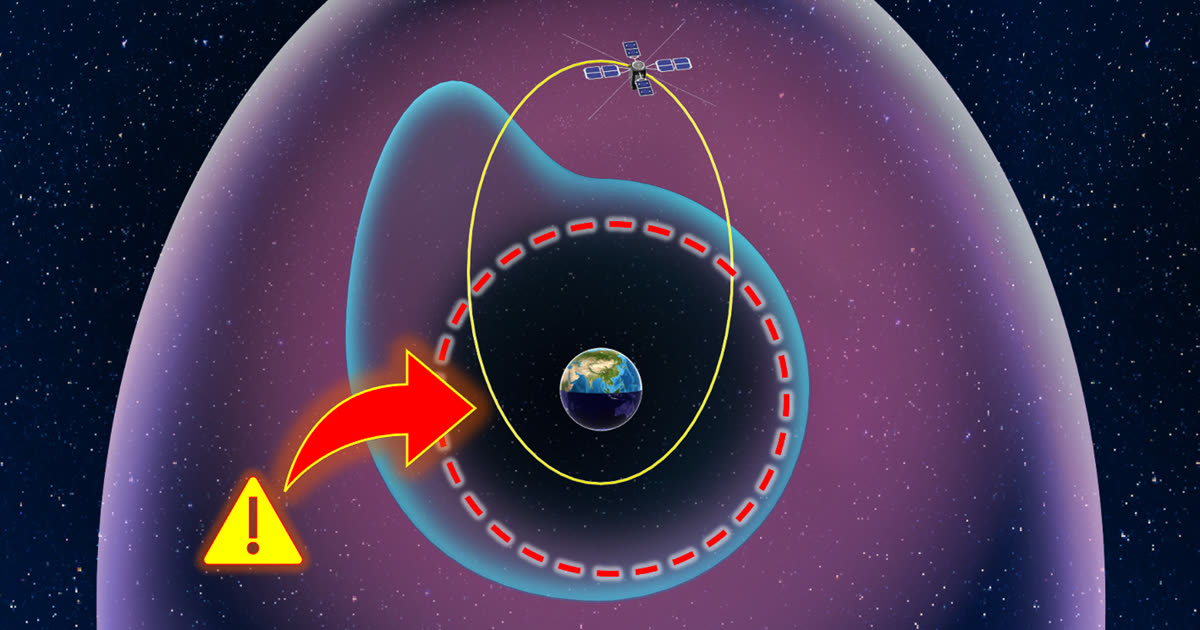
The May 2024 solar storm broke through Earth's 'impenetrable barrier' in space, a new study finds
A new study finds the May 2024 solar storm made very fast electrons inside Earth's impenetrable barrier. What it means for satellites and space weather.
India's NVS-03 satellite clears the step where its sister NVS-02 failed
ISRO's NVS-03 satellite fired its engine for 36 minutes and is healthy, passing the step where NVS-02 failed. Here is what it means for NavIC.
Voyager 1 went quiet for two days. NASA got it back, and still wants to know why
Voyager 1 lost contact with Earth for about 48 hours in October, then came back on its own. Here is what NASA knows, and why 18 November matters.