NASA asks companies how to save Hubble: boost it higher, upgrade it, or bring it down safely
- On 29 October NASA asked US companies how they could raise Hubble to a higher orbit, upgrade it, or guide it down safely at the end of its life.
- Hubble has no engine, and thin air is slowly pulling it down. NASA expects re-entry around 2033-2034, so any mission would need to fly by 2032.
- Answers are due on 30 November. This is a request for ideas, not a contract: no company has been chosen and no cost has been named.
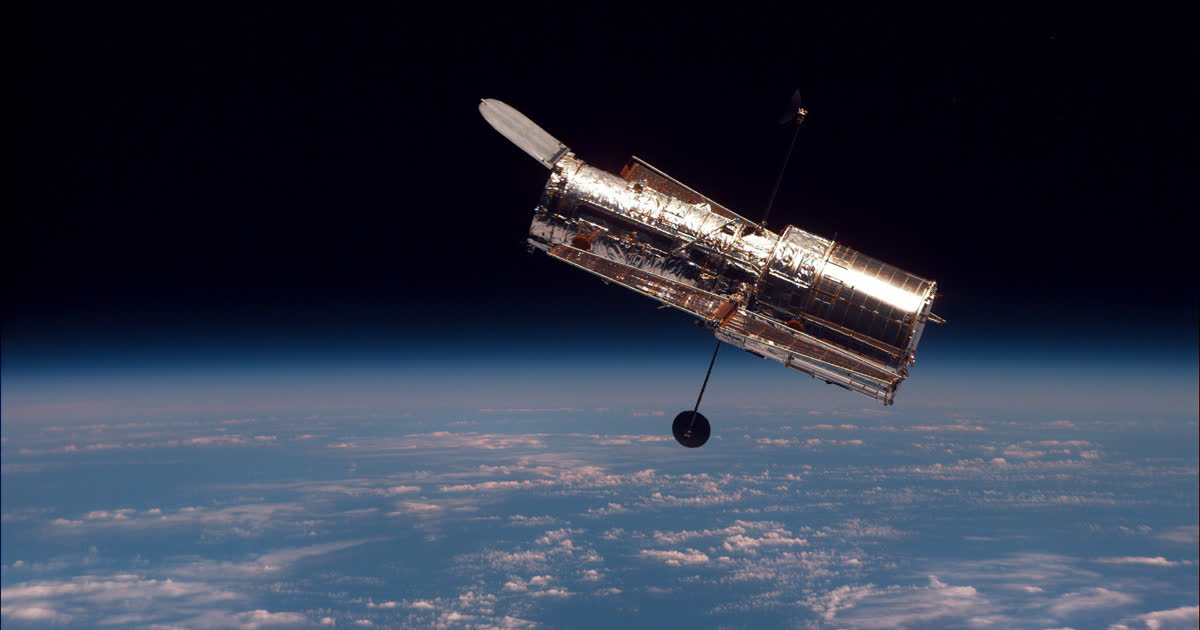
For more than three decades, the Hubble Space Telescope has given us pictures of the universe that many of us first saw in school books. It has no engine. Every day, a thin trace of air at its height drags it a little lower.
On 29 October, NASA asked companies a simple question with a deadline: can you help? The agency wants ideas for a Hubble reboost to a higher orbit, an upgrade, or a safe, controlled trip back to Earth when the mission ends.
This matters because time is short. NASA’s analysis says Hubble will likely fall back into the atmosphere around 2033-2034. To change that, a mission would need to launch by 2032, only about six years away, which is not long in spaceflight.
A Hubble reboost, an upgrade or a safe goodbye
NASA’s announcement describes a Request for Information (RFI). An RFI is how a government agency asks industry what is possible before it commits money. US companies can answer on SAM.gov until 3 p.m. EST on Monday, 30 November.
NASA lists three paths:
- Lift it higher, so the drag is weaker and Hubble can keep working for longer.
- Service it, to improve what the telescope can do.
- Bring it down safely, through a controlled re-entry or disposal at the end of the mission.
According to the notice, as reported by The Register and TS2 Space, a boost would aim for at least 600 km. The Register also reports NASA’s own odds for a Hubble telescope reentry: a 10% chance by September 2032, and 50% by December 2033. Any visiting spacecraft must not harm the telescope.
“Hubble still has important science ahead of it,” said NASA Administrator Jared Isaacman. Nicky Fox, who leads NASA’s Science Mission Directorate, called Hubble “a national icon”.
A rescue idea that has come back before
This is not the first time. Before he led NASA, Isaacman backed a SpaceX plan to boost Hubble, The Register notes, and NASA did not go ahead with it. This time, he is the person asking.
Hubble is also working with less than it once had. In 2024 its operators moved it to a one-gyroscope mode (gyroscopes help it point steadily) to stretch its working life. The last Hubble servicing mission, flown by astronauts on the space shuttle, was in 2009. The shuttle has since retired.
What we don’t know yet: what a mission would cost, whether NASA would pay for it, and which companies will answer. No firm has been named, and any list of likely bidders is guesswork for now.
How long will Hubble stay in space, and why it matters to you
The honest answer today: probably until around 2033-2034, unless someone gives it a push. The Habitable Worlds Observatory, a possible successor, is not expected before the 2040s, The Register reports. That could leave a gap of several years with nothing quite like Hubble in orbit.
You don’t need to be an astronomer to feel that gap. Hubble’s free public images feed classrooms, museums and science apps around the world. The James Webb Space Telescope is powerful, but it mostly sees infrared light, so it complements Hubble rather than replacing it.
There is also a safety side. Without an engine, Hubble’s fall would be uncontrolled, The Register notes. A guided re-entry is the responsible ending if it can’t be saved.
Why asking first is the sensible step
On balance, this is a careful, sensible move. A Hubble reboost or repair mission by a private company would be new territory, and an RFI lets NASA see what is realistic before spending public money. The good: companies may already have some of the tools, and a single trip could buy years of extra science.
The risk is just as real. Docking with a telescope that has flown for more than three decades is delicate, and a mistake could end its science early. The deadline leaves little room for delay. NASA’s Swift observatory ended its mission this month after its orbit sank and a robotic rescue failed, a reminder that not every ageing spacecraft gets saved.
Our reading: the fairest outcome is a clear decision soon, either a well-tested boost or a planned, safe farewell. Drifting until 2032 without a choice would be the worst path.
Answers are due on 30 November. What NASA learns from them, above all what a mission would cost, will decide whether Hubble gets a second act or a graceful goodbye.
Sources (4): every key fact checked against at least two
- NASA: NASA Explores Potential Commercial Servicing for Hubble Telescope (30 October 2026)
- The Register: NASA ponders a Hubble servicing mission, or a controlled deorbit (30 October 2026)
- TS2 Space: NASA seeks plans to service Hubble and boost it to 600 kilometres
- STScI: NASA to Change How It Points Hubble Space Telescope (June 2024)
Related stories

One of the oldest Mars meteorites ever found shows water once moved through the planet's crust
Teghaza 001, one of the oldest Martian meteorites, formed over 4.1 billion years ago. A new Science paper shows water once moved through early Mars' crust.
Webb finds lava planet TOI-561 b reflects about 75% of its starlight, possibly off mineral clouds
TOI-561 b, a lava planet 280 light-years away, reflects about 75% of its starlight, Webb data show. Why its air should be gone, and what may keep it.

Wind turbines have killed about 18.7 million US bats since 1981, USGS-led study estimates
Wind turbines killing bats: a USGS-led study estimates 18.7 million US bat deaths since 1981, and shows how design, siting and slower blades can cut them.