Developing story
FCC clears SpaceX to launch up to 1 million data-center satellites, but with narrower orbits
- The US FCC has authorized SpaceX Starmind: up to 1 million satellites acting as data centers in low Earth orbit, its Space Bureau says in order DA 26-1273.
- The grant is narrower than asked: orbits of 500 to 1,002 km, not up to 2,000 km. A request to skip the end-of-life re-entry rule was deferred, not approved.
- Astronomers and Amazon had asked the FCC to deny it. The FCC rejected their petitions. SpaceX says its first satellites could fly from 2027.
- 1,000,000Satellites authorizedFCC order DA 26-1273
- 11.1KStarlink satellites in orbitSpaceX, 30 Sep 2026
- 500-1,002 kmApproved orbit bandFCC order DA 26-1273
- 25 Nov 2040Deadline for the full fleetFCC order DA 26-1273

On Wednesday 25 November, the US Federal Communications Commission (FCC) approved a fleet of up to 1 million SpaceX satellites that work as data centers in orbit. The FCC calls it the first authorization of its kind in US history.
SpaceX Starmind is the company’s plan for computing in space. The approval turns an idea into a licence with deadlines. It comes as ground data centers strain power grids and the night sky grows busier.
What the FCC actually approved for SpaceX Starmind
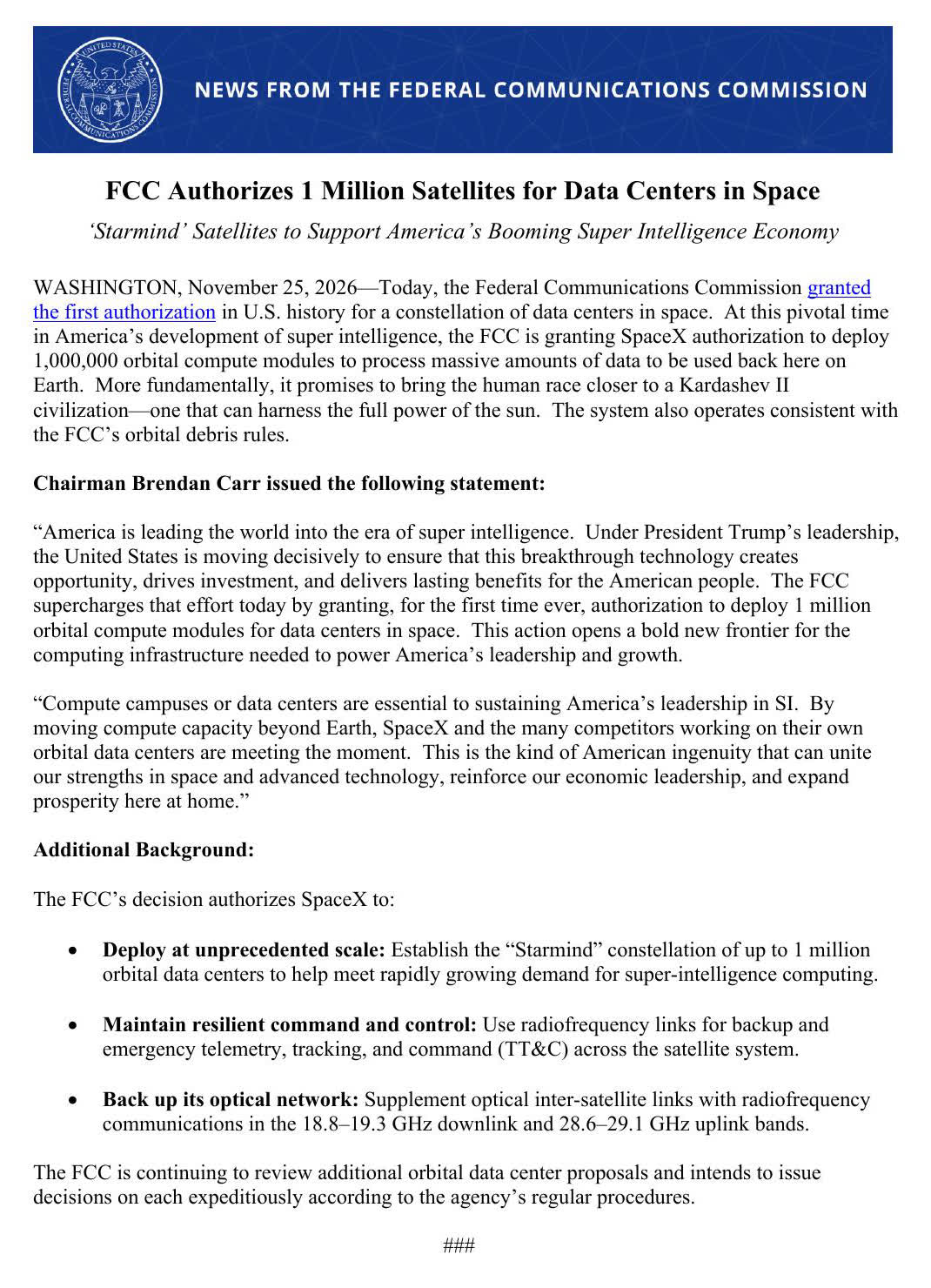 The FCC’s 25 November news release, shown in full. Read the release on docs.fcc.gov. Image: FCC
The order, DA 26-1273, was adopted by the FCC’s Space Bureau, so this was a staff-level decision, not a vote by the commissioners. Chairman Brendan Carr’s statement in the release says, “America is leading the world into the era of super intelligence.”
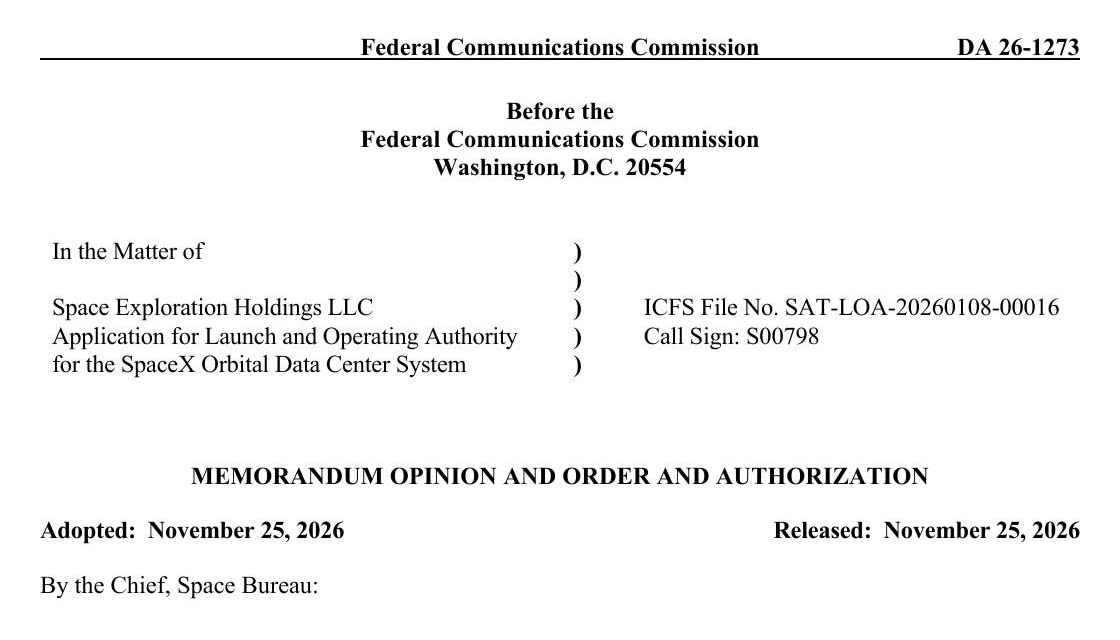 Order DA 26-1273, released 25 November 2026 by the FCC Space Bureau. Read the full order on docs.fcc.gov. Image: FCC
The grant is narrower than the request. SpaceX asked for orbits from 500 to 2,000 km; the FCC approved shells between 500 and 1,002 km.
The order sets milestones: one satellite by 25 November 2033, 100,000 by 2035, 500,000 by 2038 and all of them by 2040. For scale, SpaceX reports about 11,100 Starlink satellites in orbit at the end of September. One million is roughly 90 times that, by our arithmetic.
SpaceX says its satellite, called AI1, will carry 150 kW of peak computing power and send results back through Starlink. On its third-quarter call, president Gwynne Shotwell said Starmind satellites would begin flying in 2027. That is SpaceX’s own target, not an FCC date.
The debris question is still open
SpaceX had asked to skip a rule that satellites ending their missions below 2,000 km must re-enter the atmosphere. The FCC deferred that request. It did find SpaceX’s debris plan for satellites below 600 km meets its rules. Before SpaceX deploys any Starmind satellite above 600 km, it must file a final orbital-debris plan.
The order also requires reports twice a year on close approaches, removals and re-entries.
Astronomers and Amazon objected, and the FCC said no
The American Astronomical Society (AAS) asked the FCC to deny the application. Its filing says large satellites could be seen with the naked eye, tens of thousands at once. They could also interfere with telescopes such as the Rubin Observatory. If the FCC approved, it asked that SpaceX first fund a study of the impact.
Amazon’s Kuiper Systems, which runs Amazon Leo, called the plan speculative. Its filing says that at 2025’s world record of 4,526 satellites launched, a million would take more than 220 years. Viasat also petitioned; the order cites its concerns about radio interference and debris.
The order denied all three petitions. The FCC said licensing operations in space needs no environmental review, and that launch effects are for the Federal Aviation Administration. It also said questions such as feasibility, cooling and economics fall outside its radio-licensing role. On astronomy, the FCC declined to add conditions, saying SpaceX’s commitment to coordinate with the US National Science Foundation (NSF) was enough.
If you look at the night sky or depend on satellites
Nothing changes overhead tomorrow. If you use satellite internet, the order lets Starmind use radio only as a backup, on a no-interference basis; its main links are lasers. Readers who watch the stars, or work in radio astronomy, should follow the NSF coordination and the FCC’s twice-yearly reports.
Everyone else may feel this through computing. SpaceX says it wants to supply computing for AI from orbit. Google has already tested the idea with its Suncatcher satellite. The pressure is real: ground data centers need more electricity, as a Harvard study on data-center power use shows.
A real step, with the hardest questions still ahead
In our reading, the approval gives SpaceX room to plan, but the FCC kept control: narrower orbits, a deferred waiver and regular reports. Critics are right that the sky and space safety are shared, and one order does not settle those worries.
The order points to a gradual start: SpaceX told the FCC it will first fly satellites at lower altitudes to test them before raising them. In our reading, the likelier outcome is a smaller early fleet, tested step by step. Whether computing in orbit can be cooled and made cost-competitive is unproven; the FCC did not rule on it.
The next marker to watch is the debris plan, due before any satellite climbs above 600 km. It will show how the promise meets the rules.
Prefer to watch? Follow us on YouTube
The tech stories that matter, explained in plain words. Subscribe so you never miss one.
Quick answers
What is SpaceX Starmind?
SpaceX's name for a planned fleet of satellites that act as data centers in orbit. SpaceX says it will capture solar energy in space to power computing for AI on Earth.
Did the FCC approve 1 million satellites?
It authorized up to 1 million, in orbits of 500 to 1,002 km. The Space Bureau granted it, not a vote of the full Commission.
When will Starmind satellites launch?
SpaceX says it plans to begin flying them in 2027. The FCC's first deadline is one satellite by 25 November 2033.
Were the debris rules waived?
No, not at this stage. The FCC deferred SpaceX's request to skip the re-entry rule. SpaceX must file a final debris plan before deploying any Starmind satellite above 600 km.
Words to know
- Orbital data center
- A satellite that carries computers, so it can process data in space.
- Low Earth orbit (LEO)
- The region of space up to about 2,000 km above Earth, where most satellite fleets fly.
- Petition to deny
- A formal filing asking the FCC to refuse an application.
- Waiver
- Official permission to skip a rule.
- Sun-synchronous orbit
- A near-polar orbit that passes over the same place at the same local solar time each day.
Sources (10): every key fact checked against at least two
- FCC: Memorandum Opinion and Order and Authorization, DA 26-1273 (25 Nov 2026)
- FCC news release: FCC Authorizes 1 Million Satellites for Data Centers in Space (25 Nov 2026)
- FCC public notice DA 26-113: SpaceX application accepted for filing
- SpaceX: Starmind
- SpaceX: Third Quarter 2026 results
- SpaceX: Third Quarter 2026 webcast transcript
- American Astronomical Society: Petition to Deny SpaceX Orbital Data Centers (6 Mar 2026)
- Amazon (Kuiper Systems): Petition to Deny SpaceX Data Center Application (6 Mar 2026)
- StockAnalysis: FCC approves SpaceX Starmind data centers in space
- Fox Business: FCC clears SpaceX for 1 million satellites
Related stories

Harvard study: 403 US data centers used up to as much electricity as Michigan
Data center electricity consumption, estimated: a Harvard-led study of 403 US hyperscale sites finds 68 to 99 TWh in a year, near Michigan's use.

Vulcan rocket fails 10 minutes into flight, and 40 Amazon Leo satellites do not reach orbit
Vulcan rocket failure on 15 November: ULA's rocket suffered an anomaly 10 minutes in and did not deliver 40 Amazon Leo satellites to orbit.

A flash of laser light briefly lines up the hidden electric order inside a quantum crystal
Auburn physicists used laser pulses to briefly line up tiny electric regions in a quantum ferroelectric metal, for about a trillionth of a second.