Developing story
Neuralink says the FDA has approved a pivotal trial of its brain implant for people with ALS
- Neuralink says the US FDA approved its LINK Pivotal Study for adults with severe paralysis from ALS. The FDA has not commented.
- This is permission to run a trial, not to sell the implant. Trial size, sites and goals are not published, and no registry entry is listed.
- Neuralink says enrolment is open and 30+ people were implanted in earlier studies. Talk to your own doctor and read the official trial page.
- 30+People implanted so farNeuralink, earlier studies
- 3Countries in earlier studiesUS, Canada, UK (Neuralink)
- ~24 monthsFollow-up per participantNeuralink trials page
- $0Cost to participantsNeuralink says

For people living with ALS, small things can become hard: sending a message, turning on a screen, asking for help. On 25 November, Neuralink said it now has US approval to test a way to do those things by thought alone.
The Neuralink FDA approval, as the company describes it, covers its LINK Pivotal Study. Neuralink says the US Food and Drug Administration (FDA) approved the first pivotal trial of an implantable brain-computer interface in the US. The FDA has not commented, so this comes from the company.
A pivotal trial is the stage before a company can ask regulators to approve a product. It is still not something you can buy.
What Neuralink says the LINK Pivotal Study will test
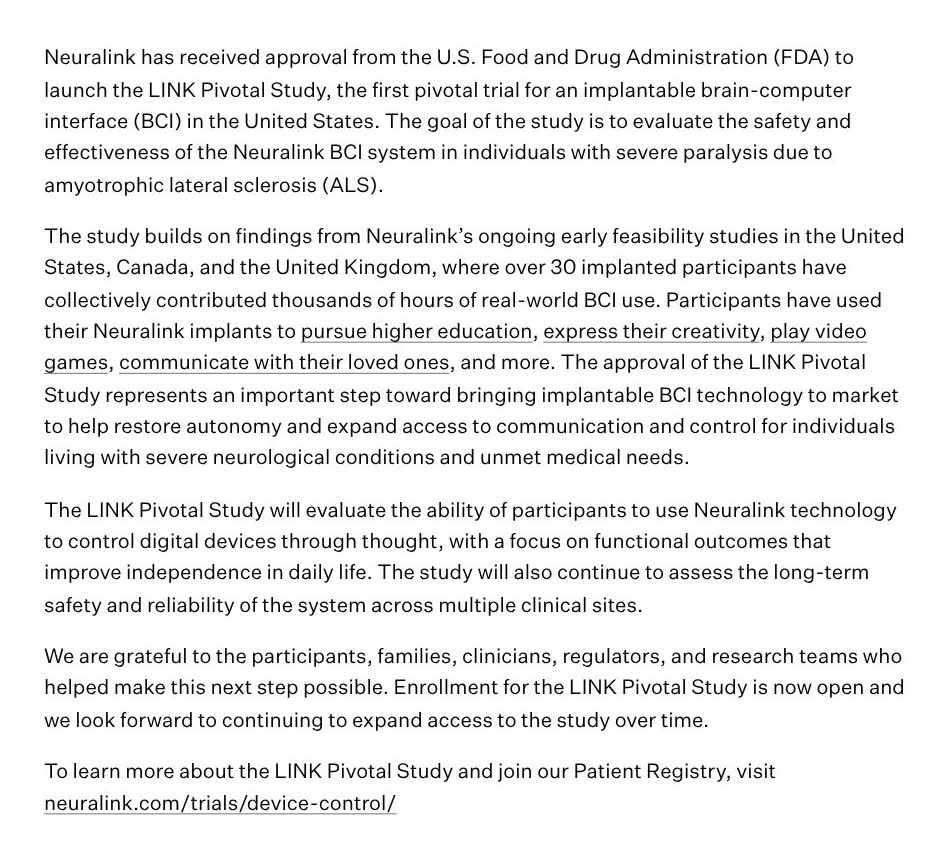 Neuralink’s 25 November announcement, shown in full. Read it on neuralink.com. Image: Neuralink
The study is for adults with severe paralysis from ALS. Neuralink says it will test long-term safety and reliability, and how well people can control computers and phones with their thoughts. Enrolment is open, and access will expand “over time”, the company says.
How it works, as Engadget and others describe it: a coin-sized implant sits in the skull, and hair-thin threads placed by a surgical robot read signals from the motor cortex, the brain area that plans movement. Software turns those signals into cursor moves and clicks. One participant’s story, in Neuralink’s own video:

Neuralink FDA approval is for the trial, not the product
The FDA describes a pivotal study as “the definitive study or studies” used to judge a device’s safety and effectiveness, usually to support a Premarket Approval application. Passing one does not guarantee approval. So the answer to “is Neuralink FDA approved?” is no: the trial is, the device is not.
Neuralink says more than 30 people have been implanted in earlier studies in the US, Canada and the UK. As of January 2026, it reported no serious device-related adverse events. Both are company figures, not independently verified.
Neuralink's figures, from its January 2026 update. Not independently verified. Source: Neuralink: Two years of telepathy
What has not been published
Several basics are missing. Neuralink has not said how many people will join, which sites will run the trial, or what its formal goals are. The trials page lists registry numbers for the earlier studies, but the pivotal study shows “Not listed”. We could not find a ClinicalTrials.gov entry for it.
The record is not spotless either. In May 2024, Neuralink disclosed that threads had pulled back in its first participant, cutting the number of working electrodes. Performance fell and then recovered after software changes.
Experts raised questions in 2024. Kip Ludwig, a former US National Institutes of Health programme director, questioned transparency and whether the device keeps working over months and years. Victor Krauthamer, a former FDA reviewer of brain-implant trials, said public registration shows how participants are protected (both to Reuters, February 2024). We found no independent expert comment on this approval yet.
If you or someone you love has ALS
Neuralink’s trials page says participants must be adults (18+) living with ALS and have a caregiver, and that some ventilator users may qualify case by case. It says there is no cost for the device, surgery or study visits, and that travel and lodging are supported. We could not confirm that independently. The pivotal study is US-only for now. Neuralink’s earlier feasibility studies run in Canada and the UK, and the trials page lists their registry numbers.
We cannot advise on whether a trial is right for anyone. Talk to your own neurologist, and read the official trial page and Patient Registry before deciding. Trial sites have not been named, so there is nothing to compare yet.
For a different approach to reading the brain, see our story on an EPFL chip that reads how brain regions talk.
A real step, with the evidence still to come
In our reading, there is good news here. Moving from small feasibility studies to a pivotal trial suggests the FDA saw enough early data to let Neuralink test the device more widely. For people with ALS, who have few options, that deserves respect.
The caution is equally fair. The data behind the claims is the company’s own, the trial’s design is unpublished, and the 2024 episode shows why long-term results matter. The likelier outcome is a slow process: with about 24 months of follow-up per person, full results will take years, not months.
The next markers to watch are a public registry entry, the site list and the goals. Until they appear, the approval is a promise; the evidence comes later.
Prefer to watch? Follow us on YouTube
The tech stories that matter, explained in plain words. Subscribe so you never miss one.
Quick answers
Is Neuralink FDA approved?
Not as a product. Neuralink says the FDA approved the trial. The implant is still investigational and cannot be sold.
How do you sign up for the Neuralink trial?
Neuralink points to its Patient Registry at neuralink.com/trials/device-control. It lists adults (18+) living with ALS, with a caregiver. Check your options with your own doctor.
Where are the Neuralink trial sites?
Not named yet. Neuralink says the study will run at multiple clinical sites in the US.
Does it cost anything to join?
Neuralink says no: the device, surgery and study visits are free, and travel and lodging are supported. We could not check this independently.
Words to know
- BCI (brain-computer interface)
- A device that reads brain signals so a person can control a computer or phone.
- Pivotal trial
- The FDA's term for the definitive study used to judge a device's safety and effectiveness, after earlier exploratory work.
- ALS
- Amyotrophic lateral sclerosis, a disease that weakens muscles over time. Called motor neurone disease in the UK.
Sources (13): every key fact checked against at least two
- Neuralink: Neuralink Receives FDA Approval to Launch LINK Pivotal Study (25 Nov 2026)
- Neuralink: LINK study details (trials page)
- Neuralink: Two years of telepathy (28 Jan 2026)
- Neuralink: PRIME study progress update (8 May 2024)
- Engadget: Neuralink receives FDA approval for brain implant trial in ALS patients
- Newsweek via Yahoo: Neuralink moves toward a pivotal trial
- Anadolu Agency: Neuralink gets FDA approval for pivotal brain implant trial
- Interesting Engineering: Neuralink FDA approval, LINK pivotal trial
- FDA CDRH Learn: Design considerations for pivotal clinical investigations
- Reuters via Malay Mail: Want details on Musk's brain implant trial? (Feb 2024)
- Fortune: Neuralink gets FDA approval for human testing (25 May 2023)
- Axios: First human receives Neuralink implant (30 Jan 2024)
- Tubefilter: ALS patient edits YouTube video with Neuralink implant (May 2025)
Related stories

FCC clears SpaceX to launch up to 1 million data-center satellites, but with narrower orbits
SpaceX Starmind gets US approval for up to 1 million orbital data-center satellites. The FCC narrowed the orbits and deferred a key debris decision.
· 4 min read

Harvard study: 403 US data centers used up to as much electricity as Michigan
Data center electricity consumption, estimated: a Harvard-led study of 403 US hyperscale sites finds 68 to 99 TWh in a year, near Michigan's use.
· 4 min read

Vulcan rocket fails 10 minutes into flight, and 40 Amazon Leo satellites do not reach orbit
Vulcan rocket failure on 15 November: ULA's rocket suffered an anomaly 10 minutes in and did not deliver 40 Amazon Leo satellites to orbit.
· 3 min read