Switzerland confirms its first cyberattacks carried out by AI agents, and most of them got in
- Switzerland's National Cyber Security Centre says it has received its first reports of cyberattacks carried out with AI agents.
- Its director told SRF there were five confirmed cases and four intrusions succeeded. Who is behind them is not known.
- The advice is plain: patch within 24 hours, use MFA or passkeys everywhere, limit what is exposed and watch for odd behaviour.
- 5Confirmed casesBACS director, via SRF
- 4Intrusions that succeededBACS director, via SRF
- 3 / 2Critical infrastructure cases / breachedBACS director, via SRF and Keystone-SDA
- 24 hoursTarget time for critical patchesNCSC advisory

Picture an IT manager at a small firm who finds a stranger already inside the network. In this kind of attack, no person has to sit typing commands all night. Software does the probing, tries new routes and adapts when it is blocked. Switzerland’s cyber security centre says this is now happening inside the country, in the first confirmed Switzerland cyber attack cases carried out with AI agents.
The country’s National Cyber Security Centre (NCSC) said it had received its first reports of cyberattacks carried out with AI agents. Organisations and operators of critical infrastructure in at least two sectors were affected, it said. The NCSC called this “a shift in the cyber threat landscape” and expects more fast, successful attacks.
This matters because a national agency has confirmed such attacks at home, with figures, instead of warning about them in general terms.
What the Switzerland cyber attack notice says, and what it leaves out
The NCSC describes tools it calls agentic offensive frameworks. These AI agents look for a way in, pick their own tools, check what worked and decide what to try next. They go after default or easily guessed passwords and known flaws that were never patched on systems open to the internet. The agency says they leave defenders much less time.
It also notes that the number of freely available AI attack agents has almost doubled since October. That counts tools, not attacks. The advisory names two, ARTEX and CyberStrikeAI, but does not say either was used in the Swiss cases.
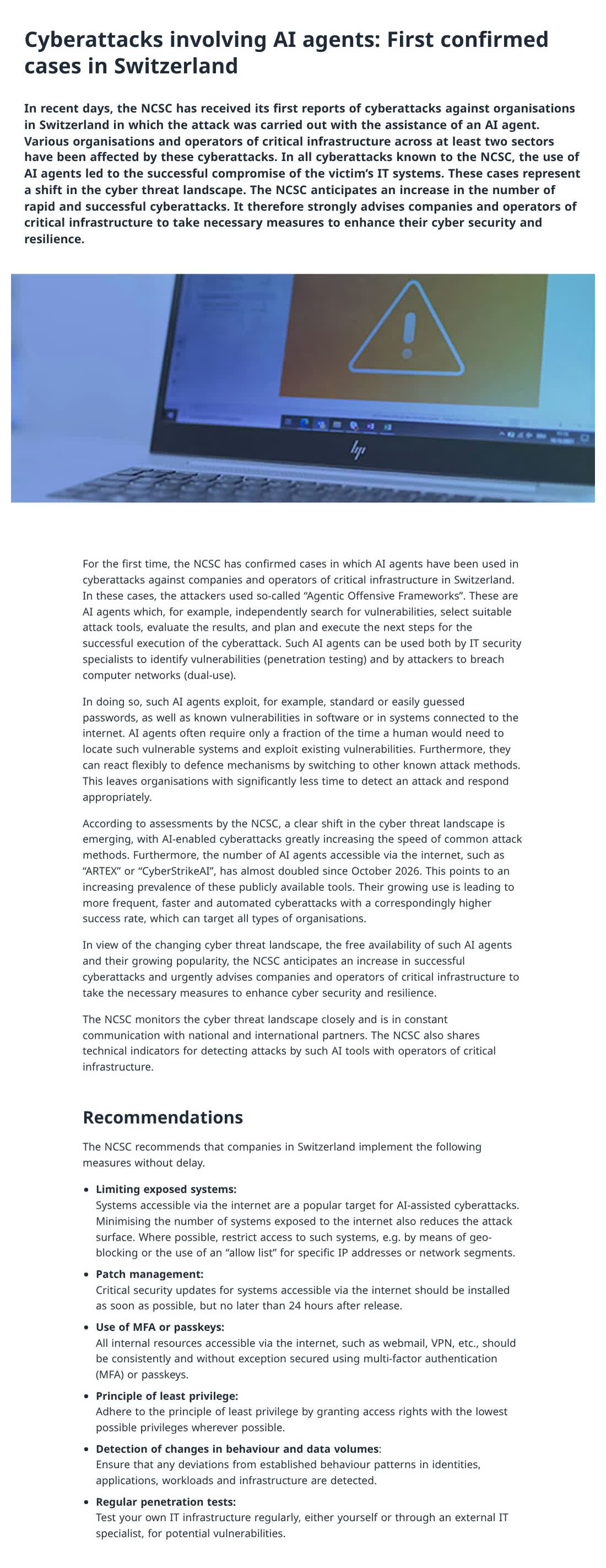 The advisory as published on 24 November 2026. Read it on bacs.admin.ch. Image: Swiss National Cyber Security Centre
The numbers came two days later. Speaking to Swiss public broadcaster SRF, Florian Schütz, director of the Federal Office for Cybersecurity (BACS), which houses the NCSC, said there were five confirmed cases. Four intrusions succeeded.
Schütz also said, as reported by the news agency Keystone-SDA on Swissinfo, that three cases targeted critical infrastructure operators and two of those succeeded. Both outlets say there were no major outages.
Four of five, or all of them? A gap worth noting
The written advisory gives no count, and says every known case led to a successful compromise. The director’s interview says four of five. Neither source explains the difference.
Other things are also unknown. The sectors are not named. SRF lists electricity, water and telecoms, and Swissinfo electricity and drinking water, only as examples of critical infrastructure. They are not confirmed victims. The BACS will not name the organisations; Schütz told SRF that those affected have the right to speak for themselves. The attackers are unidentified.
If you run a small business, the six steps that matter
Small firms were among those who reported, according to SRF, so the advice is aimed at ordinary offices too. The NCSC’s six recommendations, in plain English:
-
Show less to the internet. Limit exposed systems, for example with geo-blocking (blocking traffic from regions you don’t need) or allow lists (letting in only approved addresses).
-
Patch fast. Install critical updates on internet-facing systems within 24 hours of release.
-
Lock every door twice. Use MFA or passkeys on every service reachable from outside, such as webmail and VPN, with no exceptions.
-
Give people only what they need. This is called least privilege.
-
Watch for odd behaviour. Unusual activity or sudden data transfers deserve a look.
-
Test yourself. Run regular penetration tests, yourself or with an outside specialist.
The patch point echoes our look at the patch rush behind November’s outages, where officials suggest rushed fixes may have caused problems too. In another recent case, one step of an attack used a flaw fixed months earlier: see how hackers reached Check Point management servers.
In our reading: a sober warning, not a reason for panic
The good news first. A national agency spoke early, gave numbers in a radio interview two days later and published practical steps. SRF reports that no major outages followed.
The worry is speed. If agents shorten the time between a flaw appearing and being used, a slow update schedule becomes the weak point. Schütz and security expert Raphael Reischuk, co-founder of Switzerland’s National Test Institute for Cybersecurity, both told SRF that companies should use AI for defence too.
On balance, the likelier outcome is more cases, not fewer, and the advice is old advice made urgent. The new “AI-agent attack” is, so far, aimed at old weaknesses. Whether AI agents can slip out of their makers’ control is a separate question, now raised in a US lawsuit over alleged AI agent attacks, where the claims are still unproven.
Today’s habits will matter more than tomorrow’s tools. Check your updates and your logins this week, and watch for the NCSC’s next advisory.
Prefer to watch? Follow us on YouTube
The tech stories that matter, explained in plain words. Subscribe so you never miss one.
Quick answers
What is an AI agent in a cyberattack?
It is software that picks its own tools, checks the results and plans its next step, with little human input. The NCSC says such agents look for weak spots and change method when defenders react.
Was critical infrastructure in Switzerland hit?
Yes. The NCSC says operators of critical infrastructure were affected. Its director told SRF that three of the five cases targeted such operators and two succeeded. The sectors have not been named.
Who is behind the attacks?
Not known. SRF and Swissinfo both report that the attackers have not been identified, and the advisory gives no attribution.
Were the AI attack tools named in the advisory used here?
The advisory names two freely available agents, ARTEX and CyberStrikeAI. It does not say they were used in the Swiss cases.
How can a small business reduce the risk?
Follow the NCSC's six steps: limit exposed systems, install critical updates within 24 hours, use MFA or passkeys, give people least access, watch for odd behaviour, and test your defences.
Words to know
- AI agent
- Software that works toward a goal by choosing tools and next steps itself, instead of following one fixed script.
- Agentic
- Describes AI that acts on its own across several steps. The NCSC calls these attack tools 'agentic offensive frameworks'.
- MFA / passkey
- Multi-factor authentication asks for a second proof beyond your password. A passkey replaces the password with a key stored on your device.
- Patch
- A software update that fixes a security flaw.
Sources (3): every key fact checked against at least two
- Swiss National Cyber Security Centre (NCSC/BACS): Cyberattacks involving AI agents: First confirmed cases in Switzerland (24 Nov 2026)
- SRF: Fünf bestätigte Fälle: Erstmals Cyberangriffe mit KI-Agenten in der Schweiz (26 Nov 2026, German)
- Swissinfo / Keystone-SDA: Switzerland reports first AI-based cyberattacks on critical infrastructure (26 Nov 2026)
Related stories
Florida man gets 47 months for using an AI copy of streamer N3on's voice in a $260,000 crypto fraud
An AI voice scam cost memecoin organisers about $260,000. A Florida man got 47 months in prison. Here is what happened and how to protect yourself.
· 4 min read

Tesla starts rolling out FSD v15 to first owners, and Musk says wide release comes in December
Tesla FSD v15 began reaching early-access owners on 21 November. Release date, HW3 left out, Reality View, and what Tesla has not yet shown.
· 3 min read
Uber, Nuro and Lucid take the safety driver out of their robotaxi, but public rides wait until 2027
The Uber Nuro Lucid robotaxi is now testing with no one at the wheel in four Bay Area cities. Public rides on Uber are planned for Q1 2027.
· 4 min read