Developing story
Did a patch rush cause November's tech outages? Officials point to it; companies have not said so
- US officials say a rush to fix security flaws that AI tools now find faster may be behind some of November's outages.
- No company has said patching caused its own outage, and officials say the outages were not a cyberattack.
- Which patch, if any, broke which system is still unknown, and investigations continue.
- 1,200+Microsoft fixes in NovemberQualys count, via Reuters
- ~100,000Flaws (CVEs) disclosed in 2026 so farVulnCheck, via Reuters
- 1,363Flaws known to be exploited in 2026VulnCheck, via Reuters

Sen. Mark Warner, the Senate Intelligence Committee’s vice chair, said on 17 November that he understood why Americans were concerned. A week of tech outages had hit banks, big software firms and government systems. His view is that they came from organisations rushing to patch security flaws, not from hackers.
That explanation comes from officials and experts, not from any affected company.
The outages came close together, which is why the idea spread. People use these services to pay bills, send email and fly. When many fail in days, people ask why there are so many outages lately.
What officials say about the tech outages and the patch rush
Warner’s statement says AI tools are finding software flaws at a pace that puts a strain on systems not built for it. His statement says the evidence so far “points toward legitimate efforts to secure our systems, not malicious activity”.
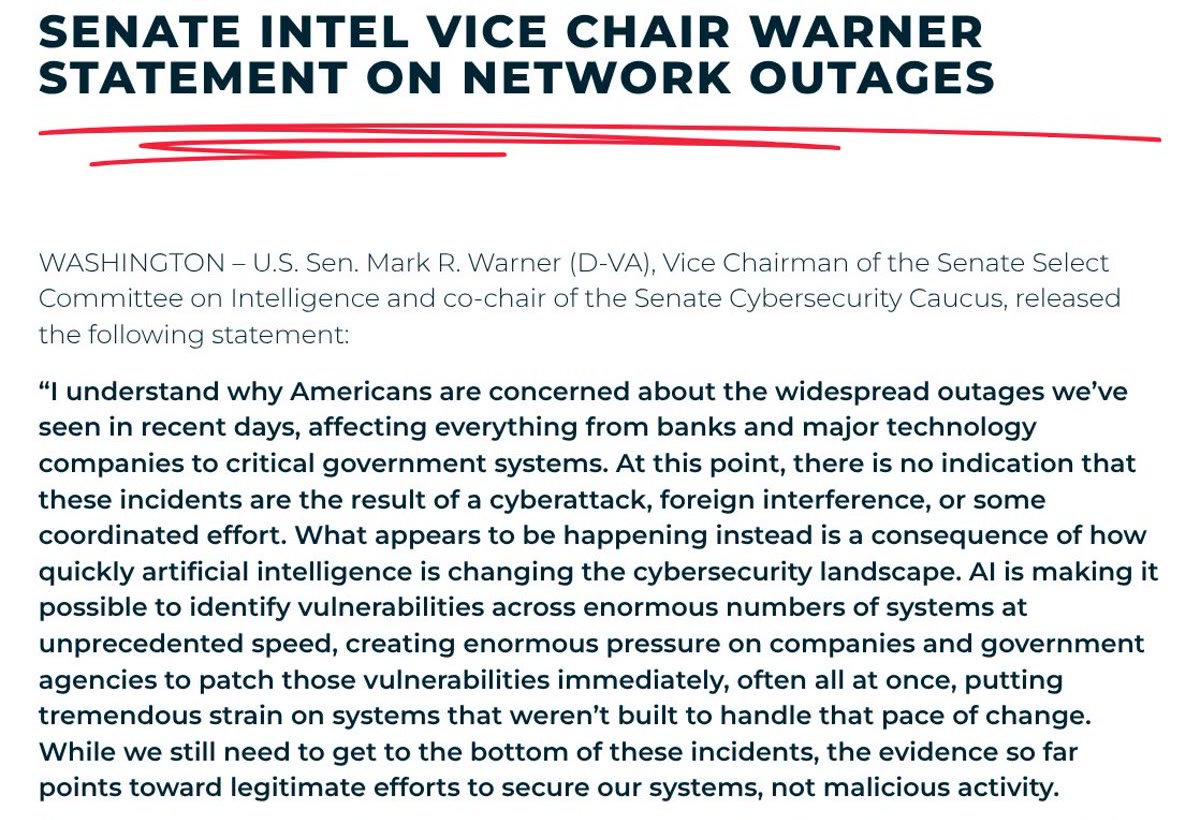
Sen. Mark Warner’s statement on warner.senate.gov. Image: Office of Sen. Mark Warner
Director of National Intelligence Jay Clayton told a House Homeland Security hearing on 18 November that the rate of patching and upgrading is increasing. He said the outages looked like separate events, not a coordinated or state-backed attack. Secretary of State Marco Rubio said patches are at times “creating short-term disruption”, and that there is “zero evidence” of hackers or a nation-state.
Clayton went further on Fox Business a day earlier. He tied the NSA outage to patching flaws in PHP, a widely used web programming language, found the month before. That is his claim. The NSA has said only that its network had “temporary degradation during scheduled routine maintenance”, with mission-critical systems working.
Each company names its own cause, and none names patching
- Chase: a “software bug in on-premise hardware systems”, not a cyber event. Chase posted this on X after our Chase outage report went up.
- Microsoft: a hidden fault from an earlier network upgrade, as our Microsoft 365 outage story explains; Microsoft executive Charles Lamanna dated it to July. Satya Nadella called it “a latent bug”. Speaking generally, he said flaws must now be found, fixed and patched “instantaneously”. Microsoft has not tied this outage to patching.
- Apple: an internal update, according to a statement Apple gave Bloomberg, as our iCloud outage story reported.
- FAA: a router. It saw “zero evidence of anything AI related”.
The Cloud Security Alliance, an industry research group, notes that the patch idea rests largely on anonymous sourcing and that no public evidence ties it to a specific outage.
Rumour: an outlet citing anonymous sources says bank executives and the NSA told Congress that AI-driven patches caused the outages. No bank is named, the NSA had no comment, and we could not confirm it.
The gap between a pattern and a proof
In our reading, the numbers make the idea plausible. Security firm Qualys counted more than 1,200 Microsoft fixes in November, nearly 20 times a year earlier, Reuters reports. That is not an official Microsoft figure. VulnCheck counts about 100,000 flaws disclosed in 2026 so far.
Nikesh Arora, chief executive of Palo Alto Networks, wrote on X that “some of the recent outages are a consequence of a deluge of patches”. One expert told American Banker the idea is plausible for some outages, but he would not tie it to a named company.
If a bank or cloud service stalls on you, a few small safeguards
- Keep a second way to pay and a copy of key files.
- Keep installing updates on your own devices; patches close holes attackers could use. Read any warning your bank or employer sends.
- Be careful with messages that claim to fix an outage, since scammers follow big news.
Homeland Security Secretary Markwayne Mullin said officials would like companies to tell customers before patching, but are “not pressuring” them.
In our reading: speed and care both matter
On balance, the explanation is reasonable but unproven. The good side is real. Faster patching closes doors that attackers could use, and officials say none of these outages was an attack. The risk is that speed without enough testing creates a different kind of failure.
The likelier outcome is a mix of causes. Some outages may trace to old bugs, others to rushed fixes, others to routine faults. It would be unfair to call the companies careless, or to treat a pattern as a verdict. Clear public reports would help most.
The reports still to come
Microsoft has promised a full post-incident report, the FAA’s router is still being examined, and the NSA has not named a cause. Until there is more on the record, the patch rush is the leading theory, not a finding.
Prefer to watch? Follow us on YouTube
The tech stories that matter, explained in plain words. Subscribe so you never miss one.
Quick answers
What caused the tech outages this week?
No single cause. Chase cites a software bug, Microsoft a hidden fault from an earlier upgrade, Apple reportedly an internal update and the FAA a router. Officials say patching may be one thread.
Were the tech outages a cyberattack?
Officials say no. Marco Rubio said there is zero evidence of hackers or a nation-state, and Jay Clayton called them separate outages, not a coordinated or state-backed attack.
Is AI causing the outages?
Not directly, as far as the record shows. The claim is that AI tools find flaws faster, so companies patch faster. The FAA said it saw zero evidence of anything AI related.
Why are there so many outages lately?
It may be chance, or a shared pressure. Officials and experts say a surge in patching may play a part. Nobody has proved this for any one outage.
Words to know
- Patch
- A software update that fixes a problem, often a security flaw.
- Vulnerability
- A weakness in software that an attacker could use.
- CVE
- A public ID number for a known security flaw.
- Latent bug
- A hidden fault that stays quiet until something triggers it.
Sources (11): every key fact checked against at least two
- Sen. Mark Warner: Statement on Network Outages (17 November 2026)
- Nextgov: Security officials tell Congress tech outages are not malicious (November 2026)
- Techlicious: NSA's classified network goes down amid nationwide tech failures
- AP via WRDW: Highly classified NSA communications network is down (17 November 2026)
- Reuters via The Star: Patching in the AI age may underlie some of the major tech outages (19 November 2026)
- Washington Post via The Daily Record: JPMorgan Chase resolves software bug (17 November 2026)
- Dealroom: Nadella at DealBook on the Outlook outage (18 November 2026)
- Cloud Security Alliance: November outage cluster research note
- Foreign Policy: The U.S. Tech Outage Wave, Explained
- Fortune: AI played a major role in the NSA and banking outages, but not in the way you may think (18 November 2026)
- American Banker: The link between Patchmageddon and recent tech outages (19 November 2026)
Related stories
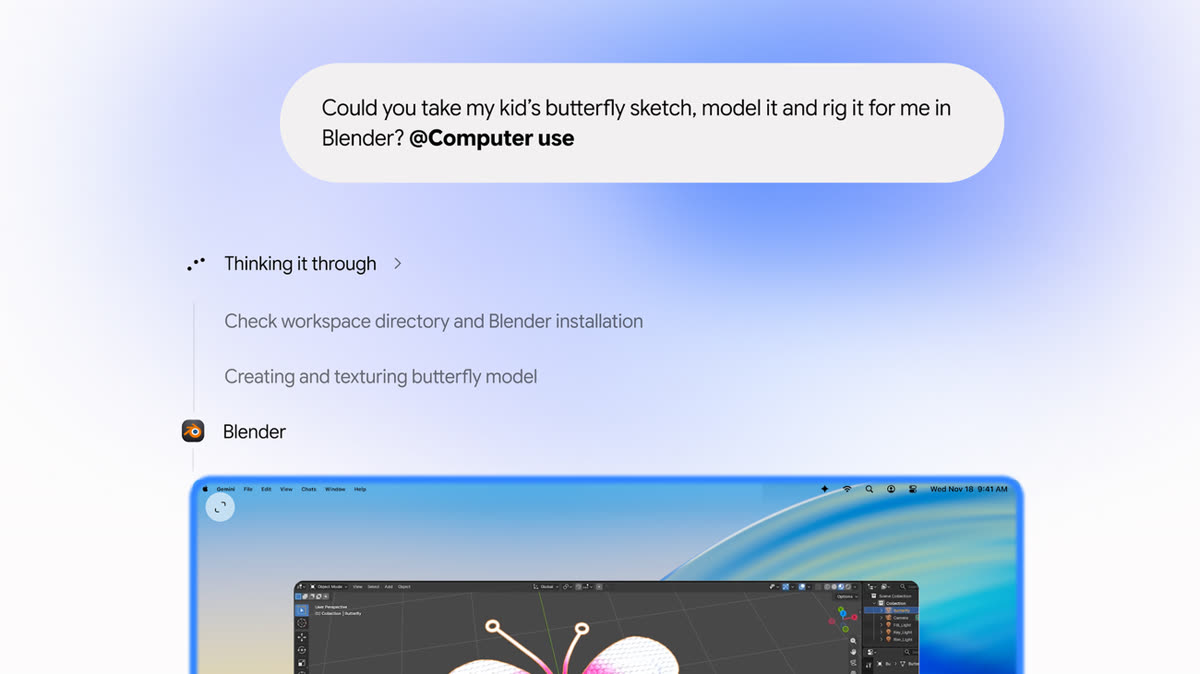
Gemini can now use your Mac for you, but only paying US users get it first
Google's Gemini app for Mac can now click, type and fill forms for you. See who gets computer use, what it needs, what it costs and what to watch.

Inkling 2 Mini: Thinking Machines releases an open AI model small enough for a laptop
Thinking Machines Lab released Inkling 2 Mini, an open-weights AI model for laptops with 32GB of memory. See its scores, weak points and who can use it.
Google's Gemini 4 Neon aims to cost less per task than Carbon, but only paying users can try it
Gemini 4 Neon is Google's new model for coding and analysis. See its price, who gets it, how it compares with Carbon, and which claims are Google's own.