Florida man gets 47 months for using an AI copy of streamer N3on's voice in a $260,000 crypto fraud
- A Florida man was sentenced to 47 months in federal prison for using an AI-cloned voice to pose as streamer N3on and take about $260,000 in crypto.
- He pleaded guilty to money laundering and aggravated identity theft, and was ordered to pay restitution. The amount has not been given.
- The FBI's advice is simple: agree a secret word, call back on a number you found yourself, and slow down when you are pressured.
- 47 monthsFederal prison sentenceUS Attorney's Office
- ~$260,000Crypto sent to his accountsUS Attorney's Office
- 2Charges he pleaded guilty toUS Attorney's Office
- 1AI voice recording used as proofUS Attorney's Office
Picture the organisers of a new memecoin, waiting for a yes. Then a voice recording arrives, and it sounds like the popular streamer N3on, confirming the deal. The money was sent. It was an AI voice scam.
On 24 November, the US Attorney’s Office for the Southern District of Florida announced that David Anthony Sanchez was sentenced to 47 months in federal prison. The Port St. Lucie man had used an AI-generated copy of the streamer’s voice to pose as him and take about $260,000 in cryptocurrency, the office said. He pleaded guilty to money laundering and aggravated identity theft.
In our reading, it matters because the fraud itself was ordinary. One AI voice clip was enough to make it believable.
How a fake voice sealed a real deal
According to the release, he created online accounts designed to look like N3on’s. He spoke with the project’s organisers while posing as the streamer and as the streamer’s representative. He signed agreements using N3on’s identity. To “confirm” the deal, he sent an AI-generated recording that copied N3on’s voice.
Note what is not in the story. The release and the reports we checked describe no video call and no fake face. The tools were fake accounts, paperwork and one convincing audio clip.
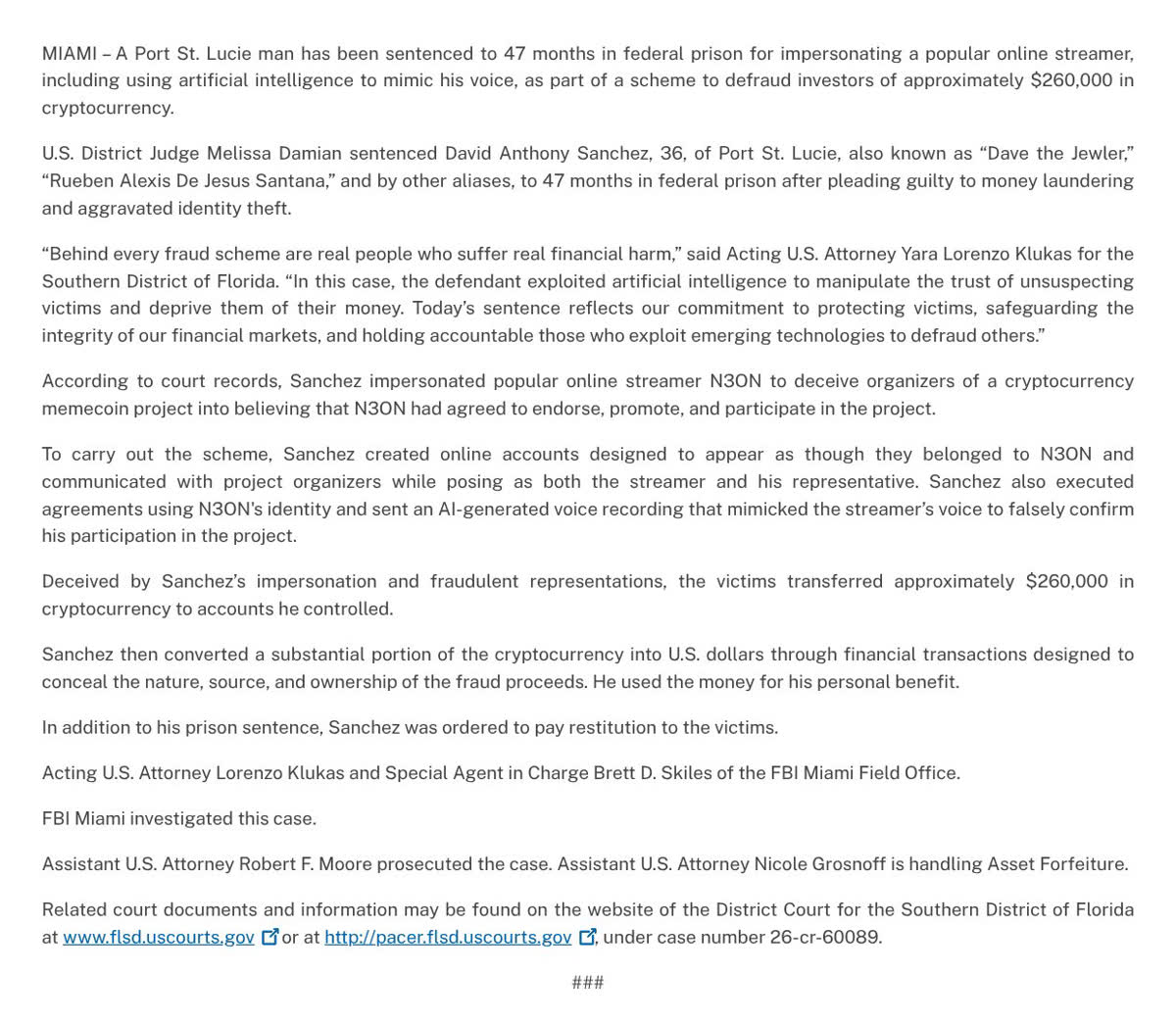 The full press release of 24 November 2026. Read it on justice.gov. Image: US Attorney’s Office, Southern District of Florida
The victims then sent the crypto to accounts he controlled. He turned much of it into US dollars through transactions meant to hide where it came from, and spent it on himself, the release says. The court ordered restitution to the victims, but no amount is stated. Neither is the name of the memecoin.
Acting US Attorney Yara Lorenzo Klukas said: “Behind every fraud scheme are real people who suffer real financial harm.” The FBI Miami Field Office investigated. Aftermath says it has no comment from N3on.
Why a memecoin scam is an easy target for a voice clone
In our reading, an AI voice clone only needs a deal that moves fast, and people who cannot easily check who is on the other end. A memecoin scam fits that pattern: the money moves in crypto, the deals are often agreed online, and a famous name speeds up trust.
What we do not know is how the clip was made, which tool was used, or how long the scheme ran. The release does not say, and we will not guess. We weighed the good and bad of human-sounding AI voices in our report on a voice model built to sound human.
How to spot an AI voice scam, the FBI way
The FBI’s Internet Crime Complaint Center (IC3) has public advice that fits this case. None of it needs special software.
- Agree a secret word or phrase with family, friends or colleagues, and ask for it when a request feels off.
- Hang up and call back on a number you find yourself, not the one that contacted you.
- Never send money or crypto to someone you know only online or by phone.
- Slow down when you are pressured. Urgency and strong emotion are warning signs.
- Check small details: names, email addresses, phone numbers and links that are slightly changed.
The FBI also says voice clones can sound almost identical to the real person. So the first rule of how to spot deepfake audio is simple: treat a voice as a clue, never as proof.
For business deals, confirm through a verified channel, such as an official agent’s email or the creator’s verified account, before any money moves. These same habits are the core of how to spot deepfake scams of any kind. For another crypto case with the FBI involved, see how the FBI named North Korea’s TraderTraitor in the Binance hack.
A calm reading of a hard case
In our reading, there is real good news here. A court has punished a fraud built on a stolen identity, AI voice included, and the sentence tells people that AI does not make a fraud harmless. Victims also got a restitution order, though we do not yet know how much they may recover.
There is a limit, too. One sentence does not make the next fake voice easier to spot. The likelier outcome is that cases like this will keep appearing. On balance, the best protection is a habit, not a gadget: verify through a second channel, every time, before money moves.
Courts can punish after the fact. A secret word and a call-back take seconds, and they can save you before it happens.
Prefer to watch? Follow us on YouTube
The tech stories that matter, explained in plain words. Subscribe so you never miss one.
Quick answers
What is an AI voice scam?
A scammer uses a cloned voice, made with AI, to sound like someone you trust. In this case it was used to 'confirm' a business deal.
How do I spot a voice-clone scam?
Listen for odd tone or word choice, and pause if you feel rushed. Hang up and call back on a number you find yourself. The FBI also suggests agreeing a secret word with family or colleagues.
Was there a deepfake video call in the N3on case?
No. The official release describes fake accounts, signed agreements and an AI-generated voice recording. It does not mention video.
Has N3on commented on the sentence?
Not in the reports we found. Aftermath says it has no comment from him.
Words to know
- Voice clone
- An AI-made copy of a real person's voice that can say words they never said.
- Memecoin
- A cryptocurrency built around an internet joke, brand or personality. Prices can swing sharply.
- Restitution
- Money a court orders a convicted person to pay back to the victims.
Sources (5): every key fact checked against at least two
- US Attorney's Office, Southern District of Florida: Port St. Lucie Man Sentenced to 47 Months in Prison for Using AI to Impersonate Popular Streamer (24 Nov 2026)
- FBI IC3 public service announcement I-120324-PSA (3 Dec 2024)
- FBI IC3 public service announcement I-072026-PSA (20 Jul 2026)
- Aftermath: N3on impersonator AI prison $260,000 (25 Nov 2026)
- Engadget: Man sentenced to 47 months after using AI to impersonate streamer (26 Nov 2026)
Related stories

Tesla starts rolling out FSD v15 to first owners, and Musk says wide release comes in December
Tesla FSD v15 began reaching early-access owners on 21 November. Release date, HW3 left out, Reality View, and what Tesla has not yet shown.
· 3 min read

Uber, Nuro and Lucid take the safety driver out of their robotaxi, but public rides wait until 2027
The Uber Nuro Lucid robotaxi is now testing with no one at the wheel in four Bay Area cities. Public rides on Uber are planned for Q1 2027.
· 4 min read
UN talks on 'killer robots' end with two more years of discussion, not a treaty
Autonomous weapons treaty talks in Geneva ended with no negotiation mandate, only two more years of expert work. What was agreed and what to watch.
· 4 min read