Developing story
Hackers got inside Check Point management servers at 22 organisations, GreyNoise says
- GreyNoise says an unknown group, GT13, broke into Check Point management servers at 22 organisations in 17 countries from 17 October to 2 November.
- How they first got in is unknown. One step used CVE-2026-16232, patched in July. Check Point had not commented as of 24 November.
- Admins should install the newest hotfix, limit who can reach the server and check logs. The victims have not been named.
- 22Organisations hit, per GreyNoiseIn at least 17 countries
- 24Servers with data copiedGreyNoise's own count
- 99IP addresses used by the attackersVPN exits or hijacked devices
- 9.3CVSS score of CVE-2026-16232Out of 10; Check Point's rating
Imagine the console that decides what your firewalls allow, quietly open to someone else for weeks. Security firm GreyNoise says that happened at no fewer than 22 organisations. It says an unknown group it calls GT13 copied data from 24 servers, using a known Check Point flaw along the way. How the attackers first got in is still unknown.
Check Point had not commented as of 24 November, according to BleepingComputer and Cybersecurity Dive. The main claims so far come from one company.
Why a Check Point management server vulnerability matters most
A Check Point Security Management Server is the control room for firewalls. Whoever controls it can read the rules, change them or switch protection off.
GreyNoise says GT13’s confirmed activity ran from 17 October to 2 November, in 17 countries. It lists financial services, energy, government, transportation, mining, engineering and manufacturing, with no clear pattern. GreyNoise found 99 IP addresses in use, some of them VPN exits and some hijacked devices.
What GreyNoise says the attackers did
Between 20 and 26 October, GreyNoise says, the attackers ran more than 100 tasks on several servers. They copied firewall databases and internal certificate authority files, created a new certificate, and unloaded security policies, which switches off firewall protection. A bulk certificate task on 26 October failed on 24 servers, and the errors helped GreyNoise warn victims.
GreyNoise says one step used CVE-2026-16232, a SmartConsole login bypass. The flaw itself is confirmed by Check Point: in July it said an attacker with no login could get a token and sign in with full admin rights. It scored the flaw 9.3 out of 10, said it was already exploited against a handful of customers, and released a hotfix on 22 July.
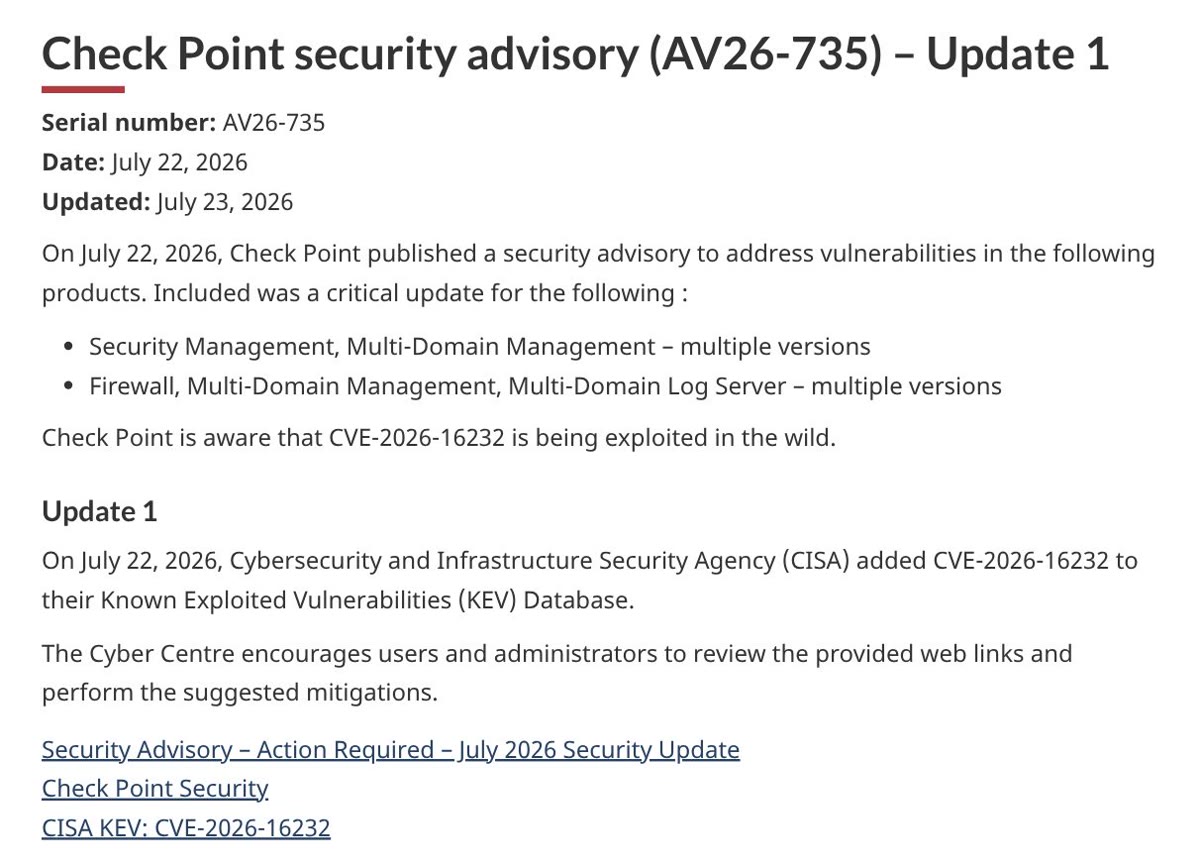 This is Canada’s July 2026 advisory about the flaw itself, not about the new campaign. It says Check Point is aware the flaw is exploited and that CISA added it to its exploited-flaws list on 22 July. Source: Canadian Centre for Cyber Security. Image: Canadian Centre for Cyber Security
The question nobody can answer yet
GreyNoise is clear on one point. The attackers already had access to the Check Point servers before they took over a file server they later used as a relay. GreyNoise “could not determine when or how” they got in. So a flaw used late in the chain does not show it was the way in.
GreyNoise also lost sight of the group on 2 November. Because the attackers had persistent access, it expects the campaign to continue. It says it is working with government partners and national response teams to notify victims.
What admins should do now
- Install the hotfix: R82.10 Take 36 or later, R82 Take 118 or later, or R81.20 Take 158 or later. No fix is listed for end-of-support versions such as R81.10 and R81, so plan to move off them.
- Check Point also warned in September of a separate exploited management flaw, CVE-2026-93616, fixed in later Takes, so install the newest jumbo hotfix rather than the minimum. Nobody has linked that flaw to this campaign.
- Set Trusted Clients to known addresses, never “Any”.
- Keep the management server off the open internet.
- Search SmartConsole audit logs for the login method “application token” from unknown admins or addresses.
- Compare against the indicators in sk185169 and in GreyNoise’s report.
Check Point says Smart-1 Cloud customers were already protected from CVE-2026-16232.
If you are only a customer of one of these firms
You cannot patch a company’s firewall, and the victims have not been named. GreyNoise describes stolen firewall settings and security certificates, not customer records, but it saw only part of the attack, so whether anything more was taken is not known. Good habits still help: a password manager, two-step login, and care with unexpected messages.
Why the patch was the easy part
In our reading, there are two sides. The good: the flaw was disclosed, fixed and listed by the US government in July, and a private firm shared its findings in detail, including clues admins can check. The harder side: a patch does not remove someone who is already inside. A server open to this Check Point management server vulnerability before 22 July needs its logs, certificates and credentials reviewed, not just an update.
The open gap is trust in a single source. GreyNoise’s account is detailed and three news outlets have reported it, but no one else has confirmed the campaign, Check Point included. In our reading, the sensible course today is to treat it as credible and act, while waiting for the vendor’s own words. As with PHP’s seven critical flaws and the Chainalysis breach, installing the fix is only the first step.
Watch for a statement from Check Point, and for how the attackers got in.
Prefer to watch? Follow us on YouTube
The tech stories that matter, explained in plain words. Subscribe so you never miss one.
Quick answers
What is Check Point SmartConsole used for?
It is the desktop app that administrators use to manage a Check Point Security Management Server, the central console that sets the rules for a company's firewalls.
Was Check Point itself breached?
Nothing published says so. GreyNoise describes break-ins at customers' own management servers. Check Point had not commented as of 24 November.
How did the attackers first get in?
Nobody knows yet. GreyNoise says it could not tell when or how they gained access to the Check Point servers.
Is there a Check Point management server vulnerability I should patch?
Yes. CVE-2026-16232 has a fix in Check Point's July hotfixes. Check Point says it only affects servers reachable from the internet without a Trusted Clients limit. Install the newest hotfix, which also covers a separate September flaw, CVE-2026-93616.
How do I know if my server was hit?
Check SmartConsole audit logs for the login method "application token" from unknown admins or addresses, and compare against the indicators in Check Point's sk185169 and GreyNoise's report.
Words to know
- Security Management Server
- The central console that sets the rules for a company's Check Point firewalls.
- Authentication bypass
- A flaw that lets someone log in without valid credentials.
- Trusted Clients
- The list of computers allowed to connect to the management server.
- Jumbo hotfix
- Check Point's bundled update package, released in numbered Takes.
- Indicators of compromise
- Clues, such as addresses, domains or log lines, that a system was attacked.
- CISA KEV
- A US government list of flaws known to be exploited, with patch deadlines for federal agencies.
Sources (9): every key fact checked against at least two
- Check Point: Security Advisory, July 2026 Security Update (22 July 2026)
- Check Point support: sk185169 (CVE-2026-16232)
- Canadian Centre for Cyber Security: Check Point security advisory AV26-735
- Check Point: Security Advisory, CVE-2026-85102 and CVE-2026-93616 (22 September 2026)
- GreyNoise: An Active Intrusion Campaign Against Check Point Security Management Servers
- BleepingComputer: Hackers compromise Check Point servers in 22 organizations
- SecurityWeek: Check Point security management servers hacked
- Cybersecurity Dive: Campaign targets Check Point security management servers
- Rapid7: CVE-2026-16232 exploited in the wild
Related stories

GitLab patches Ruby2Shell, and GnuPG fixes a GPGME flaw: who needs to update
GitLab's critical patch release fixes Ruby2Shell, and GnuPG fixed a GPGME flaw the same day. Who must update, and how: a GitLab security update guide.

Tidal AI ban: fully AI songs will be removed from 9 December, and AI-assisted ones stay
Tidal AI ban: from 9 December, songs Tidal judges 100% AI-generated are rejected and removed. What changes for listeners and independent artists.
FBI hacked again? Reports say hackers reached the police crime database, as USDA fights a breach
FBI hacked again? CNN reports a break-in at NCIC, the police crime database, and USDA is recovering from a cyber attack. Here is what is confirmed.