India's NVS-03 satellite clears the step where its sister NVS-02 failed
- ISRO's GSLV-F18 rocket launched the NVS-03 navigation satellite from Sriharikota on 30 October 2026 at 23:51 India time.
- On 31 October the satellite fired its own engine for 2,174.8 seconds to raise its orbit, and ISRO says its health is normal.
- That is the step where NVS-02 got stuck in 2025. More burns and tests must follow before NavIC can use it.
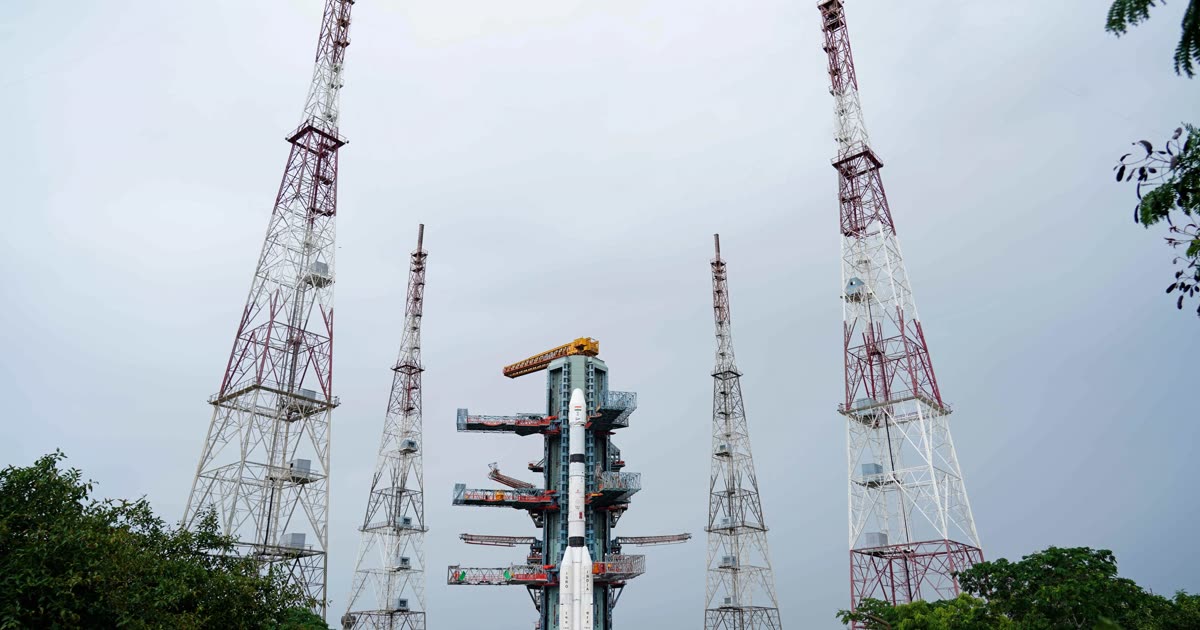
For about 36 minutes on Saturday, a small engine burned high above the Earth. Last year, at this same moment, a sister satellite’s engine never got its fuel. This time the burn finished. ISRO’s update carried four calm words: “satellite health is normal.”
The NVS-03 satellite is India’s newest navigation satellite, part of NavIC, the country’s own version of GPS. A GSLV rocket launched it from Sriharikota late on 30 October. On 31 October it passed its first orbit-raising burn, the exact step where NVS-02 got stuck in 2025.
ISRO shared its official video of the mission:
Why does one engine burn matter so much? Because NavIC has been short of working satellites. In July, Dr Jitendra Singh, India’s Minister of State for Space, gave a written reply to the Lok Sabha, India’s lower house. Basic positioning needs at least four working satellites, he said, and NavIC had three. NVS-03 is the satellite meant to close that gap.
From launch pad to a higher orbit in 17 hours
Here is what ISRO and independent reports confirm:
- The launch: GSLV-F18 lifted off at 23:51 India time on 30 October (18:21 UTC). It was the 20th flight of the GSLV rocket, from the Second Launch Pad at the Satish Dhawan Space Centre.
- The first orbit: the rocket left the satellite in a long, oval path, from 170.3 km to 38,080 km above the Earth.
- The burn: on 31 October the satellite’s own main engine, the Liquid Apogee Motor, fired for 2,174.8 seconds. ISRO says it finished at 16:48 India time.
- The new orbit: about 5,477.6 km by 37,833.4 km. More burns in the coming days will take it to its fixed slot at 111.75° East.
- The satellite: about 2,250 kg, with an atomic clock built in India plus clocks bought abroad. It adds a new L1 signal to NavIC’s L5 and S-band signals. It covers India and about 1,500 km beyond its borders.
Why the NVS-03 satellite’s real test came after launch
NVS-02 had a clean launch in January 2025. Then, during orbit raising, the valves that feed oxidiser to its engine did not open, and it stayed in the wrong orbit. ISRO’s review, as reported by The Week, traced this to a loose contact in a connector. The same report says the minister has called the fault fixed and tested on a later satellite.
NVS-03 has now passed that point. What we don’t know yet is the date it will start serving users. More burns and in-orbit tests come first, and ISRO has not given a timeline.
If your phone already uses satellites to find you
Most readers never think about which satellites guide their map app. Modern phones listen to several systems at once: America’s GPS, Europe’s Galileo, China’s BeiDou, Russia’s GLONASS and, in some phones, India’s NavIC. More satellites overhead usually means a faster, steadier fix, especially in crowded cities.
NavIC also matters beyond phones. Satellite signals keep time for power grids, banks and phone networks, and guide ships and planes. Countries build their own systems so they are not fully dependent on someone else’s. The new L1 signal is the one most phones already listen to for GPS, so, according to The Week, it should help more everyday devices pick up NavIC.
For now, nothing changes on your screen. If you are in India or nearby, watch for ISRO’s notice that NVS-03 has reached its slot and joined the service.
A careful recovery, not yet a finished one
There is a lot to credit here. ISRO studied a painful failure, traced its cause and has now cleared the same step in orbit. That is how good engineering teams recover. The home-built atomic clock also matters, because clock failures hurt earlier NavIC satellites, such as IRNSS-1A in 2016.
On balance, though, this is one step, not the finish. Four working satellites is the bare minimum, and a system with no spare is fragile. In practice, navigation systems stay reliable only when launches keep pace with satellites wearing out. The minister has said NVS-04 and NVS-05 are in their final stages, The Week reports. Space runs on a long clock everywhere: Japan’s MMX mission to Phobos won’t bring its soil home until 2031. The likelier outcome is steady progress, as long as the next satellites follow on time.
The next sign to watch is quiet: an ISRO note saying the NVS-03 satellite has reached 111.75° East. When that comes, India’s own map in the sky will have its fourth working satellite back.
Sources (8): every key fact checked against at least two
- ISRO: Orbit manoeuvring of NVS-03 spacecraft (31 Oct 2026)
- ISRO: GSLV-F18/NVS-03 mission
- ISRO: GSLV-F18/NVS-03 mission brochure
- Deccan Chronicle: NVS-03 completes first orbit-raising manoeuvre, functioning normally
- The Week: ISRO GSLV-F18 NVS-03 launch (30 Oct 2026)
- Business Today: Centre acknowledges NavIC standalone navigation gap (30 Jul 2026)
- All India Radio News: NVS-02 satellite encounters technical glitch during orbit-raising manoeuvre (3 Feb 2025)
- ISRO Official on YouTube: GSLV-F18/NVS-03 mission
Related stories

Bones may help the body age well: loading them added 9% to old mice's lives
Does exercise slow aging? In a mouse study, loading the shin bone of old mice added 9.4% to their lives and pointed to a bone protein called PEDF.

Even birds get jet lag: fast flights skew seabirds' Sun compass, Oxford study finds
Do birds get jet lag? GPS tracks of 1,045 Manx shearwaters show fast east-west flights throw their body clock off and nudge their Sun compass off course.
NASA asks companies how to save Hubble: boost it higher, upgrade it, or bring it down safely
A Hubble reboost is back on the table. NASA asks companies to lift, upgrade or safely retire the telescope, with a mission needed by 2032. Here's why.