Inkling 2 Mini: Thinking Machines releases an open AI model small enough for a laptop
- Thinking Machines Lab released Inkling 2 Mini on 20 November 2026, a free open-weights AI model built to run on a laptop.
- Artificial Analysis scores it 20 on its Intelligence Index, level with a model about five times larger in active size, at a lower cost per task.
- To run it yourself you need a Mac with 32GB or more of memory or an NVIDIA DGX Spark, and the model card lists clear weak points.
- 26.4BTotal parametersThinking Machines
- 5.4BActive, counting the loops3.4B per word without loops
- 20Artificial Analysis Index scoreLevel with Qwen3.8 27B
- $0.59Cost per Index taskvs $3.53 for Qwen3.8 27B

Thinking Machines Lab released an AI model on 20 November 2026 that it says is “small enough to run on your laptop.” It is called Inkling 2 Mini, and the weights are free to download. For anyone who would rather keep their data on their own machine, that is the part worth a closer look.
Local AI has mostly meant a trade: smaller models that fit on your device, and weaker answers. Inkling 2 Mini is an attempt to narrow that gap, and an independent benchmarker has put a number on how far it gets.
Thinking Machines’ announcement on thinkingmachines.ai. Image: Thinking Machines Lab
Inkling 2 Mini is a 26 billion parameter model that loops back on itself
Inkling 2 Mini reads text and images and writes text. It has 26.4 billion parameters in total, the numbers a model learns during training. The company’s post and model card say about 3.4 billion are active per token (a word or part of a word), or 5.4 billion counting the loops. The weights come under the Apache 2.0 licence, per the model card, which allows commercial use.
The loops are the unusual part. This is a looped transformer: the model stores 24 layers, but runs the middle 12 three times for every word. Think of rereading the same pages three times instead of carrying a thicker book. The file is about 20GB, and the context window, how much text it can hold at once, reaches 1 million tokens.
You can get it on Hugging Face, through Thinking Machines’ Tinker service, or with tools such as Ollama, vLLM, SGLang, Unsloth and llama.cpp.
What the independent scores say, and what the company says
Artificial Analysis, an independent benchmarker, scores Inkling 2 Mini 20 on its Intelligence Index, level with Qwen3.8 27B at its “xhigh” reasoning setting. The index blends nine tests across knowledge work, coding, science and general reasoning, and about 60% of it comes from private or held-out test sets. Artificial Analysis says the model costs $0.59 per index task against $3.53, and finishes in 9.0 minutes against 38.2. It also writes about 38% more output tokens. It is not the top model overall: GPT-6 Luna at its maximum setting scores 28, for $0.15 per task.
Scores as published in Thinking Machines' table; Artificial Analysis rounds both top scores to 20. Source: Hugging Face: Inkling-2-Mini model page (Thinking Machines)
Thinking Machines’ own benchmark table, reported by the company itself, shows 48.2% on DeepSWE v1.1 against 42.2% for Qwen3.8 27B, and 79.2% against 77.8% on SWE-bench Verified. It also shows the model behind on Terminal Bench v2.1 (71.6% against 73.0%) and on AA-Omniscience non-hallucination (63.4% against 71.4%). Those cover command-line tasks and avoiding made-up facts.
What the model card warns about, and what is still unclear
The company’s own model card is plain about limits. The model has weaker factual recall, can loop in long reasoning, and is weaker outside English. It is less reliable with tools and may take destructive actions without asking. It also advises against using it for medical, legal or safety-critical decisions without extra fine-tuning, careful checks and human oversight.
Two things are still unclear. Artificial Analysis lists a price of $0.15 per million input tokens and $0.50 per million output tokens, but Thinking Machines’ own pricing page does not show the model yet. And there is no official speed figure for Macs, so “runs on a laptop” does not yet tell you how fast.
If you want to run it yourself, check your memory first
Here is the catch for most readers. The 32GB memory floor rules out most ordinary laptops, and a DGX Spark is a specialist machine. If your device qualifies, you get an offline assistant with no per-use fees and with your data staying put. If it doesn’t, the hosted route exists, though then your data leaves your device. On a Mac with 32GB or more, Thinking Machines lists Ollama as one way to run it.
Our earlier story on Meta’s Muse Spark Open on two Mac Studios showed a much larger model that needs far pricier hardware. Inkling 2 Mini sits at the gentler end of that range.
In our reading, a useful step with honest limits
The good news is real. A model with open weights, a permissive licence and a size that fits one machine is more accessible than most. The independent score suggests it keeps pace with a bigger rival at a lower cost per task.
The cautions are just as real. Benchmark scores are one view, the company’s own table mixes wins and losses, and the model card tells you not to trust it blindly with tools. In our view, the likelier outcome is that it suits careful tinkerers and privacy-minded teams first, with ordinary users following as memory gets cheaper.
Watch for Thinking Machines’ own price listing, and for real speed numbers from people running it at home.
Prefer to watch? Follow us on YouTube
The tech stories that matter, explained in plain words. Subscribe so you never miss one.
Quick answers
What is Inkling 2 Mini?
It is an open-weights AI model from Thinking Machines Lab, released on 20 November 2026. It reads text and images, writes text, and is built to run on a laptop.
Can I run Inkling 2 Mini on my laptop?
Only on a high-end one. Thinking Machines and Hugging Face name an Apple silicon Mac with 32GB or more of memory, or one NVIDIA DGX Spark. The file is about 20GB.
Is Inkling 2 Mini free to use?
The weights are free to download from Hugging Face under the Apache 2.0 licence, per the model card. You pay only if you use it through a hosted service.
How does it compare with Qwen3.8 27B?
Artificial Analysis gives both a score of 20 on its Intelligence Index. It says Inkling 2 Mini costs about six times less and runs about four times faster per Index task.
Words to know
- Active parameters
- The part of a model's numbers that does the work on each word. Fewer active parameters usually means less memory and power.
- Open weights
- The trained model files are public, so you can download and run them yourself. It is not always the same as open source.
- Looped transformer
- A design that reuses some of its layers several times for each word, instead of storing more layers.
Sources (7): every key fact checked against at least two
- Thinking Machines Lab: Introducing Inkling 2 Mini (official post)
- Thinking Machines Lab: Inkling 2 Mini model card
- Hugging Face: Inkling-2-Mini (model page)
- Artificial Analysis: Inkling 2 Mini
- Artificial Analysis: Intelligence Index v5 method
- Hugging Face blog: Inkling 2 Mini
- TestingCatalog: Thinking Machines releases Inkling 2 Mini
Related stories
Did a patch rush cause November's tech outages? Officials point to it; companies have not said so
Tech outages hit banks, Microsoft, Apple and the NSA in one week. Officials point to a patch rush. No company has said so. Here is what we know.
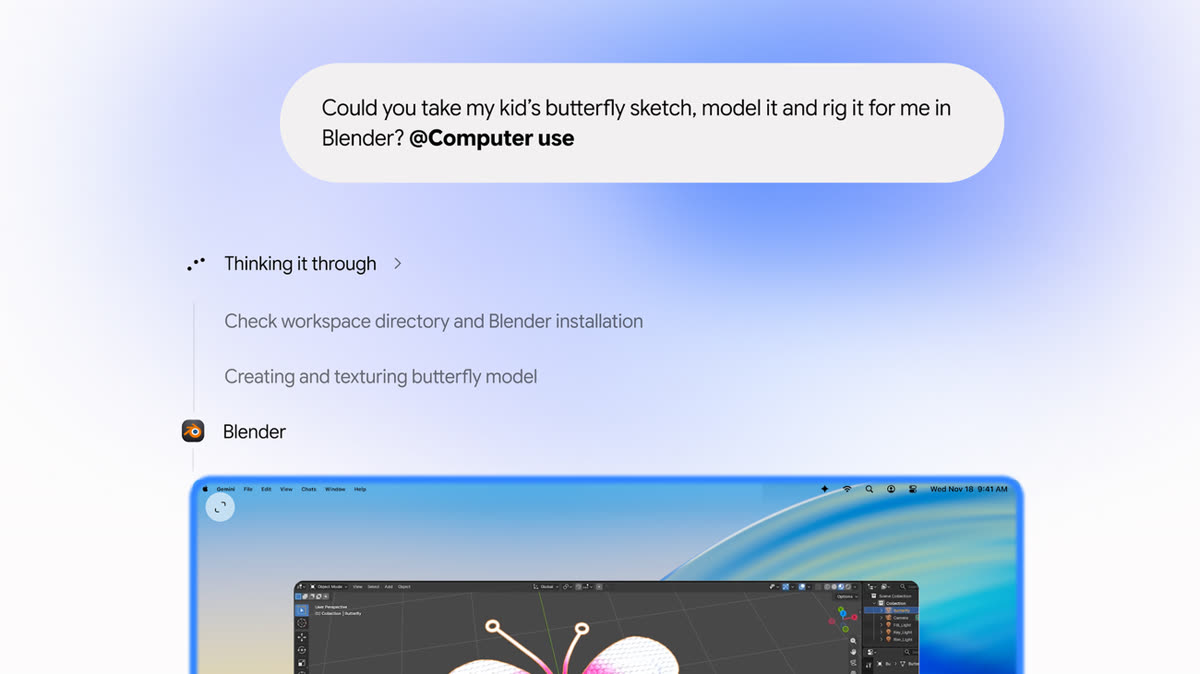
Gemini can now use your Mac for you, but only paying US users get it first
Google's Gemini app for Mac can now click, type and fill forms for you. See who gets computer use, what it needs, what it costs and what to watch.
Google's Gemini 4 Neon aims to cost less per task than Carbon, but only paying users can try it
Gemini 4 Neon is Google's new model for coding and analysis. See its price, who gets it, how it compares with Carbon, and which claims are Google's own.