Developing story
Google's Gemini 4 Neon aims to cost less per task than Carbon, but only paying users can try it
- Google released Gemini 4 Neon on 18 November, a model that sits between its top-end Carbon and its fast everyday Hydrogen.
- The API costs $3 per million input tokens and $15 per million output. It is for paid plans only: Google AI Pro and Ultra, and paying developers.
- Most benchmark scores, and the 32% lower cost per task than Carbon, are Google's own figures. No independent hands-on test has appeared yet.
- $3 / $15Per million input / output tokensGemini API price, per Google
- 32%Lower cost per task than CarbonGoogle's own claim, default setting
- 61Artificial Analysis score, rank #3Google's figure, highest setting
- 1MTokens of contextGoogle blog and model card
Gemini 4 Neon costs $3 per million input tokens and $15 per million output tokens, and only paying users can try it. On 18 November, Google released the model for coding, analysis and long agent tasks. It is a third Gemini 4 option for people who want strong results without Carbon’s bill.
This matters because the Gemini 4 family now has a clear ladder. Carbon is the premium tier, Hydrogen is the quick everyday one, and Neon sits between them. Google’s own line is that “Neon balances depth and efficiency.”
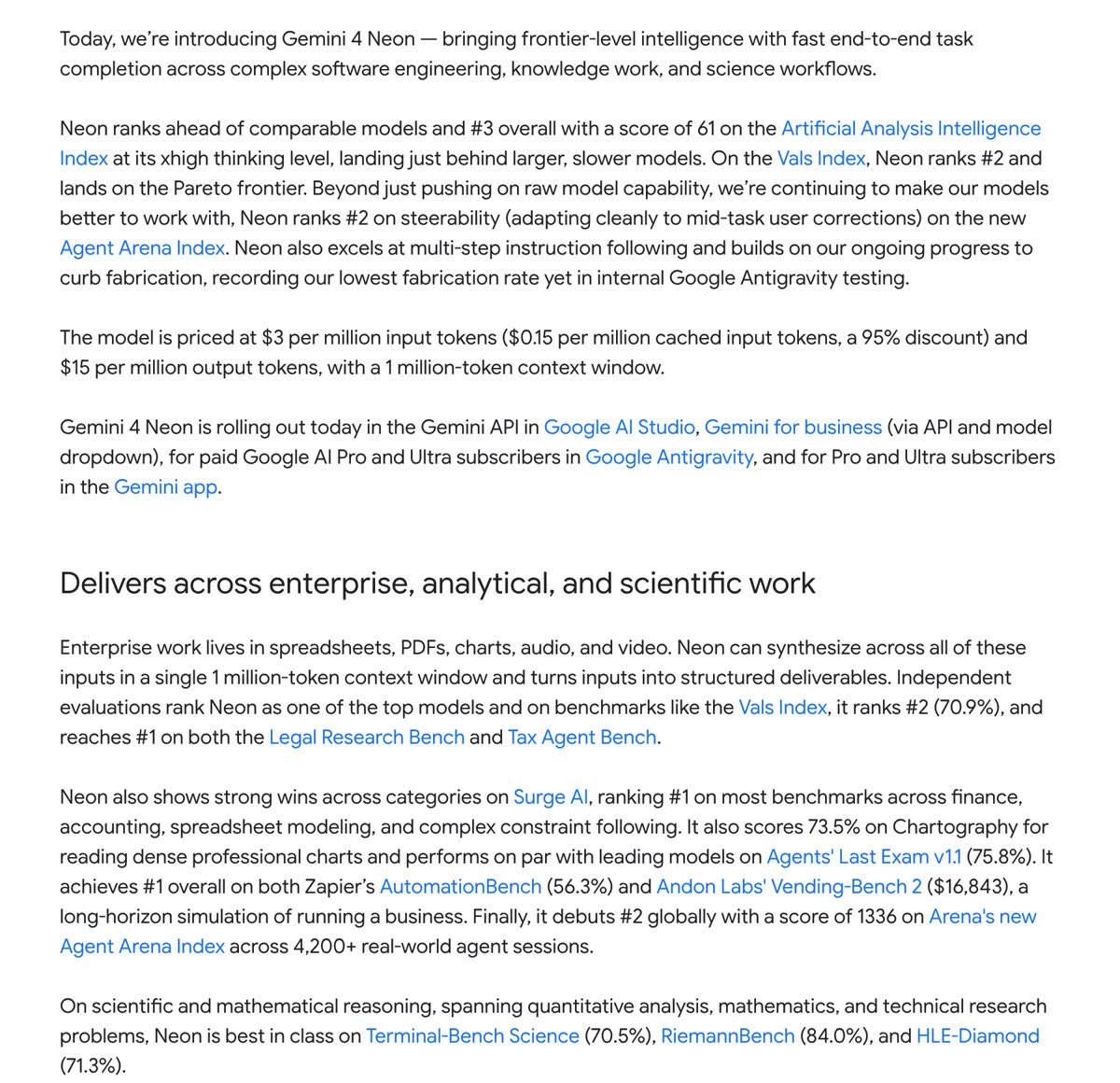 The opening of Google’s announcement, from Google’s blog. Image: Google
The price, the plans and the one-million-token window
Google lists Neon’s price at $3 per million input tokens and $15 per million output tokens. Cached input, text the model has already seen, costs $0.15, a 95% discount. iClarified reports the same rates. The context window is one million tokens. Google’s API pricing page (checked 19 November) lists the same prices, and shows Neon as not available on the free tier.
It is rolling out in the Gemini API’s paid tier in Google AI Studio, in Gemini for business, in Google Antigravity for paid AI Pro and Ultra subscribers, and in the Gemini app for Pro and Ultra. Free users are not included. Google gives no country list, so check your own plan.

In Antigravity it can act as an Orchestrator that plans the work while Hydrogen handles routine steps. That differs from our Hydrogen story, where Carbon did the planning.
What Google says Neon can do, and what it leaves open
Almost every number here is Google’s own. It says Neon scores 61 on the Artificial Analysis Intelligence Index at its highest thinking level, ranking third, and second on the Vals Index. It also reports 65.2% on Terminal-Bench 4.1, a coding test. Google credits much of one coding gain to its Antigravity tool. Both iClarified and BigGo report that other models edged Neon on a few tests.
The headline claim in the Neon-versus-Carbon comparison is that Neon costs 32% less per task at its default setting. That is Google’s figure, and it measures whole tasks, not tokens. Until 30 November, Carbon’s introductory $2 and $10 is cheaper per token. From 1 December Carbon rises to $4 and $20, as we covered in our Carbon rollout story.
Google's published Gemini API prices, checked 19 November 2026. Carbon's price changes on 1 December. Source: Google AI for Developers: Gemini API pricing
Safety needs care too. Google reports a 0.09% misaligned-action rate (how often it acts against its instructions) and says Neon resisted every attack on one outside prompt-injection test, a test of hidden instructions that try to trick the AI, with safeguards on.
The model card’s own safety comparisons with Hydrogen are automated tests only, with no human evaluation or red-teaming reported. It also says Neon may hallucinate, and the full Safety and Security Report is due “in the coming days.”
If you pay for Gemini, or build with it
If you use the Gemini app on a free plan, nothing changes today. If you pay for AI Pro, you can pick Neon from the model menu. Paid Pro and Ultra subscribers, and developers on the paid API tier, can try it in Google AI Studio.
Teams doing long coding or research jobs should test on their own work, with the cost per finished task as the measure, not the price per token. Security teams should note that “Neon for cyber” goes first to eligible Fairwind members, who begin receiving access over the next few days. Defenders who are not yet in the Fairwind Program can ask their Cloud account team about access.
Why the claim is plausible, and still unproven
In our reading, the idea is sensible. Most work does not need the strongest model every time, and a middle tier that finishes tasks faster and cheaper helps real budgets. Thai Tran, AI Product Lead at Glean, a Google partner, said Neon “matched or exceeded Gemini 4 Carbon on overall quality at 3x the speed and 60% of the cost.” Google chose that quote, so we treat it as encouraging, not as proof.
The cautions are fair too. Neon’s per-token price advantage over Carbon only begins on 1 December, the benchmark claims are mostly Google’s, and the model card’s safety tests are automated only.
In our view, Neon looks like a useful step toward cheaper capable AI. In practice, launches like this usually look cheaper on a vendor’s chart than on a team’s own bill, so a small test on your own work is the safest first step.
On 1 December, Carbon’s price doubles to $4 and $20, so the real test of Gemini 4 Neon comes in early December, when independent results show whether it is good enough to switch.
Prefer to watch? Follow us on YouTube
The tech stories that matter, explained in plain words. Subscribe so you never miss one.
Quick answers
Is Gemini 4 Neon free?
No. Google says it is on the paid Gemini API tier and for paid Google AI Pro and Ultra subscribers. Free users are not included at launch.
How much does Gemini 4 Neon cost?
Google lists $3 per million input tokens, $0.15 for cached input and $15 per million output tokens. iClarified reports the same rates.
Gemini 4 Neon vs Carbon: which is cheaper?
Per token, Carbon's introductory $2 and $10 is lower until 30 November. Google says Neon costs 32% less per task, and from 1 December Carbon rises to $4 and $20.
What is Gemini 4 Neon for?
Google positions it for demanding coding, analysis and agent jobs where you want strong results without Carbon's cost.
Is Gemini 4 Neon safe?
Google reports strong results, but the model card's safety tests against Hydrogen are automated. Google also says Neon may hallucinate.
Words to know
- Token
- A small piece of text, roughly a short word or part of one. AI prices are set per million tokens.
- Context window
- How much text, in tokens, a model can read and keep in mind at one time.
- Thinking level
- A setting that lets the model reason longer on hard tasks. Neon has four, and High is the default.
- Orchestrator
- A mode in Google Antigravity where one model plans the work and cheaper models carry out the steps.
- Fairwind Program
- Google's programme that gives trusted security defenders early access to its cyber models.
Sources (6): every key fact checked against at least two
Related stories
OpenAI says its AI improved AMD's GPU design by up to 14%; we found no AMD statement
OpenAI AMD chip design: OpenAI says its models improved AMD's flagship GPU design by up to 14%. We found no AMD statement. What the claim means and lacks.
Microsoft launches MAI Code 2 and five more of its own AI models at Ignite
MAI Code 2 is live in GitHub Copilot. Microsoft says it gets 98% of GPT-6.1 Sol's score at 40% of the price. Here are all six MAI models.
GPT-6.2 Astra and Sol arrive: Astra's API price falls 20%, Sol gets more efficient
GPT-6.2 Astra and Sol are out today. Astra's API price falls 20% and Sol's stays the same. Who gets them, what Ultrafast is, and what OpenAI claims.