Developing story
Google will make AI agents use its own Workspace tools from February 2027, and developers are pushing back
- From 1 Feb 2027, Google says AI agents must use its MCP servers or command-line tool for Workspace apps, not the regular APIs.
- A free tier allows 5,000 MCP requests a day per project per product. Paid billing starts 1 April 2027, at $0.10 to $0.50 per 1,000 requests.
- Developers criticise cost and control. Google cites safety and data rules. Whether personal Gmail and add-ons are covered is unclear.
- 5,000Free MCP requests a dayper project, per product
- 1 Feb 2027Technical enforcement starts
- 1 Apr 2027Scaled-tier billing starts
- 99%+Developers on the free tierGoogle's own figure
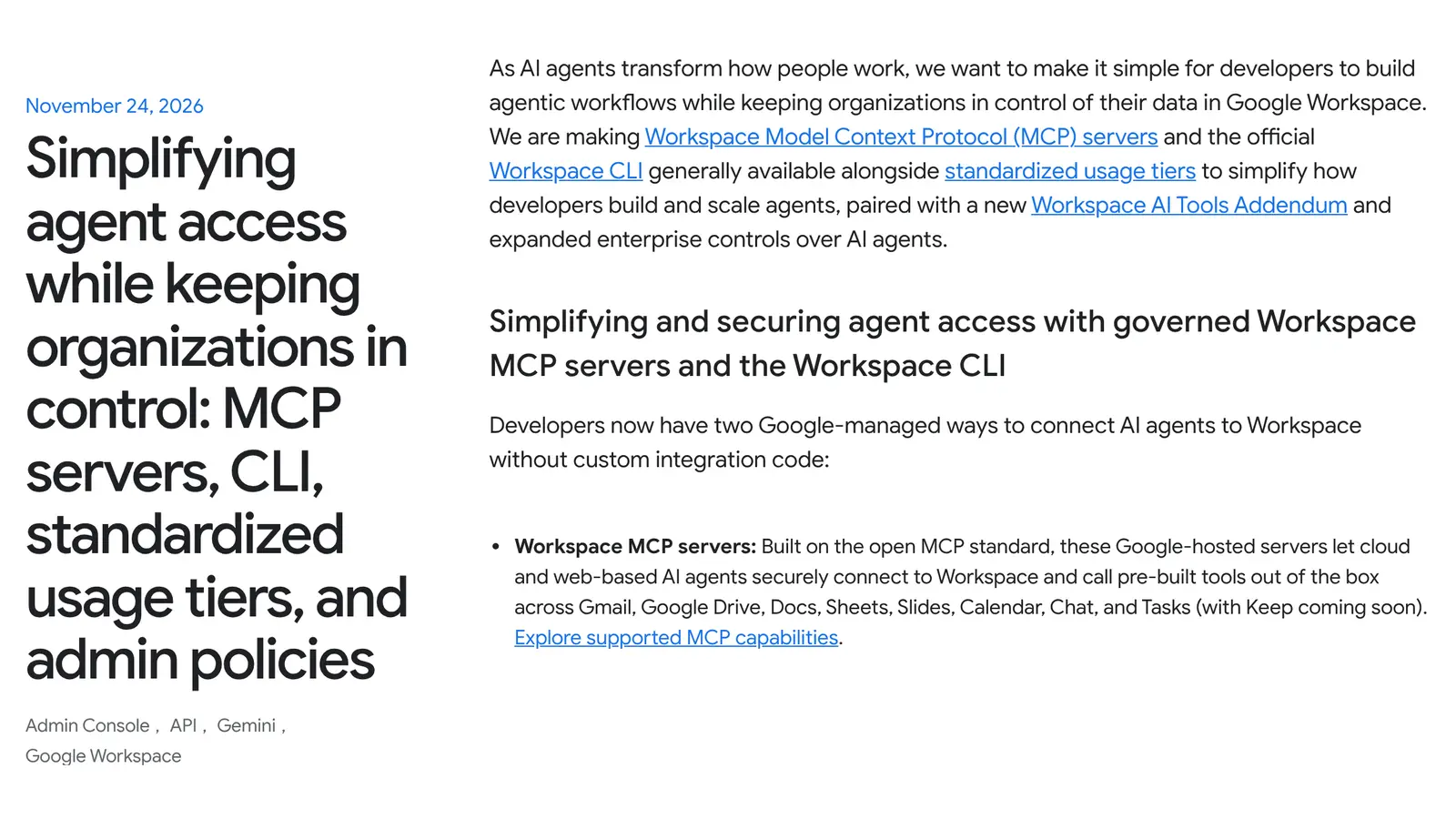
A developer who built a tool that reads your inbox and drafts replies now has a date to plan around: 1 February 2027. From then, Google says AI agents “or similar access tools” must reach Workspace through its own MCP servers or its new command-line tool, not by calling the regular APIs directly. This is the Google Workspace MCP rule, and developers are already pushing back.
Google announced the rule on 24 and 25 November. It matters because it decides who stands between your email, files and calendar and the AI tools that want to use them, and who sets the price.
What the Google Workspace MCP rule requires, and what it costs
Google’s Workspace Updates post makes the Google Workspace MCP servers and CLI generally available. MCP is an open standard that gives AI assistants one common way to plug into apps, like a universal adapter. Google runs the server side, so an agent asks for a tool such as “search my email”. The servers cover Gmail, Drive, Docs, Sheets, Slides, Calendar, Chat and Tasks.
Google’s Workspace Developers channel walks through the setup.

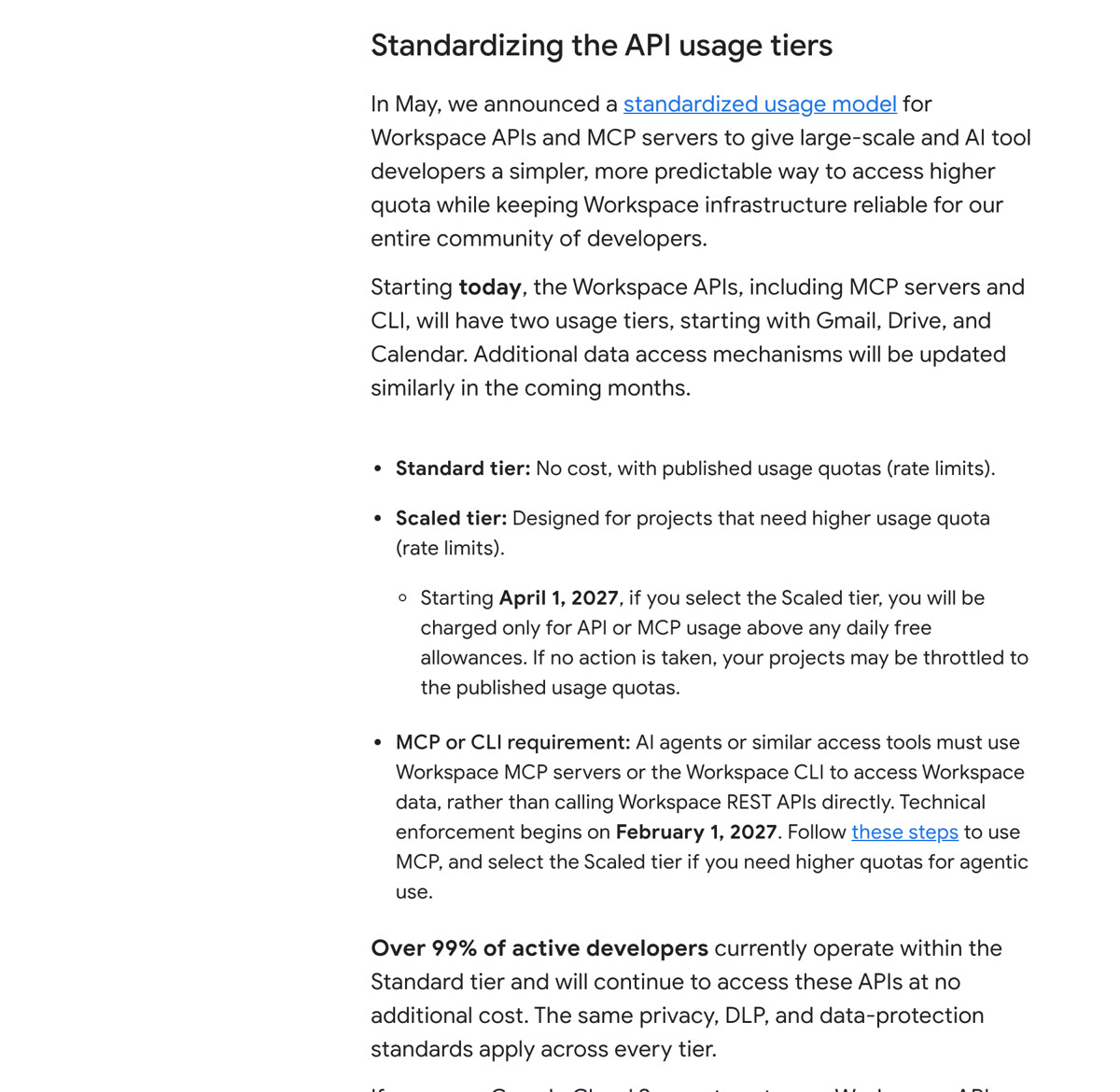
The “Standardizing the API usage tiers” section of Google’s Workspace Updates post, as published. Read it on Google. Screenshot: Google (Workspace Updates)
There are two tiers. Standard is free, up to 5,000 MCP requests a day per project per product. Scaled allows more and is billed from 1 April 2027. For Gmail, Calendar and Drive on Scaled, Google’s developer documentation says billing starts from the first request. Google’s pricing page lists $0.10 to $0.50 per 1,000 requests, depending on the type of request (checked on 29 November 2026). Google’s announcement says over 99% of active developers stay within the free tier today.
Google’s case: a sign-in token is no longer enough
Google’s reasoning, set out in its Workspace and Cloud blogs, is that regular APIs were built for people. A valid sign-in meant the user wanted the action. Agents act alone and fast, so checks must sit on every request. Google adds that MCP tools return summaries rather than raw data, which cuts cost and delay.
The rules come with promises. Google’s AI Tools Addendum bans training AI models on user data, storing user data beyond what an active, user-approved task needs, and scraping. Derived data, such as memory indexes and embeddings, may be kept for 30 days at most, and data must be deleted when a user disconnects. Admins get new controls, audit logs and rules that ask people to confirm sensitive actions, such as sharing data.
What developers say: “an agent tax”
This part is reaction and opinion, not fact. Developer Martin Alderson calls the new agent pricing an “agent tax” and argues that charging customers again to let agents read their own email could push them away. Developer Flavio Copes says the 30-day limit hurts long-term agent products and that Google gains control over who does what.
Copes also says sending, replying and forwarding are kept for partners. Google’s Gmail tool reference does list send, reply and forward tools and mentions no partner limit. It notes some tools are still rolling out and may be temporarily unavailable.
Who this touches, and who it may not
- Developers and companies building agents: move to MCP or the CLI by 1 February, and set up a separate sign-in client for agents.
- Businesses on Workspace: admin controls arrive now. Heavy agent use could cost money from April.
- Everyday users: probably more “confirm this action” prompts. Some third-party assistants may change features.
Google has not said whether personal Gmail accounts are covered, or how it will spot agents on the old route. It has not mentioned Apps Script or add-ons. Help Net Security reports that regular apps that are not AI agents can keep using the existing APIs.
Safety gained, choice narrowed
In our analysis, the case for the rule is real. One audited route, data limits and the option to make people confirm risky actions are protections most people would want, and the free tier covers nearly everyone building today. The worry is also fair. Google sets the tools, the limits and the price, and it can change all three. The likelier outcome is that most developers shrug and switch, while a few agent-heavy products rethink their costs.
Google is not the only company drawing lines around agents: United Airlines says it will block personal AI agents from booking its flights. Google’s own Gemini can now use your Mac for you, but asks you to approve key actions. In our reading, companies want agents, but on their own terms.
Three things to watch. How will Google spot agents still on the old route? Will personal Gmail accounts be covered? And will developers who do the maths on the new prices stay or look elsewhere?
Prefer to watch? Follow us on YouTube
The tech stories that matter, explained in plain words. Subscribe so you never miss one.
Quick answers
What is the Google Workspace MCP server?
It is Google's hosted tool for AI agents. The agent asks it to do a job, such as search email, instead of calling Gmail's regular interface directly. Eight apps are covered, including Gmail, Drive and Calendar.
Will my AI tool still work with Gmail after February?
Tools that move to Google's MCP servers or CLI should keep working. Google has not said how it will detect agents on the old route, and has not said whether personal Gmail accounts are covered.
Is it free?
The Standard tier is free, up to 5,000 MCP requests a day per project per product, and Google says over 99% of active developers are on it. Paid Scaled billing starts 1 April 2027, at $0.10 to $0.50 per 1,000 requests on Google's pricing page (checked on 29 November 2026).
Do regular apps have to change?
Google's rule is aimed at AI agents, and Help Net Security reports that regular apps can keep using the existing APIs. Google has not said this in one sentence, and it has not mentioned Apps Script or add-ons.
Words to know
- MCP
- Model Context Protocol, an open standard that gives AI assistants one common way to connect to apps and data.
- REST API
- The regular way software talks to an app such as Gmail, built for programs that act at human pace.
- CLI
- Command-line interface: a tool you control by typing commands.
- AI agent
- An AI that carries out tasks for you, step by step, not just answers questions.
Sources (11): every key fact checked against at least two
- Google Workspace Updates: MCP servers, CLI, standardized usage tiers and admin policies (24 Nov 2026)
- Google Workspace blog: new AI agent protections and developer tools (25 Nov 2026)
- Google Cloud blog: Deploying agents safely in your enterprise (25 Nov 2026)
- Google for Developers: Workspace tools safety and usage tiers
- Google for Developers: Workspace API quotas and pricing
- Google for Developers: Gmail MCP server tool reference
- Google for Developers: Configure Workspace MCP servers
- Google Workspace AI Tools Addendum
- Help Net Security: Google's AI agent security requirements (26 Nov 2026)
- Flavio Copes: Google Workspace MCP (developer opinion)
- Martin Alderson: The agent tax has arrived (developer opinion)
Related stories

Switzerland confirms its first cyberattacks carried out by AI agents, and most of them got in
Switzerland's NCSC reports its first cyber attacks by AI agents. Four of five succeeded, its director says. What is known, and six steps to take.
· 4 min read
Florida man gets 47 months for using an AI copy of streamer N3on's voice in a $260,000 crypto fraud
An AI voice scam cost memecoin organisers about $260,000. A Florida man got 47 months in prison. Here is what happened and how to protect yourself.
· 4 min read
Tesla starts rolling out FSD v15 to first owners, and Musk says wide release comes in December
Tesla FSD v15 began reaching early-access owners on 21 November. Release date, HW3 left out, Reality View, and what Tesla has not yet shown.
· 3 min read