Google's Gemini 4 Hydrogen brings a faster, cheaper Gemini 4 to Search, the free app and developers
- Google has released Gemini 4 Hydrogen, a faster, cheaper Gemini 4 model for everyday coding, agent tasks and questions.
- It is rolling out in Google Search for all users, in the Gemini app, and on every Gemini API tier, free tier included.
- The paid API costs $1.50 per million input and $7.50 per million output tokens. A new Orchestrator pairs it with Carbon.
- $1.50 / $7.50Per million input / output tokensPaid API price, checked 12 Nov 2026
- 1MTokens it can read at onceAnd up to 1M tokens in its reply
- 51 vs 50Index score: Hydrogen vs ArgonGoogle's claim, default setting
- 24%Less quota used by OrchestratorGoogle's claim; also 19% faster
Ask Google Search a hard question this week and the answer may come from a model that did not exist a day ago. Google released Gemini 4 Hydrogen on 12 November: a faster, cheaper member of its newest AI family. Unlike the bigger models, it is meant for everyone.
Two days ago Google opened its strongest model, Gemini 4 Carbon, to paying developers and AI Ultra users. Carbon is built for long, hard problems, at a premium price. Hydrogen, Google says, is built for “rapid execution”. It takes over from the old “Flash” name, 9to5Google reports. For most people, this is the Gemini 4 they will actually meet.

Where Gemini 4 Hydrogen shows up, and what it costs
The Gemini 4 Hydrogen release date is 12 November, with a global rollout from that day.
- Google Search: Google says the upgrade reaches “all users globally”, in every language AI Mode supports. According to 9to5Google, Hydrogen becomes the default model in AI Mode, Google’s chat-style search, and handles the hardest questions in AI Overviews, the AI summaries above results.
- Gemini app: paying subscribers can pick it from the model menu, where it is labelled “Everyday help”. Free users get no manual choice; the Auto setting uses Hydrogen when it judges it fits the question.
- Developers: every tier of Google AI Studio and the Gemini API, free tier included, plus Android Studio. In Google Antigravity, Google’s AI coding tool, it is for paid Google AI Pro and Ultra subscribers.
- Businesses: Gemini for business, and Gemini in Google Sheets on eligible plans.
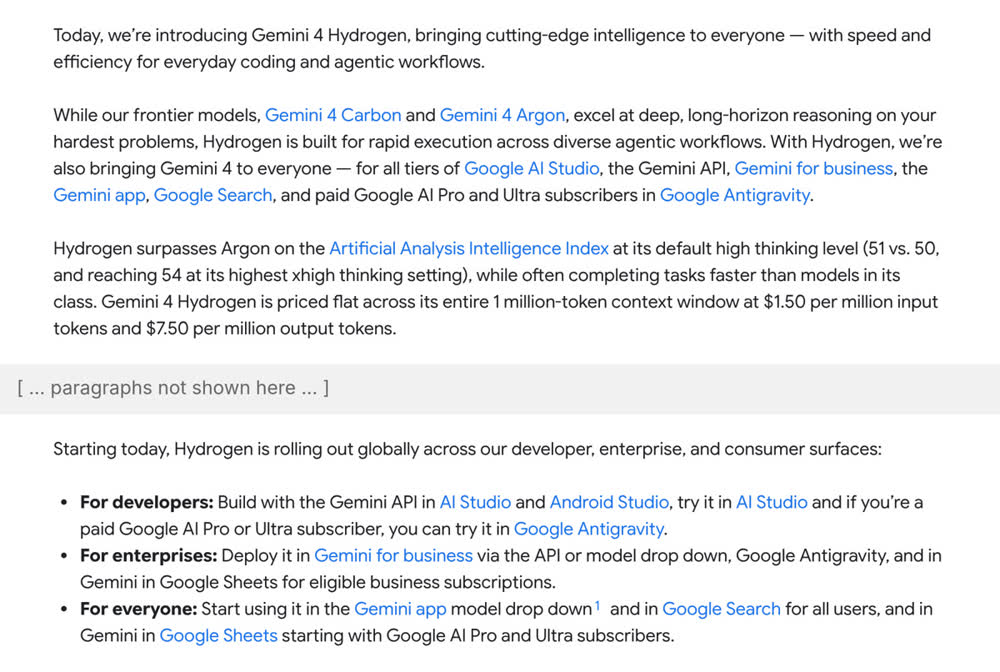 Excerpts from Google’s announcement, as published on the Google blog on 12 November. Image: Google
On Gemini 4 Hydrogen pricing, the paid API costs $1.50 per million input tokens and $7.50 per million output tokens (checked 12 November 2026). A token is a small piece of text that AI services count and bill. The price stays flat across the whole context window, the amount it can read at once: up to 1 million tokens. The free tier costs nothing, but Google says it may use that data to improve its products.
Google's published Gemini API prices, checked 12 November 2026. Input prices: 3.8 Flash $0.75, Hydrogen $1.50, Carbon $2 then $4. Gemini 3.8 Flash rises to $7.50 per million output tokens from 1 January 2027. Source: Google AI for Developers: Gemini API pricing
Faster than Flash and level with Argon, by Google’s own scores
Every figure here is Google’s own claim. On Gemini 4 Hydrogen vs 3.8 Flash, Google says Hydrogen is 2.5 times faster at its default setting. It says Hydrogen scores 57% on Terminal-Bench 4.1, a coding test, against 18.2% for 3.8 Flash, and makes things up more than five times less often.
On Gemini 4 Hydrogen vs Argon, Google says Hydrogen scores 51 on the Artificial Analysis Intelligence Index at its default “high” thinking level, one point above Argon. At a new, slower “xhigh” level it reaches 54. Google still aims Argon and Carbon at the deepest reasoning work.
Google gives no model size, no official speed in words per second, and no country list beyond “globally”. Outside testers will need time to check the scores.
Orchestrator lets two models share one job
The Google Antigravity Orchestrator is a new choice in the model menu. It pairs Carbon and Hydrogen in one session: Carbon plans, Hydrogen writes the changes and runs the tests, and the work goes back to Carbon if Hydrogen gets stuck. On Google’s own coding test, it says Orchestrator came close to Carbon’s success rate while using 24% less quota (your plan’s usage allowance) and finishing 19% faster. For now it is AI Ultra only; Google promises more plans later, without a date.
If you use Gemini or build with it, here is what changes
If you only use Search or the free app, you don’t need to do anything. If you pay for Gemini, “Everyday help” is the choice for quick tasks.
If you build apps, you can try it free on the API. Hydrogen costs double what 3.8 Flash costs today, but 3.8 Flash rises to the same price on 1 January 2027. So test both on your own work before then. Like yesterday’s Gemini Decisions API, this launch suggests Google wants routine work on smaller, cheaper models.
The everyday model will shape more lives than the flagship
On balance, this is a meaningful step. Google is putting its newest generation in front of free users and developers, not just behind a premium plan. In practice, the model inside Search shapes far more daily lives than any flagship.
The caution is just as real. The scores are Google’s own. Free app users don’t choose when they get Hydrogen. The free API tier costs nothing but may feed your data into Google’s products, and the paid price is double what 3.8 Flash costs today.
Watch for the first independent tests, for Orchestrator reaching plans beyond Ultra, and for 1 January. The quiet model may turn out to be the one that matters most.
Prefer to watch? Follow us on YouTube
The tech stories that matter, explained in plain words. Subscribe so you never miss one.
Quick answers
When was Gemini 4 Hydrogen released?
Google announced it on 12 November 2026 and started rolling it out globally the same day.
How much does Gemini 4 Hydrogen cost?
On the paid Gemini API, $1.50 per million input tokens and $7.50 per million output tokens (checked 12 November 2026). The API's free tier is free, and Google may use that data to improve its products.
Can free users use Gemini 4 Hydrogen?
Yes in Google Search, which Google says is getting it for all users. In the free Gemini app, only when the Auto setting picks it. Developers can use it on the free API tier.
Is Gemini 4 Hydrogen better than Gemini 4 Argon?
Google says Hydrogen scores 51 to Argon's 50 on the Artificial Analysis Intelligence Index at its default setting. Google still aims Argon and Carbon at the deepest, longest reasoning tasks.
What is Orchestrator in Google Antigravity?
A model choice that lets Carbon plan and Hydrogen do routine steps in one session. It is for Google AI Ultra subscribers for now.
Words to know
- Token
- A small piece of text that AI services count and charge for.
- API
- A way for apps and programs to use an AI model directly, paid by how much they use.
- Context window
- How much text the model can read and keep in mind at one time.
- Thinking level
- A setting for how long the model works on a problem before it answers.
- AI agent
- AI that carries out a series of steps on its own, such as editing code and running tests.
- Quota
- The amount of AI use a subscription plan allows.
Sources (6): every key fact checked against at least two
- Google: Introducing Gemini 4 Hydrogen (Koray Kavukcuoglu, 12 November 2026)
- Google: Google Search gets a major upgrade with Gemini 4 Hydrogen (Robby Stein, 12 November 2026)
- Google Antigravity: Gemini 4 Hydrogen and Orchestrator (12 November 2026)
- Google AI for Developers: Gemini API pricing (checked 12 November 2026)
- Google DeepMind: Gemini 4 Hydrogen model card
- 9to5Google: Google announces Gemini 4 Hydrogen (Abner Li, 12 November 2026)
Related stories

Senate Banking chair asks Jensen Huang and Howard Lutnick to testify over Nvidia and national security
Nvidia Senate hearing: Senator Tim Scott asks Jensen Huang and Howard Lutnick to testify on national security and chip exports. What we know, what's next.

United Airlines bans personal AI agents from booking its flights, even through travel agencies
The United Airlines AI booking ban stops personal AI agents buying tickets, even via travel agencies. Why United did it and what travellers should do now.
Google's Gemini Decisions API gives fast yes-or-no AI answers, each with a score for how sure it is
Google's Gemini Decisions API answers yes/no, choice and rating questions in about 0.2 seconds, with a confidence score. What it costs and who can use it.