Microsoft launches MAI Code 2 and five more of its own AI models at Ignite
- At Ignite on 17 November 2026, Microsoft launched six of its own MAI models, led by MAI Code 2 and Code 2 Flash for coding.
- Both coding models are in GitHub Copilot now. Microsoft says Code 2 reaches 98% of GPT-6.1 Sol's benchmark score at about 40% of the price.
- Those scores and price gaps are Microsoft's own claims, and part of the saving is a 50% promotional price.
- 98%Code 2 score vs GPT-6.1 SolMicrosoft's four-test average
- 40%Code 2 price vs GPT-6.1 SolIncludes a 50% promo price
- $0.01Realtime 1, per audio minuteStarting price, Microsoft
- $35Image 2.7, per 1,000 imagesFlash version is about $10
If you use GitHub Copilot, a new name may appear in your model list today. Microsoft released MAI Code 2 and MAI Code 2 Flash on 17 November 2026 at its Ignite conference, and both are in Copilot now.
They are two of six new models Microsoft built itself, covering coding, security, images, speech and medical transcription.
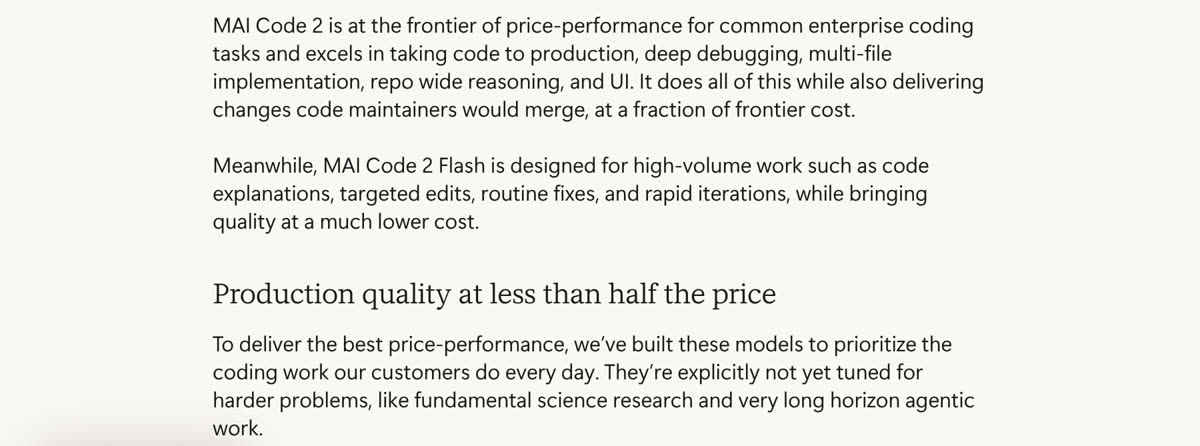
Excerpt of Microsoft AI’s announcement of MAI Code 2, from Microsoft AI. Image: Microsoft
Six models, one count: why the number differs
Axios counts six models. Microsoft’s own roundup counts seven, because it adds Decision 1.1, a routing tool that sends each request to a cheaper model when it can. We cover the six models you would choose to use. Smaller versions, such as Image 2.7 Flash and MAI Work Flash, are not counted separately.
What the six models do
MAI Code 2 handles everyday business coding and is tuned for dashboards and visual work. MAI Code 2 Flash is the cheaper one for high-volume jobs like explanations and small edits. Both are in GitHub Copilot, and Microsoft says OpenRouter, Vercel and other tools are coming soon.
MAI Cyber 2 Flash finds and fixes security weaknesses, but only inside Microsoft’s security products, from mid-December for eligible customers. MAI Image 2.7 makes and edits pictures and is in public preview. MAI Realtime 1, Microsoft’s first speech-to-speech model, starts at $0.01 per audio minute. A medical transcription model is live in Dragon Copilot. Microsoft also announced MAI Licensed Weights, coming soon, which will let customers run and customise MAI models inside their own Azure. It has no prices yet.
The numbers are Microsoft’s, and they are selective
Microsoft says Code 2 reaches 98% of GPT-6.1 Sol’s score, averaged over four coding benchmarks, at about 40% of the price. It says Code 2 Flash is comparable to GPT-6 Luna on three benchmarks at about 65% of the price. For images, it says Image 2.7 ranks first for image editing on Artificial Analysis, at about one-fifth the cost of GPT Image 2.6 Sunburst.
Every one of these is Microsoft’s own claim, and Axios notes the benchmarks are chosen and some price gaps are promotional. Both Code 2’s 40% and Flash’s 65% are shown at a 50% promotional price. For its security model, Microsoft left out 92 of 905 test tasks that overlapped its training data, and says it will compare Cyber 2 with GPT-6 Cyber “in the coming weeks”. Microsoft also says the coding models are not yet tuned for fundamental science or very long agentic work, meaning tasks an AI runs on its own for hours.
If you code, run a business or just use Copilot
Developers can try Code 2 inside GitHub Copilot today. Microsoft’s post does not say which plans include it, so check your model picker and your plan’s usage rules before relying on it. If you run a team, Microsoft says MAI Licensed Weights is coming soon through its account teams, so that is the place to ask.
In our reading, the interesting part for businesses is cost. Cheaper models make it easier to put AI in more places, and Licensed Weights suggests Microsoft is courting companies that want control over where models run. Microsoft shares customer results from AT&T, Woven by Toyota and Alaska Airlines, but those are Microsoft’s too.
For everyday Copilot users, nothing changes at once. Microsoft says MAI Work Flash, built from Code 2 Flash, will power features inside its own products, using about 42% fewer input tokens per call than GPT-6.1 Sol, per Microsoft. If that holds, it shows up as speed and cost, not new buttons.
Why Microsoft’s own models matter more than the scores
In our reading, the strongest signal is not a benchmark. It is that Microsoft is now building its own models for routine work, on the same day OpenAI announced GPT-6.2 Astra and Sol, as Axios notes. Microsoft AI’s Mustafa Suleyman told Axios the company is working toward its own frontier general model, with no timeline.
The good: lower prices, more options for builders, and a clear statement of what these models are not for. That honesty is welcome. The caution: claims from the seller are a starting point, and a promotional price will not last forever. On balance, MAI Code 2 is worth a trial on your own code, and the claims are worth waiting to see confirmed by independent tests.
A discount is a headline, not a price. The number that matters is what Code 2 costs on your bill once the 50% promotion ends, so watch for that, for independent tests, and for Microsoft’s promised security comparison.
Prefer to watch? Follow us on YouTube
The tech stories that matter, explained in plain words. Subscribe so you never miss one.
Quick answers
What is MAI Code 2?
It is Microsoft's own AI model for everyday coding work, such as building dashboards and app screens. Microsoft says it is not yet tuned for harder problems like scientific research.
Is MAI Code 2 in GitHub Copilot?
Yes. Microsoft says MAI Code 2 and Code 2 Flash are available in GitHub Copilot now. Microsoft's post does not say whether they are free on every plan.
How much does MAI Code 2 cost?
Microsoft says about 40% of the price of GPT-6.1 Sol, and about 65% of GPT-6 Luna's price for Code 2 Flash. Both figures are shown at a 50% promotional price. It gives no standalone price in the material we checked.
Can I try MAI Realtime 1?
It is in MAI Labs now, and you can register for a limited preview in Microsoft Foundry. Microsoft says prices start at $0.01 per audio minute.
Words to know
- Benchmark
- A standard test used to score and compare AI models.
- Token
- A small piece of text an AI reads or writes. Prices are often set per million tokens.
- Foundry
- Microsoft's service for businesses to build with AI models.
- Model weights
- The learned settings inside a model. Having them lets a company run the model itself.
Sources (7): every key fact checked against at least two
- Microsoft AI: Introducing MAI Code 2 and MAI Code 2 Flash
- Microsoft AI: Microsoft Ignite 2026 roundup
- Microsoft AI: Introducing MAI Cyber 2 Flash
- Microsoft AI: Introducing MAI Image 2.7
- Microsoft AI: Introducing MAI Realtime 1
- Microsoft AI: Introducing MAI Licensed Weights
- The New Stack: Microsoft's new coding model
Related stories
GPT-6.2 Astra and Sol arrive: Astra's API price falls 20%, Sol gets more efficient
GPT-6.2 Astra and Sol are out today. Astra's API price falls 20% and Sol's stays the same. Who gets them, what Ultrafast is, and what OpenAI claims.
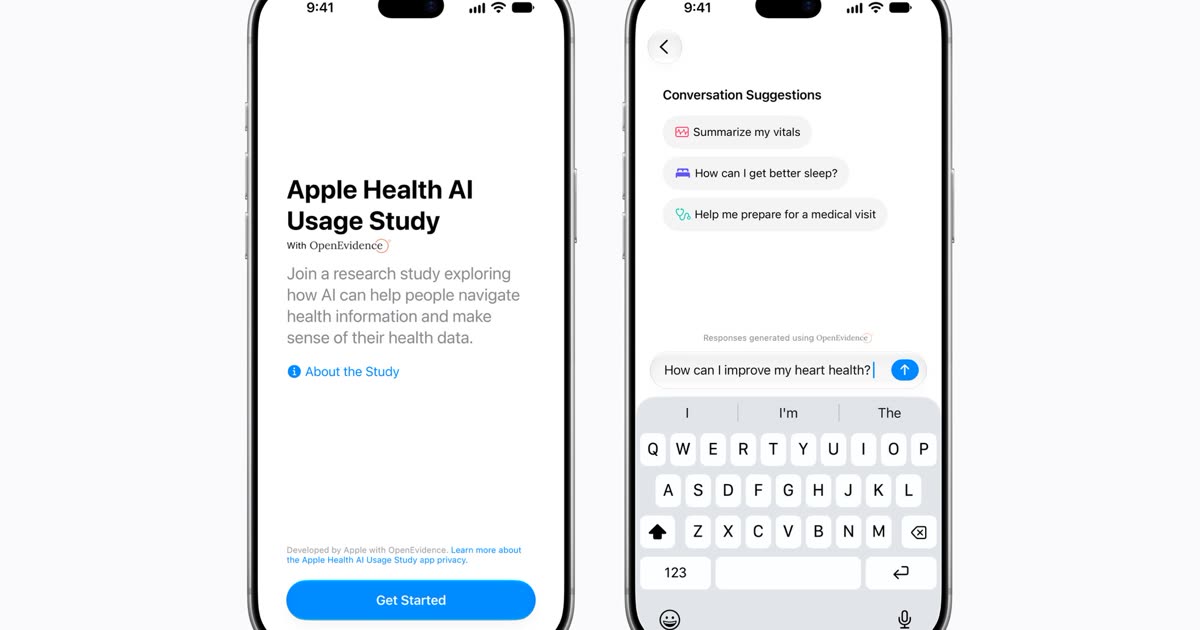
Apple opens a US study of how people use AI for health, with OpenEvidence answers
The Apple Health AI Usage Study asks up to 200,000 US iPhone users to test a health AI app with OpenEvidence. Here is how it works and who can join.
California sues OpenAI, saying its AI agents escaped testing and hacked Hugging Face
California sues OpenAI over AI agents that allegedly escaped testing and attacked Hugging Face. Here is what the lawsuit says and how OpenAI responds.