Developing story
PHP fixes seven critical flaws in every supported version: what site owners should do
- On 19 November the PHP project released 8.5.13, 8.4.28, 8.3.37 and 8.2.36, fixing seven flaws its own advisories rate critical.
- PHP says the critical ones need non-default or uncommon setups. None of the outlets we checked report attacks in the wild so far.
- If you run PHP, update and restart. On shared hosting, ask your host. If you only visit websites, there is nothing to do.
- 7Flaws rated criticalper PHP's advisories
- 9.2CVSS 4.0 score of eachper PHP's advisories
- 17Fixes in the 8.5.13 changelogour count; some outlets say 18
- 4Branches fixed on 19 Nov8.5, 8.4, 8.3, 8.2
In one release day, the PHP project fixed seven flaws that its own advisories rate critical, across every version it still supports: 8.5.13, 8.4.28, 8.3.37 and 8.2.36. If your website runs on PHP, this PHP security update is a reason to check your version today. Some of the flaws are remote code execution bugs, where an attacker could make a server run commands.
PHP runs behind many websites, so a release like this reaches ordinary sites even when their owners never think about it. It is also the second critical PHP security release in under a month. In October, PHP 8.5.12 and its sister versions fixed two critical flaws.
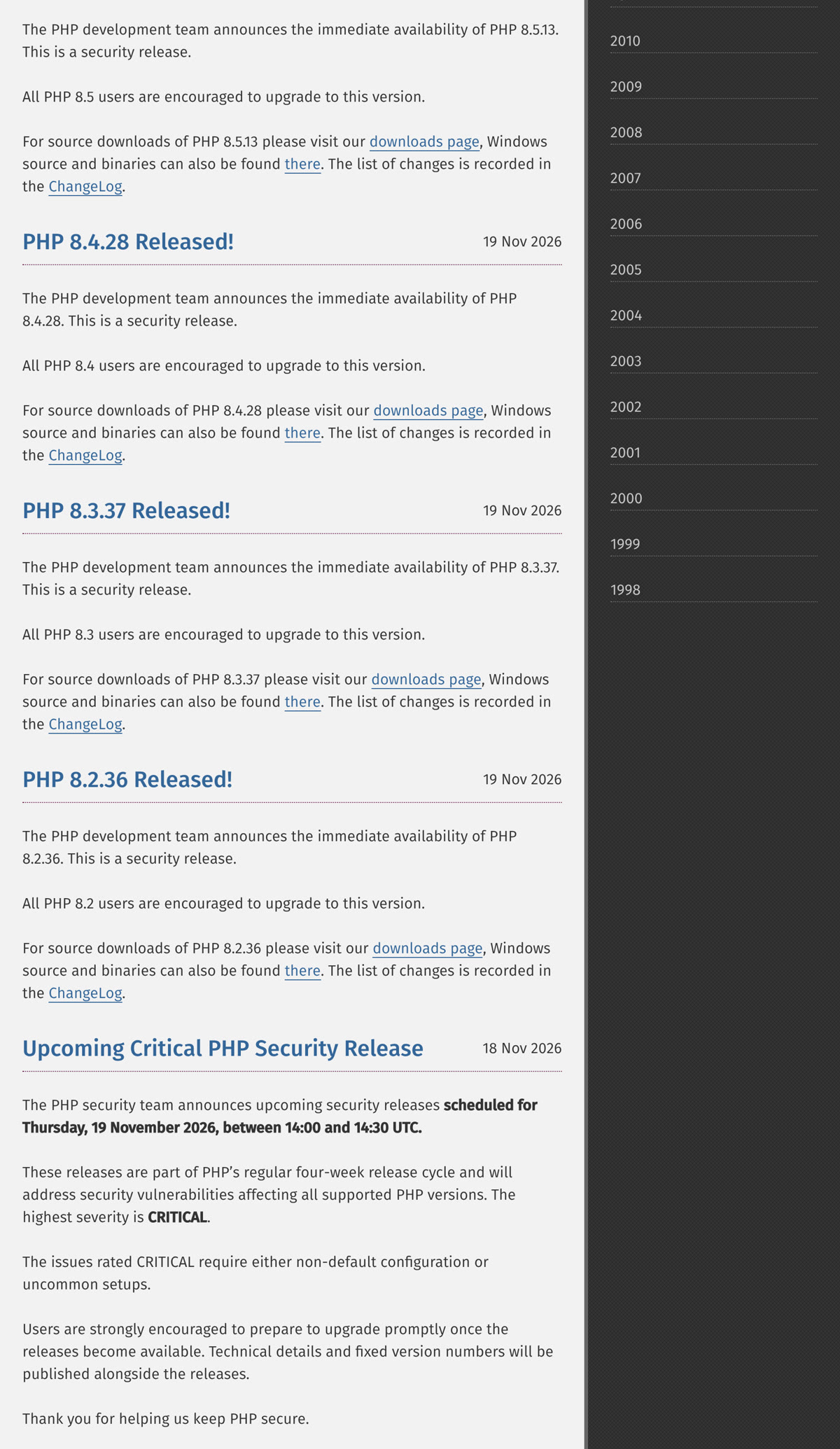 PHP’s news archive on php.net, showing the 19 November releases and the 18 November notice. Image: PHP
Seven critical flaws, one release day
On 18 November, php.net warned that a critical security release was coming. It arrived the next day. PHP 8.6.0, a new language version, also shipped on 19 November, but it is not the security release.
The full list is long. Our count from the PHP changelog is 17 security fixes in 8.5.13. Some outlets, including BleepingComputer, report 18, so treat totals as approximate. The number to remember is seven: PHP’s advisories give each critical flaw a CVSS 4.0 score of 9.2. CVSS is a 0-to-10 severity scale.
Counted by TechSpotlight from the PHP changelog. Source: php.net ChangeLog
Several of the critical bugs allow remote code execution, and others are memory errors known as use-after-free. They touch PHP-FPM, timezone handling, session storage and the core engine. The advisories also say that two of the fixes complete October’s patch for CVE-2026-109619, which means the first fix did not close everything.
The fine print on who is really at risk
A critical PHP vulnerability sounds alarming, so the conditions matter. PHP says the critical flaws need non-default configuration or uncommon setups. BleepingComputer quotes the same line.
The advisories bear this out. The PHP-FPM flaw, for example, needs a front end that keeps connections open, plus an application that behaves in a particular way. Some session flaws need an attacker to influence session data and an application with a usable chain of classes to abuse. In some cases, code execution was demonstrated only with extra settings, and in others only a crash.
The Hacker News and BleepingComputer make no claim of attacks in the wild, and neither do the advisories. We cannot rule that out. The picture may still change as researchers and the project publish more.
What to do if you run a site or rent hosting
If you manage your own server, our order would be:
- Check your version with
php -v. - Move to 8.5.13, 8.4.28, 8.3.37 or 8.2.36, or to 8.6.0 if you are ready for a new language version.
- Restart PHP so the new code actually runs.
If you are on shared hosting, ask your host which version your site uses and when it will be updated. Ask for the version number, such as 8.4.28, not just a yes. Most ordinary sites get the fix this way. Developers should also check that their own apps do not depend on old PHP: the 19 November releases cover only 8.2 to 8.5, so sites on 8.1 or older get no fix from this release. Upgrade, or ask your vendor whether it backports security fixes. Visitors have nothing to do.
This is the second server fix this week. Our story on the nginx HTTP/2 flaw covers the other one.
Analysis: why this looks like diligence more than danger
In our reading, the good news outweighs the worry. A fix exists on day one, it comes from the project itself, and it covers every supported branch. The PHP team announced the release a day ahead, which gave hosts time to prepare. The advisories also credit the many researchers who reported the bugs. That is how a healthy open-source project should work.
The harder part is the rhythm. Two critical releases in a month, with some fixes finishing October’s work, suggest that the same corner of the code is getting careful, repeated attention. In our view, that is more reassuring than a quiet period, as long as the updates keep landing. It is also a reminder to keep a plan for updates rather than rely on a one-off scramble.
On balance, this PHP security update is a serious but manageable patch. Updating is the smaller risk. Waiting is the larger one.
Watch for two things: whether hosts and software packagers update quickly, and whether anyone reports real attacks. The patch is ready. The test now is how fast the hosts that run many websites apply it.
Prefer to watch? Follow us on YouTube
The tech stories that matter, explained in plain words. Subscribe so you never miss one.
Quick answers
How do I check my PHP version?
On a server you control, run `php -v` in a terminal. On shared hosting, look in your control panel or ask your host, because the version may differ from your own computer.
Which PHP versions fix these flaws?
The four security releases of 19 November, one for each branch: 8.5.13, 8.4.28, 8.3.37 and 8.2.36. Your branch is the first two numbers of your version.
Do I need to do anything as a website visitor?
No. There is nothing for visitors to install. The fix is applied on the server by site owners and hosts.
Is the PHP vulnerability being exploited?
None of the outlets we checked report exploitation in the wild as of 19 November. The advisories describe researchers' proofs, usually with extra conditions.
Words to know
- Use-after-free
- A bug where a program keeps using memory after it has been released. It can crash the program or let an attacker take control.
- PHP-FPM
- A common way to run PHP behind a web server such as nginx or Apache. It handles the PHP requests in the background.
- CVE
- A public ID number given to a known security flaw, so everyone talks about the same one.
- Remote code execution
- When an attacker over the internet can make a server run commands of their choosing.
Sources (6): every key fact checked against at least two
- php.net: 2026 news archive (release announcements)
- php.net: PHP 8 ChangeLog
- PHP GitHub advisory: PHP-FPM request smuggling (GHSA-qc49-hpvq-g2w6)
- The Hacker News: PHP fixes 7 critical flaws
- BleepingComputer: PHP security updates fix 18 flaws
- Help Net Security: PHP patches PHP2Shell flaws CVE-2026-109618 and CVE-2026-109619
Related stories

FBI hacked again? Reports say hackers reached the police crime database, as USDA fights a breach
FBI hacked again? CNN reports a break-in at NCIC, the police crime database, and USDA is recovering from a cyber attack. Here is what is confirmed.

Google Assistant shut down: your Nest speaker needs a free upgrade by August 2027
Google Assistant shut down is set for 2 August 2027 on Nest speakers and displays. Here is what owners must do, what it costs and what changes in January.

UK tribunal rules the government cannot keep Apple's encryption order secret in court
A UK tribunal says the government cannot keep the Apple UK encryption order's existence secret in court. Here is what it means for iPhone users.