Developing story
Nginx HTTP/2 flaw: F5 fixes an 11-year-old bug that can crash servers
- F5 disclosed CVE-2026-123007 on 18 November, a flaw in nginx's HTTP/2 support that can crash servers and may allow code execution.
- Per F5, it is fixed in nginx 1.31.9 and 1.30.7. Only setups using HTTP/2 are affected. The Hacker News reports no attacks so far.
- If you run nginx, update and fully restart. If you only browse the web, there is nothing for you to do.
- 9.2CVSS 4.0 score (Critical)per F5
- 8.1CVSS 3.1 score (High)per F5
- 1.30.7Fixed in the 1.30 lineper F5
- 1.31.9Fixed in the 1.31 lineper F5

A flaw in nginx’s HTTP/2 support, there for about 11 years, now has a fix. On 18 November, F5, which maintains nginx, published the patch. The nginx http2 vulnerability, tracked as CVE-2026-123007, can crash a server and may let an attacker run code on it.
What is nginx used for? It is web server software that sits in front of websites and hands pages to visitors. Wiz, a security firm, cites Netcraft in saying it powers more than 225 million websites, though we could not check that figure ourselves. That reach is why a bug here matters to ordinary readers, even though the fix is a job for site owners.
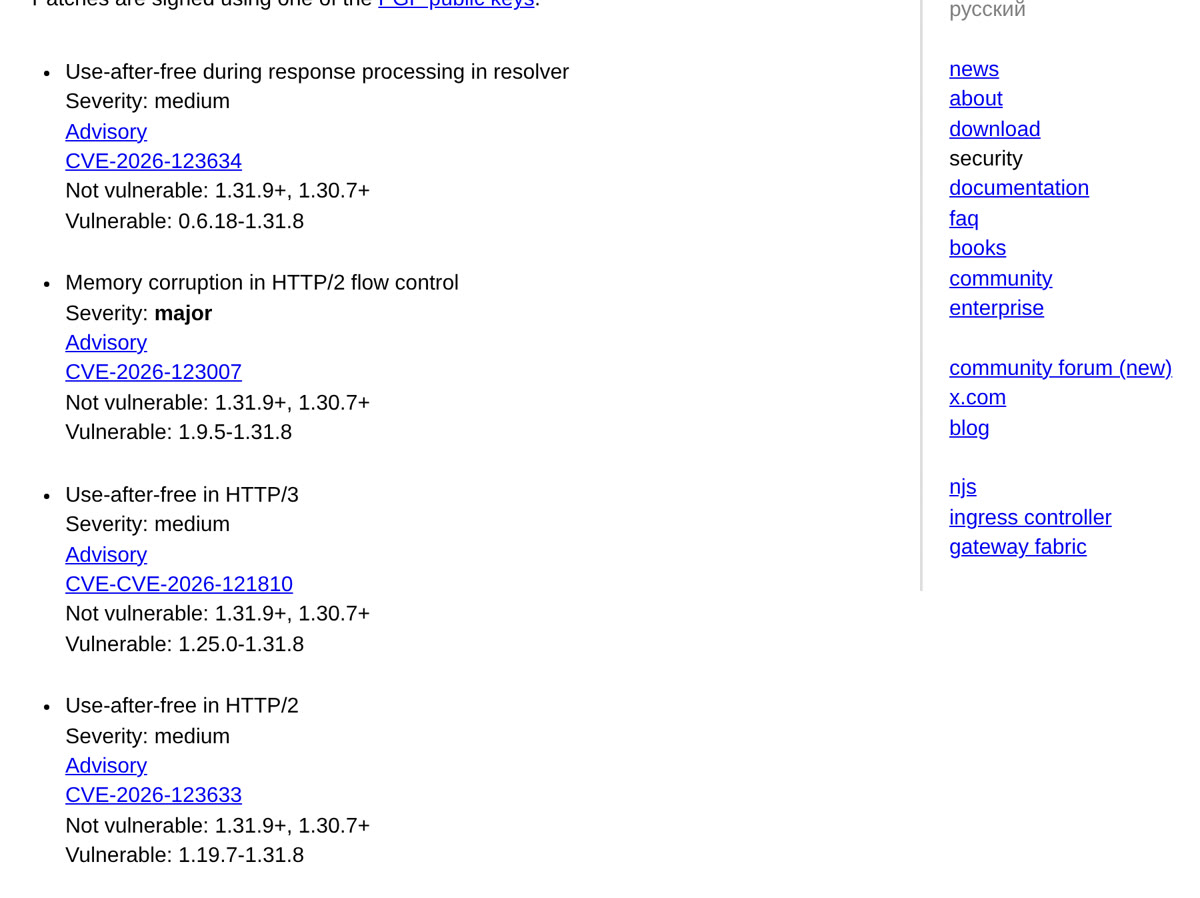 The nginx security advisories page, from nginx.org. Image: nginx
Which nginx versions the http2 vulnerability affects
F5’s advisory K000163926 names the bug “memory corruption in HTTP/2 flow control”. In plain terms, a counter that tracks how much data a connection may send can be pushed past its limit, which can damage the server’s memory.
Per F5, it affects NGINX Open Source 1.9.5 to 1.30.6 and 1.31.0 to 1.31.8, fixed in 1.30.7 and 1.31.9. For NGINX Plus, 37.0.0 to 37.0.7.1 and 37.1.0 to 37.2.0.1 are affected, fixed in 37.0.8.1 and 37.3.0.1. F5 lists Plus R34 to R36 as not affected. It says the issue applies only to setups that use HTTP/2.
F5 scores it 9.2 (Critical) on CVSS 4.0 and 8.1 (High) on CVSS 3.1. CVSS is a standard 0-to-10 severity scale. Per F5, the usual result is a crash of a worker process, the program that serves web traffic. Memory damage and, potentially, remote code execution are also possible. F5 says only the traffic-handling side is exposed, not the control side.
How easy is an attack, and is it happening?
The headline risk is code execution, but F5 puts a condition on it. Per F5, running code also depends on ASLR, a memory safeguard, being off or bypassed. A crash is the more usual result.
The Hacker News reports that neither F5 nor the researchers at Wiz and Rapid7 have reported attacks. Wiz says it has working lab demonstrations but is not releasing them, and describes a real attack as hard. The Hacker News reports that Rapid7 has published a proof-of-concept, suited only to a test setup and needing heavy traffic. In our reading, that is reassuring but temporary: public code tends to improve, and defenders usually have a short window.
F5 thanks Rapid7’s Stephen Fewer, Tomer Schwartz of Wiz Research, Xint.io and Ikotas Labs. Wiz says five teams, including Ikotas Labs, found the bugs independently. The fix and the public disclosure arrived on the same day, which is what coordinated disclosure is meant to achieve.
One point of disagreement is worth knowing. F5 lists no mitigation. Wiz and The Hacker News both say turning HTTP/2 off is a stop-gap. Wiz also lists NGINX Plus R33 as affected, while F5’s advisory does not. If you run an older Plus release, check with F5 directly. The same release also fixes a related HTTP/2 bug, CVE-2026-123633, which nginx.org rates “medium”.
If you run nginx: check, update, then restart
If you only browse the web, nothing changes for you.
If you run nginx, here is the order we would follow:
- Check your version with
nginx -vand whether anylistenline useshttp2. - Update to 1.30.7, 1.31.9 or the fixed Plus release. The Hacker News says some Ubuntu and Debian packages were not yet patched when it wrote, so check your provider’s own security notice before assuming you are patched.
- Restart fully. The Hacker News notes a reload can leave the old program running.
- If you cannot update today, Wiz and The Hacker News say disabling HTTP/2 is a stop-gap. It is not an F5-listed fix, so update as soon as you can.
Managed hosts and cloud providers may handle this for you. Ask them. For another case of hidden software risk in everyday devices, see our story on an Android TV box botnet.
Why a patch note deserves a calm, quick response
In our view, the good news outweighs the worry. A fix exists on day one, it comes from the vendor, and nobody reports attacks yet. The less comfortable part is the age: it arrived with HTTP/2 support in 2015. Wiz also argues that AI is lowering the barrier to finding and exploiting memory flaws like this, which is one more reason not to wait.
On balance, this is a routine, serious patch rather than a crisis. Updating is the smaller risk. Leaving the flaw open for weeks is the larger one.
Watch for two things: whether Ubuntu and Debian packages catch up, and whether anyone reports real attacks. Until then, the safest advice is short: update, then restart.
Prefer to watch? Follow us on YouTube
The tech stories that matter, explained in plain words. Subscribe so you never miss one.
Quick answers
Am I affected by the nginx HTTP/2 vulnerability?
Per F5, only if you run NGINX Open Source or NGINX Plus with HTTP/2 turned on, on an affected version. If you only visit websites, you do not need to do anything.
Which nginx version fixes it?
Per F5, NGINX Open Source 1.31.9 or 1.30.7. For NGINX Plus, the fixed versions are 37.3.0.1 and 37.0.8.1.
How do I disable HTTP/2 in nginx?
Wiz and The Hacker News say you can set 'http2 off;' on nginx 1.25.1 or later, or remove 'http2' from the 'listen' line. F5 lists no mitigation, so treat this as a stop-gap and update.
Is the flaw being exploited?
The Hacker News reports that neither F5 nor the researchers have seen attacks, though Rapid7 has published a proof-of-concept. That can change, so updating soon is the safer path.
Do I need to restart after updating?
The Hacker News says yes. A reload can leave the old, vulnerable program running, so do a full restart.
Words to know
- HTTP/2
- A newer way for browsers and servers to exchange web pages. It sends many requests over one connection, so pages load faster.
- Remote code execution
- When an attacker over the internet can make a server run commands of their choosing.
- ASLR
- A safety feature that shuffles where a program's data sits in memory, so attackers cannot easily predict it.
- Worker process
- One of the background programs nginx starts to handle web traffic.
Sources (4): every key fact checked against at least two
Related stories
Instagram's new Direct app lets you chat without an Instagram account
The Instagram Direct app is a new Meta messaging app, now in test in Türkiye and Thailand. It works with or without Instagram. What it does.

Meta says it tuned Instagram's India recommendations to keep out more suggestive and violent posts
Meta changed Instagram recommendations in India. Here is how the Instagram sensitive content control works, and what Meta has not said.

Thousands of Lovable-built apps left personal data readable without a login, researchers find
Lovable data exposure: researchers found thousands of AI-built apps sending records without a login. The facts, the limits and what to do.