Developing story
UK tribunal rules the government cannot keep Apple's encryption order secret in court
- On 19 November a UK tribunal rejected the government's claim that confirming Apple was given a technical capability notice would harm national security.
- Its demands are not officially stated; reports say it concerns encrypted data. The parties are aiming for a full hearing in the first half of 2027.
- Nothing changes for iPhone users yet. Per Apple's support page, dated September 2025, Advanced Data Protection is unavailable to new UK users.
- 10iCloud categories off E2E in the UKper Apple Support
- 15Still end-to-end encrypted by defaultper Apple Support
- 5Grounds in Apple's challengeper the judgment
- H1 2027Hearing the parties aim forper the judgment
For a long time the UK government would not say in public whether it had ordered Apple to change how it protects users’ data. On 19 November, a tribunal ruled that it cannot keep that one fact secret in court. The Investigatory Powers Tribunal rejected the argument that confirming the order the press calls Apple’s UK encryption order, formally a “technical capability notice”, would damage national security.
The ruling matters because the case asks how far a government can go in asking a company to keep user data reachable, as the notice is reported to do, and whether that question can be argued openly. It decides that the argument can start in public.
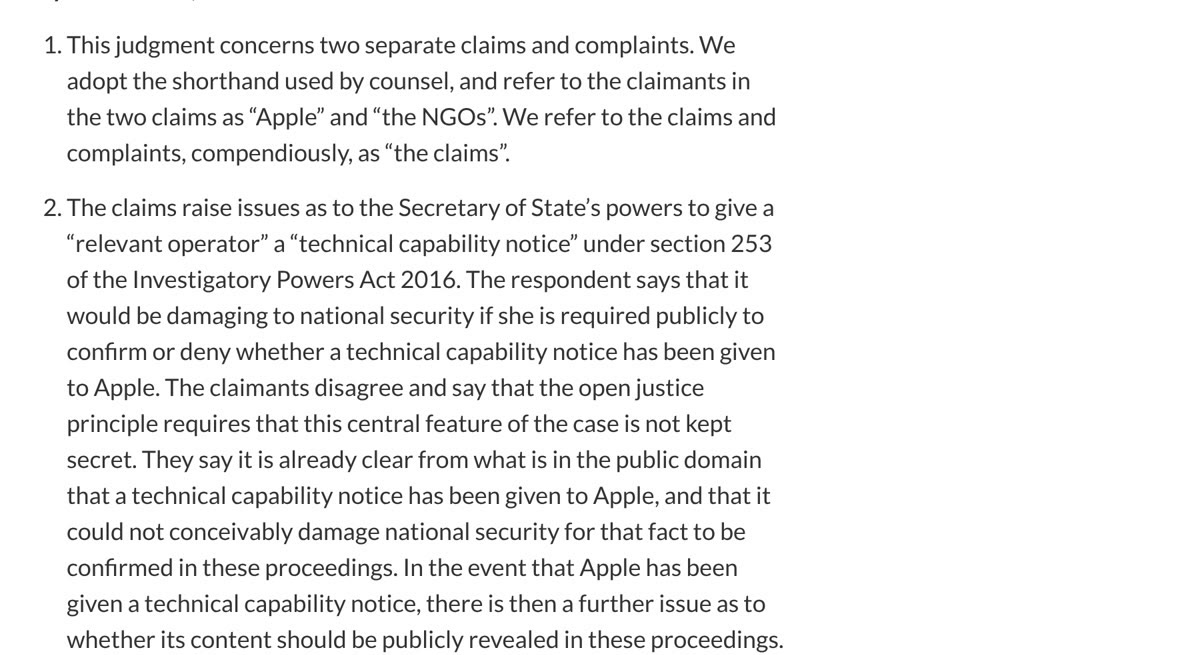 The opening of the tribunal’s judgment, from the Investigatory Powers Tribunal. Image: Investigatory Powers Tribunal
Why the tribunal said the secret was already out
Three judges, Lady Carmichael, Mr Justice Chamberlain and Mr Justice Johnson, heard Apple’s claim alongside one from campaigners, Privacy International and Liberty. The government argued that its policy of “neither confirm nor deny” only works if it is applied every time.
The tribunal did not dismiss that. It accepted that the executive may take a precautionary approach to national security. But it found the government had not been consistent. It inferred that briefings reported by The Times and the Financial Times took place and were authorised. It also noted that Apple was allowed to brief senior US officials.
The result, in the judgment’s words: “anyone with even a passing interest in this topic already knows” that a notice was served. The difference between strong suspicion and confirmation was, it said in this context, “a distinction without a difference”. Paragraph 51 then states: “We reject the respondent’s contention that it would be damaging to national security to confirm the fact that the respondent has given Apple a technical capability notice.”
What is still secret about the Apple UK encryption order
The judgment does not say what the notice requires. It says the detail is “another matter” and should be decided later, after evidence is exchanged. The tribunal even agreed that disclosing everything would harm national security.
So treat anything about content as reported. The judgment summarises press coverage saying the notice requires Apple to keep access to users’ data in decrypted form, so it can be passed to intelligence agencies. The government has not set out in the tribunal what the notice requires.
Apple’s five grounds ask, in short, whether the law lets the Home Secretary make such an order at all, whether the consultation was proper, whether the order is proportionate under human rights law, and whether Apple was treated differently from other firms.
A government spokesman told the Telegraph that decisions on public safety belong with elected governments and independent judges, “not in the boardrooms of technology companies”. Apple did not comment, the Telegraph reported.
If you use an iPhone, what the ruling leaves unchanged
Nothing changes today. Per Apple Support (Apple’s support page, dated September 2025), Advanced Data Protection is not available to new UK users, and existing users were told they would be given a period of time to turn it off themselves. Apple says 15 iCloud categories stay end-to-end encrypted by default, and that iMessage and FaceTime remain end-to-end encrypted in the UK. The ten extra categories that the optional setting covers, such as iCloud Backup, Photos and Notes, fall back to standard protection in the UK. Because that page is dated September 2025, check Apple’s page and your own iCloud settings for anything newer. Our story on how iCloud treats shared links covers a gap Advanced Data Protection never closed.
The ruling does not cancel the order.
Why should readers elsewhere care? In our reading, large platforms often build one security design for many countries, so one country’s order can become a global question. The judgment records US officials’ close interest in 2025.
Two duties, and one question still open
In our view, the ruling is a fair step for both sides. Open courts matter, and the tribunal’s own earlier reasoning says it is undesirable for important legal questions to be settled entirely in secret. Equally, police and intelligence services have a real duty to protect the public, and the tribunal accepted that some details must stay closed.
The tribunal did not rule on whether the order is lawful, necessary or proportionate. On balance, this is a ruling about consistency and open process, not about who is right. A calm, public argument over the five grounds is more likely to serve users and security than silence.
Watch the directions for the 2027 hearing. How much of the fourth and fifth grounds the tribunal can hear in public will show how open this case can truly be.
Prefer to watch? Follow us on YouTube
The tech stories that matter, explained in plain words. Subscribe so you never miss one.
Quick answers
Can I still use Advanced Data Protection in the UK?
For new users, no, according to Apple. Existing users should read Apple's support page, which gives no deadline.
Has the government said what the order demands?
Not in the tribunal. The detail is a separate question for later. Press reports say it concerns access to encrypted data, but that is reported, not confirmed.
Is iMessage still end-to-end encrypted in the UK?
Apple says yes. It says iMessage and FaceTime stay end-to-end encrypted globally, including in the UK.
What happens next?
The parties are aiming for a full hearing in the first half of 2027, per the judgment. Parts of it may be held in private or closed sessions.
Words to know
- Technical capability notice
- A notice under section 253 of the Investigatory Powers Act 2016, as the judgment describes it.
- Neither confirm nor deny (NCND)
- A government policy of neither confirming nor denying a fact, to protect secret intelligence. The judgment says it works only if applied consistently.
- Investigatory Powers Tribunal
- A UK court that hears complaints about the use of surveillance powers. It can hold hearings in public, in private or in closed sessions.
- End-to-end encryption
- A way of scrambling data so that only you and the person you share it with can read it, not even the company that carries it.
- Advanced Data Protection
- An optional Apple setting that extends end-to-end encryption to more iCloud data, such as backups, photos and notes.
Sources (5): every key fact checked against at least two
- Investigatory Powers Tribunal: OPEN judgment [2026] UKIPTrib 9 (PDF)
- Investigatory Powers Tribunal: Apple Inc v Secretary of State for the Home Department
- Apple Support: Advanced Data Protection for iCloud (UK)
- The Telegraph via Yahoo: Britain forced to admit secret Apple order
- City AM: UK government loses bid to keep Apple surveillance order secret
Related stories
FBI hacked again? Reports say hackers reached the police crime database, as USDA fights a breach
FBI hacked again? CNN reports a break-in at NCIC, the police crime database, and USDA is recovering from a cyber attack. Here is what is confirmed.

Google Assistant shut down: your Nest speaker needs a free upgrade by August 2027
Google Assistant shut down is set for 2 August 2027 on Nest speakers and displays. Here is what owners must do, what it costs and what changes in January.

PHP fixes seven critical flaws in every supported version: what site owners should do
The php security update of 19 November (8.5.13, 8.4.28, 8.3.37, 8.2.36) fixes seven critical flaws. Here is what site owners and hosting users should do.