Microsoft Q1 2027 earnings: Azure grows 48% as AI demand rises, while Windows PC sales fall 22%
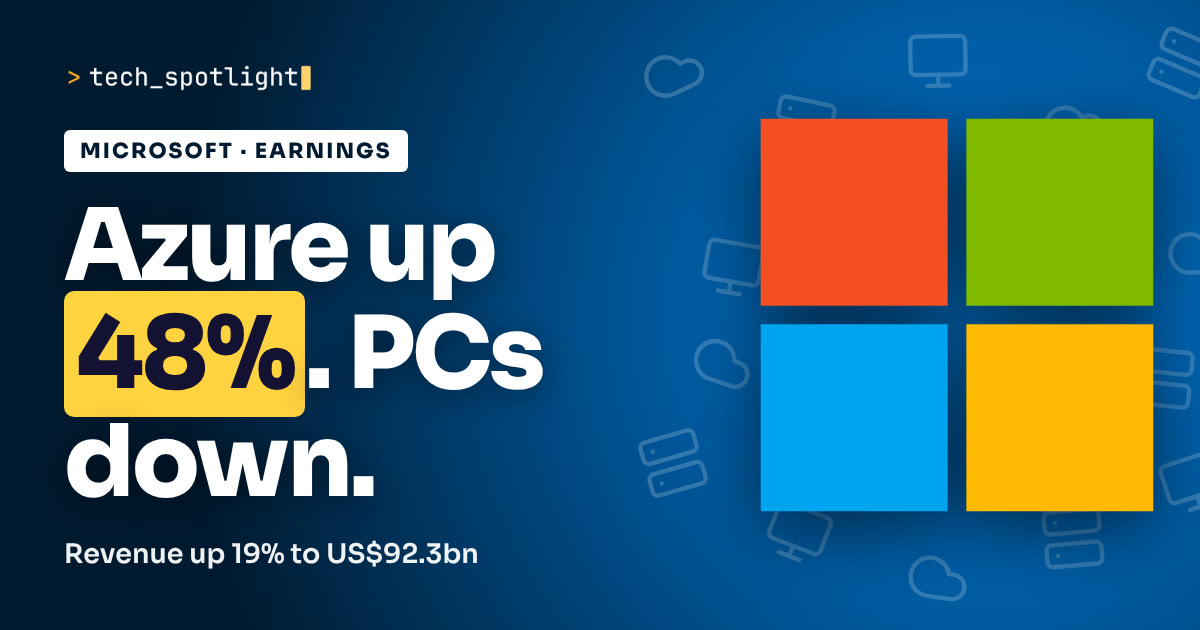
- Microsoft's revenue rose 19% to US$92.3 billion in July to September, and its Azure cloud grew 48%.
- Revenue from Windows on new PCs and Microsoft's own devices fell 22%, as last year's Windows 10 upgrade rush faded and the PC market weakened.
- OpenAI paid Microsoft US$10 billion in the quarter, and Microsoft plans to spend about US$170 billion on data centres and chips this financial year.
Somewhere today, an office worker will ask Copilot to summarise a long email thread, and a developer will rent a few hours of AI computing on Azure. Those small moments now add up to Microsoft’s fastest-growing business. Meanwhile, fewer people are buying new Windows PCs.
The Microsoft Q1 2027 earnings, released on 28 October, show both trends. Microsoft’s financial year starts in July, so this “first quarter” covers July to September 2026. Revenue rose 19% to US$92.3 billion. Azure, the cloud service that rents out computing power, grew 48%. But Windows revenue from PC makers and Microsoft’s own devices fell 22%.
Microsoft Q1 2027 earnings: where the US$92.3 billion came from
Microsoft’s official release, filed with the US Securities and Exchange Commission, gives these figures:
- Revenue: US$92.3 billion, up from US$77.7 billion a year ago.
- Operating income: US$45.9 billion, up 21%. That is about half of every dollar of sales.
- Net income: US$36.6 billion, up 32%. Adjusted earnings per share were US$4.89, above the roughly US$4.73 analysts expected.
- Microsoft Cloud: US$63.9 billion, up 30%. Amy Hood, Microsoft’s chief financial officer, said growth was “accelerating”.
- Future contracts: customers have signed US$677 billion of business not yet delivered, up 73%.
- Free cash flow: US$18.6 billion, the cash left after spending on equipment, down from US$25.7 billion a year ago.
Part of the profit jump is an accounting effect. A year ago, Microsoft’s stake in OpenAI cut its profit by US$3.1 billion. This quarter it added US$207 million. Without that effect, profit rose 18%.
It is also the first report since Microsoft’s reporting segment changes, announced in September. “Agents and Infra” holds the cloud, Azure and Microsoft 365, and grew 25% to US$76.8 billion. “Devices and Consumer” holds Windows, Xbox and search ads, and slipped 3% to US$15.5 billion.
The PC side cools as the Windows 10 rush fades
Inside that smaller segment, Windows OEM and Devices revenue fell 22%. Microsoft’s quarterly filing gives three reasons: last year’s demand from people replacing computers before Windows 10 support ended, PC makers and shops running down their stock, and a weaker PC market. Xbox content and services fell 2%, and Xbox hardware revenue dropped 14%. Search ads, excluding the cost of buying traffic, grew 12%.
One big customer, and a bigger building bill
The filing shows how closely Microsoft is tied to OpenAI. OpenAI paid Microsoft US$10.0 billion in the quarter, nearly 11% of all revenue, and owed it US$7.2 billion at the end of September, up from US$6.0 billion in June. Microsoft owns about 24% of OpenAI.
Microsoft capex (capital spending) was US$45.2 billion, including leases, below the more than US$50 billion it had pointed to in July. On the call, Hood said spending will pass US$50 billion this quarter and reach about US$170 billion for the financial year, as more third-party capacity arrives in the second half. She expects free cash flow to stay positive.
For October to December, Microsoft expects revenue of US$96.0 to 97.1 billion and Azure growth of 49% to 50% in constant currency. After the MSFT earnings, the shares rose a few per cent in after-hours trading.
If you use Windows, Copilot or Azure, or save through a fund
For businesses and developers, Azure demand is strong and Microsoft is still racing to add capacity. Expect new AI features to keep arriving, but keep an eye on prices and availability in your region.
For PC buyers, a slower market can mean better deals, though the report says nothing about prices. For gamers, Microsoft’s own games earned more, while Game Pass and console revenue fell.
For savers, Microsoft sits in many index funds and pension plans. Profit and cash came in ahead of forecasts. This is not investment advice.
Disciplined growth, with two cautions
On balance, this is a strong quarter. Azure grew faster than analysts expected while spending came in below plan, which suggests Microsoft is getting more from the capacity it already has. Unlike Alphabet and Meta, whose free cash flow turned negative in the same months, Microsoft still brings in more cash than it spends. Suppliers such as SK hynix are posting record profits from this spending.
There are two cautions, in our analysis. First, OpenAI now provides about a tenth of revenue and owes Microsoft more each quarter. That is a deep partnership, but also a concentration risk. Second, US$170 billion is a large bet that demand will last. The likelier outcome is that Microsoft carries this comfortably, because its software business still earns steady cash.
Two lines to watch in January
Next quarter, watch whether Azure really reaches 49% to 50% growth, and whether money owed by OpenAI keeps rising. If both hold, the AI build-out is paying its way. If Azure slows while the OpenAI bill keeps growing, the risk is quietly building.
Sources (5): every key fact checked against at least two
- SEC: Microsoft 8-K Exhibit 99.1, Microsoft Announces First Quarter Results (28 Oct 2026)
- SEC: Microsoft Form 10-Q for the quarter ended 30 September 2026
- CNBC: Microsoft stock jumps 4% as cloud growth drives earnings and revenue beat
- investingLive: Microsoft sees $170bn capex in fiscal 2027 but says it will stay cash flow positive
- Yahoo Finance: Microsoft earnings live coverage (28 Oct 2026)
Related stories

eBay Q3 2026 earnings: collectibles, live shopping and Depop lift revenue 14%, a week after job cuts
eBay Q3 earnings 2026: revenue rose 14% to $3.2 billion, beating its forecast, a week after eBay said it would cut 9% of staff. Here's what drove it.

Alphabet Q3 2026 earnings: Google Cloud doubles, but AI building pushes cash flow below zero
Alphabet Q3 earnings 2026: revenue rose 25% to US$127.6bn and Google Cloud doubled, but AI building costs left free cash flow negative again.

Jio Platforms opens 21% above its IPO price and becomes India's second most valuable company
Jio Platforms listing price was ₹1,358, 21% above the ₹1,119 IPO price, making it India's No. 2 company by value. What it means for users and investors.