Developing story
California subpoenas Nvidia: did chips or secrets reach China, and were investors misled?
- California Attorney General Rob Bonta served Nvidia with an investigative subpoena on 19 November.
- He wants to know if Nvidia chips or confidential information reached China, and if investors were misled.
- A subpoena is a request for information, not a charge. Nvidia had not commented publicly as of 20 November.
- 19 NovDate the subpoena was servedAnnounced by the Attorney General
- 2Questions the state says it is askingChina, and investors
- 17 NovNvidia board creates oversight panelExport control and security

On Thursday, California’s top law officer put Nvidia’s China question into a formal legal demand.
California Attorney General Rob Bonta said he had served Nvidia with an investigative subpoena. He wants answers on two points: did any of Nvidia’s advanced chips or confidential information end up in China, and did the company mislead investors and the public about that risk?
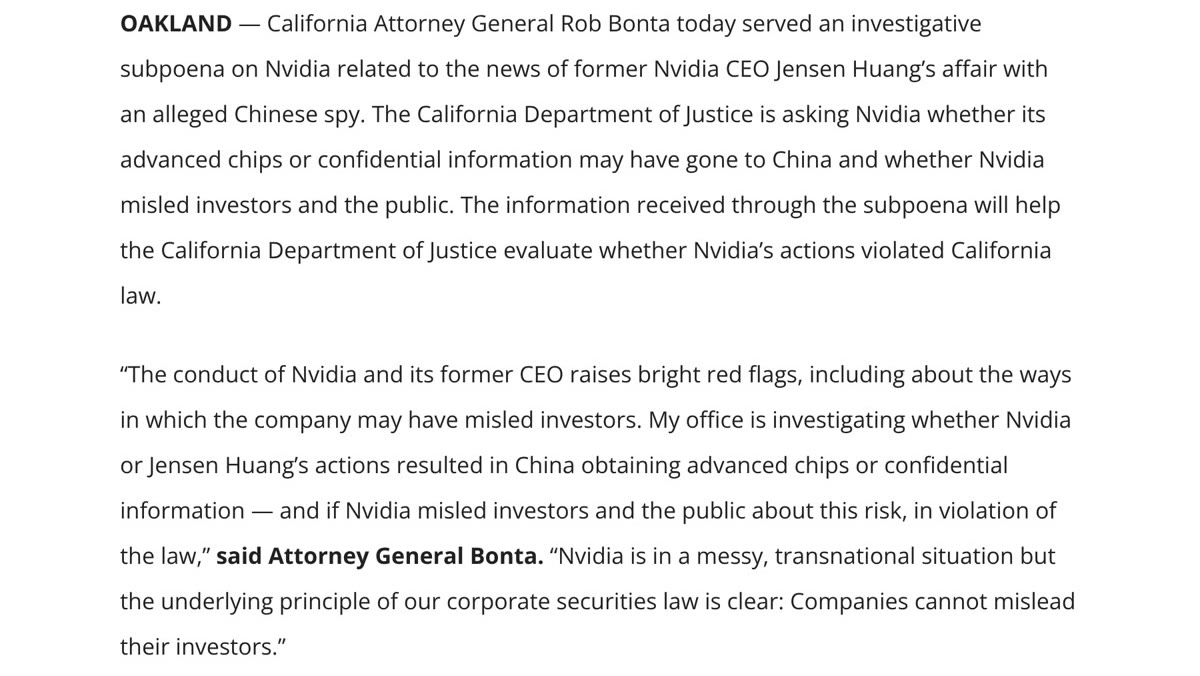 The Attorney General’s announcement on oag.ca.gov. Image: California Department of Justice
This Nvidia investigation into China links is the latest step in a fast-moving story. In less than two weeks Nvidia has gone from a board review to a CEO resignation, a request from the Senate Banking Committee’s chair and now a state investigation. For Nvidia’s shareholders, and for anyone who follows how chips and national security meet, the questions now sit inside a legal process.
Nvidia investigation China: what the Attorney General is asking
The release says the subpoena relates to news of former Nvidia CEO Jensen Huang’s affair with “an alleged Chinese spy”. That is the Attorney General’s wording, and we repeat it as his description, not as a finding. We are not naming the other person involved.
The release says the information will help the California Department of Justice “evaluate whether Nvidia’s actions violated California law”. The Attorney General said the conduct “raises bright red flags”, and that “the underlying principle of our corporate securities law is clear: Companies cannot mislead their investors.”
The release does not say which legal provision is being used or what documents are demanded. The subpoena itself has not been published.
A subpoena is a question, not a verdict
It helps to be exact about the word. A subpoena is a demand for information. It is not a charge, and it is not a lawsuit. The release itself speaks of evaluating whether the law was broken, which means that has not been decided. The release gives no deadline for Nvidia’s reply and does not say how the inquiry could end.
Nvidia had not commented publicly on the subpoena as of 20 November, and its newsroom carried no statement. CNBC and the Los Angeles Times said Nvidia did not immediately respond to requests for comment, and the BBC said it had contacted the company. We will add its reply when there is one.
What Nvidia has said is on a related subject. On 17 November its board announced a new National Security and Export Control Oversight Committee, chaired by director Suzanne Nora Johnson. Board chair Harvey Jones said Nvidia is “committed to working constructively with government and industry partners”. That statement came before the subpoena and is not a reply to it. Reuters and the BBC report that China has rejected the espionage allegations.
If you own Nvidia shares, or just watch the chip race
Nvidia is headquartered in Santa Clara, California, so this is a home-state inquiry, though its customers and shareholders are worldwide. If you hold the stock, directly or through a fund, the useful question is not what the headlines imply, but what the company discloses next. Official statements and filings, not commentary, are where new facts will show up.
Rumour: Reuters says the US Securities and Exchange Commission is also reportedly looking into Nvidia. Neither the SEC nor Nvidia has confirmed this.
The story has also been moving elsewhere. Our earlier coverage follows the board’s independent review and the Senate Banking Committee chair’s request for Huang to testify.
Investor protection on one side, trial by headline on the other
In our view, there is a fair case for the Attorney General’s move. Investors rely on companies to describe their risks honestly, and when a company’s biggest risk is suddenly in the news, asking early questions is what a state regulator is for. A formal subpoena also gives Nvidia a structured way to answer.
There is a fair case for caution too. Words like “spy” and “red flags” travel faster than the facts behind them, and a subpoena can be read as guilt when it is only an inquiry. The release asks questions rather than stating results, and readers should hold it to that standard.
On balance, the calmest reading is the right one: California has asked, Nvidia has not yet answered in public, and the law will decide what the facts mean. Nvidia’s new oversight committee is a reasonable first step; whether it answers California’s questions is for the regulators to judge.
What to watch next
Watch for Nvidia’s first public response, any word on how it will cooperate, and whether the subpoena’s scope is ever made public. Until then, the honest answer to most questions is that nobody outside the inquiry knows yet.
Prefer to watch? Follow us on YouTube
The tech stories that matter, explained in plain words. Subscribe so you never miss one.
Quick answers
What is an investigative subpoena?
It is a legal order to hand over documents or answer questions during an investigation. It is not a charge or a lawsuit, and it does not mean any wrongdoing has been found.
Is Nvidia under investigation?
California's Department of Justice says it is investigating, and Nvidia's own board has a review under way. Reports of a separate US SEC probe have not been confirmed by an official source.
Why is California investigating Nvidia?
The Attorney General links the subpoena to news of former CEO Jensen Huang's affair with what he calls "an alleged Chinese spy". He wants to know if Nvidia chips or confidential information reached China, and if investors were misled.
What has Nvidia said about the subpoena?
Nothing public as of 20 November. Nvidia's newsroom had no statement on it.
Words to know
- Subpoena
- A legal order to hand over documents or give testimony.
- Attorney General
- A state's top law officer, who can investigate companies and bring cases.
- Securities law
- Rules on how companies sell shares and what they must tell investors.
- Export controls
- Government rules on which goods, such as advanced chips, can be sold to which countries.
Sources (6): every key fact checked against at least two
- California Attorney General: Bonta Serves Investigative Subpoena on Nvidia (19 Nov 2026)
- Nvidia: Board establishes National Security and Export Control Oversight Committee (17 Nov 2026)
- CNBC: California subpoenas Nvidia
- Reuters, via Bradenton Herald
- Los Angeles Times: California subpoenas Nvidia
- BBC, via Yahoo Finance
Related stories

National cyber director Sean Cairncross is out after a week of US outages, and accounts of why differ
Sean Cairncross is leaving as US national cyber director after a week of outages. Sources disagree on whether he was fired. Here is what is on the record.
Nvidia's board says it does not intend to bring Jensen Huang back as CEO, as a petition for his return grows
Jensen Huang return: Nvidia's board chair said on the 17 Nov earnings call it does not intend to reinstate him as CEO. What we know and what comes next.

Samsung gives memory and phones their own new bosses, while both CEOs stay
Samsung leadership change: three chip leaders become Presidents and Won-Joon Choi takes over phones, while CEOs Young Hyun Jun and TM Roh stay on.