Developing story
GitLab patches Ruby2Shell, and GnuPG fixes a GPGME flaw: who needs to update
- On 20 November GitLab shipped a critical patch release (19.6.1, 19.5.8, 19.4.10) for Ruby2Shell, a Ruby flaw that Ruby says may allow remote code execution.
- The same day GnuPG published a fix for a critical GPGME flaw, which GitLab reported. Attacks are not reported for either so far.
- Self-managed GitLab admins should upgrade now. Gpg4win and mail-client users should update GPGME or Gpg4win 5.1.2. GitLab.com users need to do nothing.
- 3GitLab versions patched19.6.1, 19.5.8, 19.4.10
- 7Ruby flaws fixed togetherRuby 4.0.10, 3.4.13, 3.3.14
- 7.4NVD score for Ruby2ShellHigh; Ruby rates it Critical
- 8 daysGPGME bug: report to disclosure12 to 20 Nov, 5 days early

If you run GitLab on your own servers, your week just got a task. On 20 November, GitLab released a critical patch release for a flaw in Ruby, the language it is built on. This GitLab security update asks all self-managed installations to upgrade “immediately”.
The same day, GnuPG published a fix for a separate critical flaw in GPGME, a library behind much encryption software. GitLab reported that bug, and the two stories are linked by timing.
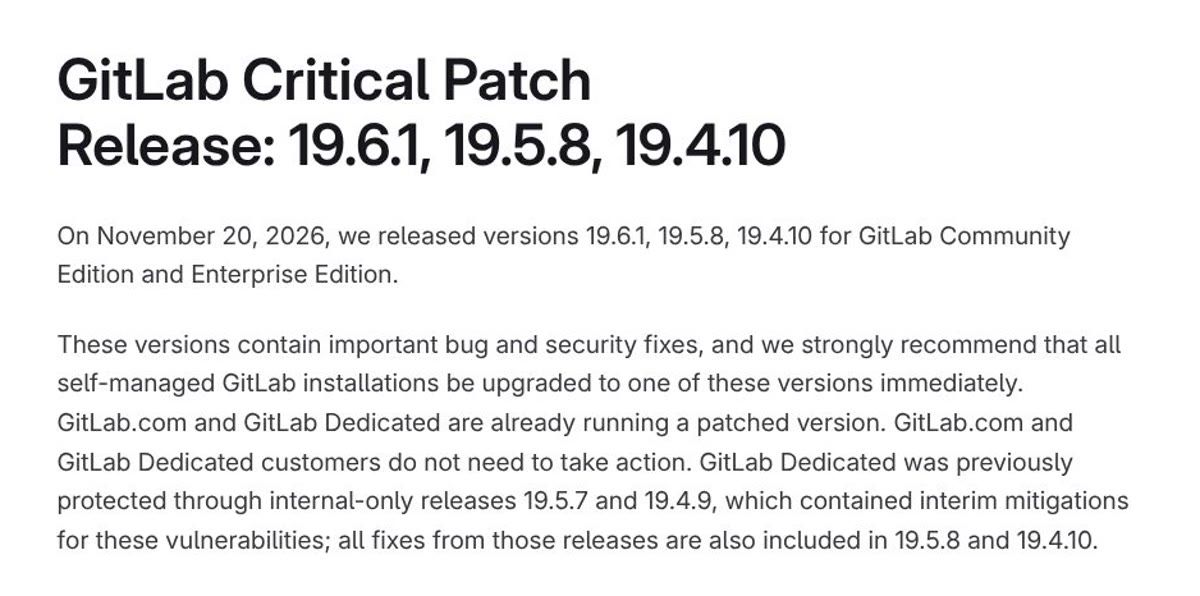 GitLab’s release post on docs.gitlab.com. Image: GitLab
One Ruby bug behind this GitLab security update
GitLab’s patch release covers versions 19.6.1, 19.5.8 and 19.4.10, for Community and Enterprise editions. It lists one security fix, CVE-2026-132825, known as Ruby2Shell. The name comes from Veria Labs. It is a bug in Ruby itself, not in GitLab’s own code.
In plain terms, in certain conditions a specially made piece of text can make Ruby write past the end of a block of memory (an out-of-bounds write) when its letters are switched between upper and lower case. Ruby says this may allow remote code execution “in some scenarios”. The Ruby team rates it Critical, and GitLab used that rating. The US National Vulnerability Database (NVD) lists it as High, 7.4 out of 10.
Ruby’s own fixed releases are 4.0.10, 3.4.13 and 3.3.14, which also close six more regex and string flaws. GitLab includes all of them.
In our analysis, when the bug sits in the language rather than the app, every product built on it has to ship a fix at once. PHP went through the same thing this week, as we reported in PHP’s seven critical flaws.
A second flaw, and what GitLab has not said
GnuPG’s advisory describes CVE-2026-129975, a double-free bug. A crafted OpenPGP key with a very long user ID can trigger it. GnuPG says it can be used to leak data from applications, and that code execution “can’t be ruled out”. Johan Carlsson found it. This GPGME vulnerability affects every version before 2.3.0, and the fix is GPGME 2.3.1.
GnuPG says GitLab told it on 12 November. The plan was to disclose on 25 November, but “due to the new Ruby2Shell bug GitLab had to update earlier”, GnuPG published on 20 November instead.
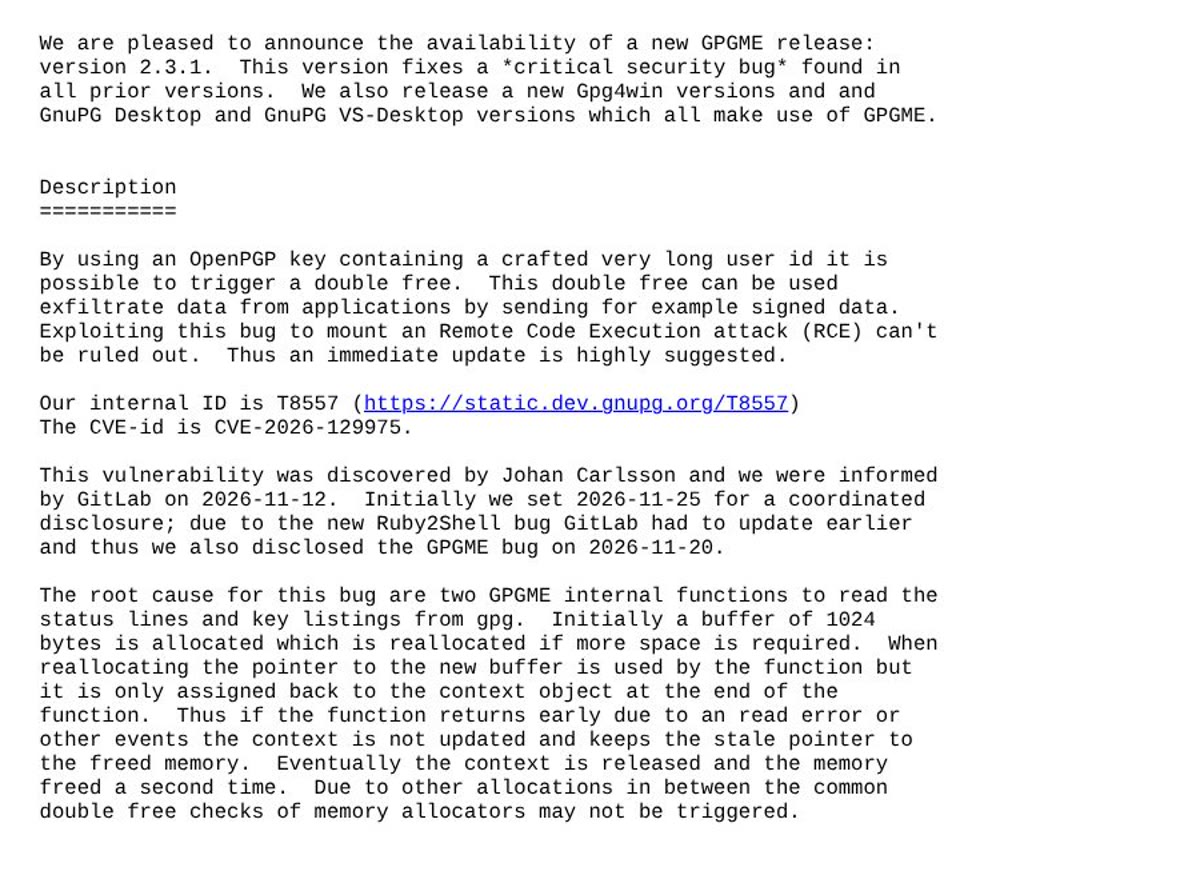 GnuPG’s advisory on lists.gnupg.org. Image: GnuPG
Here is what is not confirmed. GitLab’s release post never mentions GPGME. GitLab’s own packaging repository does have a commit patching gpgme, but we could not confirm which release ships it or how GitLab uses the library. Until GitLab says otherwise, do not assume 19.6.1 covers the GPGME bug.
What to do, depending on what you run
- GitLab.com or GitLab Dedicated: nothing. GitLab says both are already patched.
- Self-managed GitLab: upgrade to 19.6.1, 19.5.8 or 19.4.10. GitLab says its official Linux packages and container images already include the patched Ruby. If you compile GitLab yourself, rebuild Ruby with 3.3.14 or 3.4.13, or later in the same series. There are no new migrations, and multi-node setups should not need downtime.
- Other Ruby apps: Ruby 3.3.13 and older, 3.4.0 to 3.4.12 and 4.0.0 to 4.0.9 are affected. Ruby 3.2 and older are end of life, with no fix. Veria Labs and some security vendors say Rails and classic Sinatra apps in default setups can be reached without logging in. That is their claim, so check your own setup.
- Gpg4win and GPGME users: on Windows, install Gpg4win 5.1.2. Elsewhere, update GPGME to 2.3.1. GnuPG names mail clients, many XMPP chat clients, Samba and Flatpak among software that may use it. Check your distribution’s updates.
Why a quick patch is a good sign
In our analysis, the response here looks healthy. Ruby published fixes first, GitLab patched GitLab.com and GitLab Dedicated before its public release, and GnuPG brought its disclosure forward to match GitLab’s early release. For admins, a clear fix and a clear version number make the job simple. Neither flaw is on CISA’s list of known exploited flaws (checked 21 November).
The harder part is the gap in what we know. Attacks are not reported as of 21 November, but that is a statement about reports, not about safety. Ruby says it knows of working proofs of concept for some of the seven flaws. And GPGME sits inside many tools that people forget they have installed. In our reading, the second flaw will take longer to clean up than the first, because it is spread across many apps and distributions.
None of that changes the advice. Updating is a short job. Leaving a critical flaw open on a server facing the internet is the larger risk.
Next, watch for your distribution’s GPGME update and for any report of real attacks. The fixes exist. What remains is getting them onto every machine that needs them.
Prefer to watch? Follow us on YouTube
The tech stories that matter, explained in plain words. Subscribe so you never miss one.
Quick answers
What is Ruby2Shell?
It is the name Veria Labs gave to CVE-2026-132825, a bug in the Ruby language. Changing the case of a crafted string can write outside its memory. Ruby says this may allow remote code execution in some scenarios.
Do GitLab.com users need to act?
No. GitLab says GitLab.com and GitLab Dedicated already run a patched version, and their customers do not need to take action.
How do I fix a self-managed GitLab?
Upgrade to 19.6.1, 19.5.8 or 19.4.10. If you compile GitLab yourself, rebuild Ruby with 3.3.14 or 3.4.13, or a later release in the same series.
Who needs the GPGME fix?
Anyone running software that uses GPGME before 2.3.0. Update GPGME to 2.3.1. On Windows, install Gpg4win 5.1.2.
Are these flaws being exploited?
Attacks are not reported for either flaw as of 21 November. Neither appears in the US CISA list of exploited flaws.
Words to know
- Double free
- A bug where a program releases the same piece of memory twice. It can crash the program or open a way in for an attacker.
- Out-of-bounds write
- Writing data past the end of a block of memory. This can corrupt a program or let an attacker take control.
- Remote code execution (RCE)
- When an attacker over a network can make a computer run commands of their choosing.
- GPGME
- A library, a shared piece of code, that lets apps use GnuPG for encryption and signatures.
- Self-managed
- GitLab that you or your company installs and runs on your own servers, rather than using GitLab.com.
Sources (7): every key fact checked against at least two
- GitLab: Critical Patch Release 19.6.1, 19.5.8, 19.4.10
- GnuPG: Security Advisory for GPGME (CVE-2026-129975)
- Ruby: Multiple vulnerabilities in Regexp and String
- NVD: CVE-2026-132825
- Gpg4win: change history (5.1.2)
- GitLab omnibus-gitlab commit: Patch gpgme to fix double free
- watchTowr: Ruby CVE-2026-132825 FAQ
Related stories
Hackers got inside Check Point management servers at 22 organisations, GreyNoise says
GreyNoise says GT13 broke into 22 organisations and used a Check Point management server vulnerability. What is known, and what admins should do.

Tidal AI ban: fully AI songs will be removed from 9 December, and AI-assisted ones stay
Tidal AI ban: from 9 December, songs Tidal judges 100% AI-generated are rejected and removed. What changes for listeners and independent artists.

FBI hacked again? Reports say hackers reached the police crime database, as USDA fights a breach
FBI hacked again? CNN reports a break-in at NCIC, the police crime database, and USDA is recovering from a cyber attack. Here is what is confirmed.