Google's Gemini Decisions API gives fast yes-or-no AI answers, each with a score for how sure it is
- Google has launched the Gemini Decisions API, which answers yes/no, multiple-choice and rating questions instead of writing long replies.
- Every answer comes with a confidence score from 0 to 1, so apps can send unsure cases to a person.
- It costs $0.10 per million input tokens, output is free, and there is a free tier. Google Cloud support is coming soon.
- $0.10Per million input tokensOutput is free (checked 11 Nov 2026)
- 1,000Questions in a single requestAll about one shared input
- 150-250 msGoogle's end-to-end answer timeRoughly a fifth of a second
- 256KTokens of shared input per requestText, images, audio, video or PDFs
Picture a photo of an office kitchen counter. Is there a spill? What should the cleaner do? How bad is it? In Google’s own demo, a new AI tool answers all three questions in a fraction of a second, and it says how sure it is about each one.
That tool is the Gemini Decisions API, launched today by Google and built by Google DeepMind. It does not chat. It picks from answers a developer has already written out, and adds a number showing its confidence.
A day after Google opened its strongest model, Gemini 4 Carbon, to paying developers, this launch goes the other way: small, fast and cheap. In practice, much of the AI inside everyday apps is quiet sorting, not conversation: is this message spam, does this photo break the rules. Google has built a tool just for that.
What the Gemini Decisions API does, and what it costs
The API runs on a new model, Gemini Decision 1. It handles three kinds of question. A yes/no question gets the chance that a statement is true. A choice question picks one of 2 to 255 options, with a chance for each. A score question places the input on a rating scale.
One request can hold a single shared input of up to 256,000 tokens, mixing text, images, audio, video and PDFs, plus up to 1,000 separate questions about it. A token is a small piece of content that AI services count and bill. Google says answers arrive in 150 to 250 milliseconds from start to finish, roughly a fifth of a second.
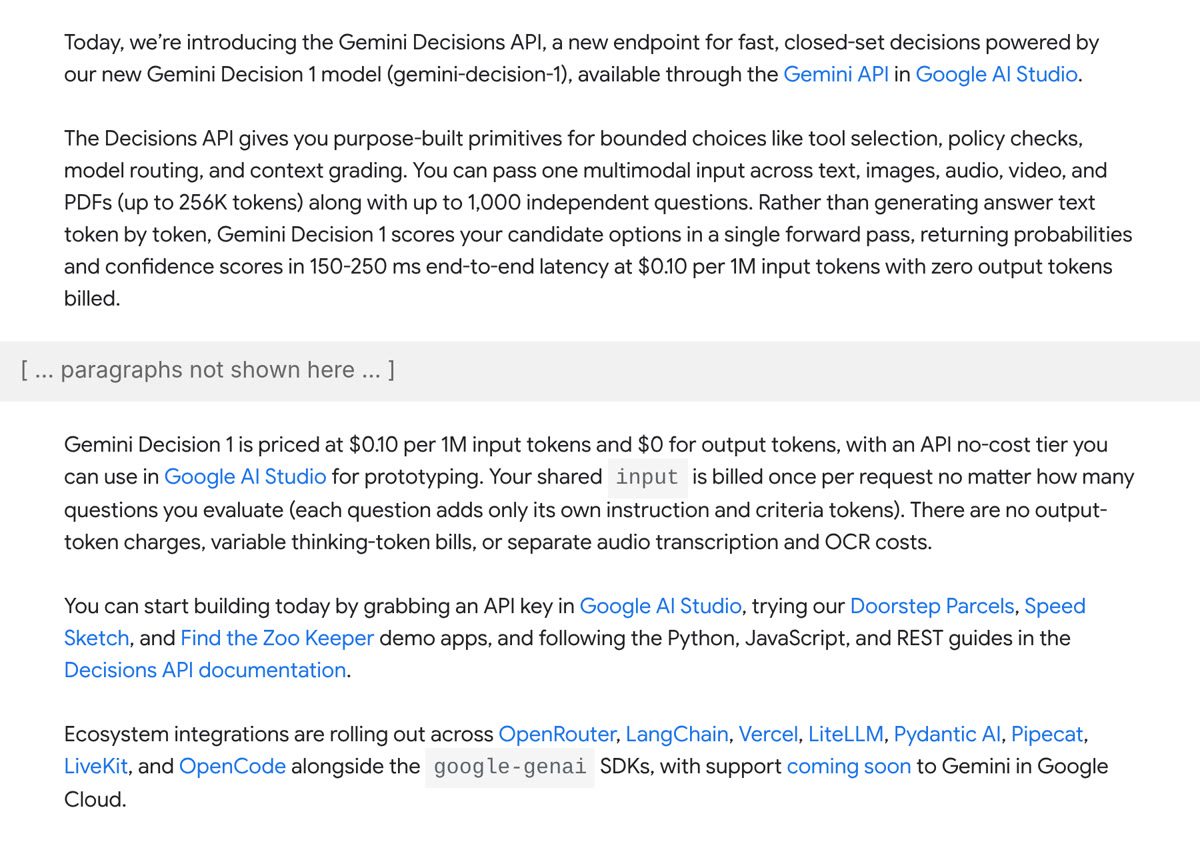 Excerpts from Google’s announcement, as published on the Google blog on 11 November. Image: Google
On Gemini API pricing, Google charges $0.10 per million input tokens for every kind of input, and nothing for output (checked 11 November 2026). The shared input is billed once, however many questions you ask. There is a free tier for prototyping. It is live today in Google AI Studio; support for Gemini in Google Cloud, which includes Vertex AI, is “coming soon”.
Google's published rate limits for Gemini Decision 1, checked 11 November 2026. Google says limits are not guaranteed. The free tier also allows 10,000 requests a day. Source: Google AI Studio: Gemini API rate limits
Why a number for “how sure” matters more than a polished reply
So what is a confidence score in AI? Here, it is a number from 0 to 1. A score of 0.95 means the model is very sure; 0.55 on a yes/no question is close to a coin toss. Google calls the scores “calibrated”, which means they should match reality: of all answers marked 0.8, about eight in ten should be right.
For a business, that number is the point. A chatbot sounds equally confident whether it is right or wrong. A score lets a company set a rule, such as “below 0.8, a person checks it”. Google suggests exactly this: send unclear cases to a backup system or a human reviewer.
Google already uses the model in its own products. Gemini Notebook uses it to send each question to the right size of model, which Google says cuts waiting on everyday questions by up to 40%. Google Search uses it as a safety layer.
Fast and cheap on Google’s tests; outsiders haven’t checked yet
The bold claims are Google’s own. It says the Gemini Decision model leads its benchmark suite, has the lowest calibration error, and is “nearly 5x cheaper” than Gemini 3.5 Flash-Lite with its Interactions API on those tests. No independent group has tested these claims yet.
Gaps remain. Google has not said which countries can use it, there is no Batch API or context caching, and Google says its rate limits are not guaranteed.
For developers, a cheap trial; for everyone else, quieter decisions
If you build apps, the free tier makes this low-risk to try. Run your own sorting tasks through it, then check whether its 0.8 really means right eight times in ten. Support in tools such as OpenRouter, LangChain and Vercel is rolling out.
If you never write code, you may still meet Gemini Decision 1 without knowing it, in apps that route questions or check safety. Those choices are invisible to most people, so an honest measure of doubt matters.
An honest “maybe” is the most useful feature here
On balance, this looks like a sensible launch. It is cheap and fast, and building in doubt is a mature design choice. Teams using large models for simple sorting could save money and time.
The caution is just as real. The confidence scores are only useful if they are truthful, and today only Google has measured that. In practice, tools like this usually win trust slowly, one outside test at a time.
Watch for the first independent calibration tests, and for the Google Cloud launch date. A tool that admits when it is unsure earns trust only if its “sure” proves right.
Prefer to watch? Follow us on YouTube
The tech stories that matter, explained in plain words. Subscribe so you never miss one.
Quick answers
What is the Gemini Decisions API?
A new part of Google's Gemini API that answers fixed questions (yes/no, pick one option, or a rating) about text, images, audio, video or PDFs, and gives each answer a confidence score.
How much does Gemini Decision 1 cost?
$0.10 per million input tokens, with no charge for output, as checked on 11 November 2026. There is also a free tier for trying it out.
What is a confidence score in AI?
A number from 0 to 1 that shows how sure the AI is about its answer. A score near 1 means very sure; near 0.5 for a yes/no question means it is close to a coin toss.
What is a good confidence score?
It depends on the risk of a wrong answer. Google gives no fixed number; it suggests sending unclear cases to a backup system or a person.
Is the Gemini Decisions API on Vertex AI?
Not yet. Google says support in Gemini in Google Cloud is coming soon, without a date.
Words to know
- API
- A way for apps and programs to use an AI model directly, paid by how much they use.
- Token
- A small piece of text (or image, sound or video) that AI services count and charge for.
- Confidence score
- A number from 0 to 1 showing how sure the AI is that its answer is right.
- Calibrated
- The score matches reality: of answers marked 0.8, about 8 in 10 should be right.
- Multimodal
- Able to take in several kinds of input, such as text, pictures, sound and video.
- Model routing
- Sending each request to the AI model best suited to it, such as a smaller, faster one.
Sources (6): every key fact checked against at least two
- Google: Gemini Decisions API: Fast, calibrated multimodal decisions (Min Choi and Felix Yu, Google DeepMind, 11 November 2026)
- Google AI Studio: Gemini API pricing
- Google AI Studio: Gemini API rate limits
- Mezha: Google introduces Gemini Decisions API (11 November 2026)
- DEV Community: Google introduces Gemini Decisions API (11 November 2026)
- OpenRouter: Google Gemini Decision 1 model page
Related stories

United Airlines bans personal AI agents from booking its flights, even through travel agencies
The United Airlines AI booking ban stops personal AI agents buying tickets, even via travel agencies. Why United did it and what travellers should do now.
Google opens Gemini 4 Carbon to paying developers and AI Ultra users, with a price rise due 1 December
Gemini 4 Carbon is now open to paying developers and Google AI Ultra users. Who gets it, the price until 30 November, and what the new swarm feature does.

Airbnb is building its own AI travel agent, and says a chatbot is the wrong way to plan a trip
The Airbnb AI travel agent starts rolling out in the first half of 2027. What it will do, why Airbnb skips the chatbot, and what is still unknown.