AWS Emulator puts a free copy of AWS on your computer, and AWS says AI agents wrote every line
- AWS has released AWS Emulator, a free, open-source program that copies AWS on your own computer so developers can test code without an AWS account.
- AWS says autonomous AI agents wrote every line, and that its own team has not written or reviewed any of the code.
- AWS warns it is not for live systems or security testing, data is lost when it stops, and usage data is sent by default.
- 200+AWS services covered, AWS saysMore than 400 API models
- US$0Service fee to run itRuns offline on your own machine
- 0Lines written or reviewed by AWS staffIn AWS's own words
- ~15 minTo build the first SQS copyA weekend experiment that grew
A student learning to build apps on Amazon’s cloud usually needs an AWS account, a payment card and a steady connection. One wrong test can leave a bill. On 11 November, AWS released a free tool that removes all three, with an unusual claim about who built it.
The tool is AWS Emulator. An emulator is a program that copies how another system behaves, so your code can’t tell the difference. This one pretends to be AWS on your own computer. The bigger news: AWS says autonomous AI agents wrote all of it. Its team “hasn’t written or reviewed any of the code.” That raises a hard question for the software industry. Can software be written and shipped with no person reading it?
What the free AWS Emulator copies, and how developers use it
AWS says the emulator covers “more than 400 API models covering more than 200 AWS services”. That count comes from Swami Sivasubramanian, the AWS vice president for agentic AI; the official documentation gives no number. An API is the set of commands a program uses to talk to a service.
Developers point their usual AWS tools at it with a few settings; their code stays the same. No AWS account is needed, and AWS charges no fee; you pay only when you deploy on real AWS.
It is open source under CC0, a public domain dedication. It installs on Linux and runs on macOS and Windows through Docker. AWS does not accept code from the public; people report gaps on GitHub, where a list shows what does not work yet.
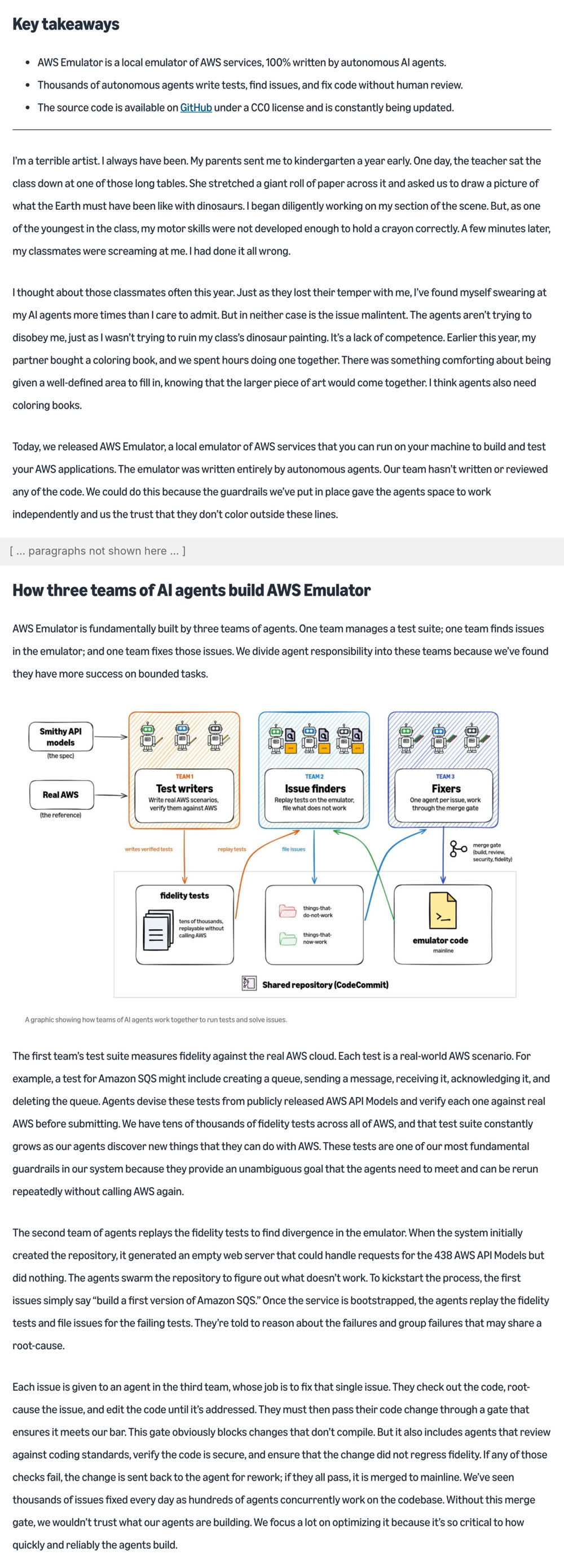 Excerpts from AWS’s announcement, as published on Amazon’s newsroom on 11 November. Image: Amazon Web Services
Three teams of AI agents, and a gate they must all pass
Matt Goldberg, a senior principal engineer at AWS, says it began as a weekend experiment: AWS’s Kiro agent copied Amazon SQS, a message service, in about 15 minutes. AWS now describes “thousands of autonomous agents” split into three teams. One writes tests and checks them against real AWS. A second runs them on the emulator and files failures. A third fixes them.
Every change must pass an automatic “merge gate”: it has to build, meet coding standards, survive security checks and keep matching real AWS. “Without this merge gate, we wouldn’t trust what our agents are building,” Goldberg writes. Sivasubramanian frames the human job as deciding “what gets built and when the work is correct”.
No one read the code, and AWS’s own warnings show the limits
AWS’s own documentation says not to use it for production, meaning live services customers use, or for security testing, because permission rules are not checked as real AWS checks them. Data is lost when it stops, and it is not tested for long or heavy workloads. Usage data, called telemetry, is sent to AWS by default, though you can switch it off.
How closely it matches each service varies; AWS publishes those scores with each release. On Hacker News, developers worried about long-term upkeep and about trusting code no human reviewed. A commenter saying they work at Amazon called it a real product; others wanted a formal public promise.
If you build on AWS, a free LocalStack alternative worth a careful look
The best-known local AWS emulator has been LocalStack. In 2026 it ended its free open-source Community Edition, InfoQ reported; it now needs an account, keeps a limited free plan for individuals, students and open-source work, and charges from US$39 per licence a month, billed yearly. Anyone wanting a free LocalStack alternative now has one from AWS itself. No independent test comparing AWS Emulator and LocalStack has been published yet.
Can you run AWS locally without an account? For testing, yes. For students and small teams, especially where dollar cloud bills hurt, that is a real saving. A sensible routine: test locally, check the “does not work” list, turn off telemetry if needed, and do a final check on real AWS.
Why trust matters more here than speed
On balance, this is a careful launch: free, open, honest about its limits, and measured against the real thing in public. In a test tool, a mistake usually shows up as a failed test, not leaked data. That makes it a sensible first home for unreviewed software.
The caution is real too: agents checking agents is a closed loop, and long-term upkeep is unclear. Our reading: this shows no-review software can work for a well-defined copying job, not that it is ready for systems handling money or health. For AWS, already spending heavily on AI, it is also a showcase.
AWS says it will share more at re:Invent. Watch two things there: a public promise to maintain the emulator, and whether its fidelity scores keep rising.
Prefer to watch? Follow us on YouTube
The tech stories that matter, explained in plain words. Subscribe so you never miss one.
Quick answers
What is AWS Emulator?
A free program from AWS that pretends to be AWS on your own computer, so you can test apps that use AWS without an AWS account or internet calls to AWS.
Is AWS Emulator free?
Yes. AWS says there is no service fee; you pay only when you deploy to real AWS. The code is released under CC0, a public domain dedication.
Is AWS Emulator a LocalStack alternative?
It does a similar job: both copy AWS on your machine for testing. No independent head-to-head test has been published yet, so it is too early to say which matches real AWS more closely.
Can I run AWS locally without an account?
For testing, yes. AWS Emulator needs no AWS account. It is not meant for running live services, and resources vanish when you stop it.
Is it safe to use code no human reviewed?
AWS itself says not to use it for production or security testing. As a test tool on your own machine, the risk is lower, but check results on real AWS before you ship.
Words to know
- Emulator
- Software that copies how another system behaves, so your code can't tell the difference.
- API
- The set of commands programs use to talk to a service such as AWS.
- SDK and CLI
- Developer toolkits and command-line tools for sending those commands.
- Docker
- A tool that runs software in a sealed box, the same way on any computer.
- Fidelity
- How closely the emulator matches the real AWS service.
- Merge gate
- Automatic checks every code change must pass before it is added.
Sources (8): every key fact checked against at least two
- About Amazon: How we built the agents that built AWS Emulator (Matt Goldberg, Senior Principal Engineer, AWS, 11 November 2026)
- AWS documentation: What is AWS Emulator?
- GitHub: aws/aws-emulator (README)
- All Things Distributed: AWS Emulator and the engineer's job when agents write the code (Swami Sivasubramanian, AWS)
- SiliconANGLE: Amazon's open-source AWS Emulator lets developers validate their code locally (11 November 2026)
- GeekWire: AWS gives developers a free local stand-in for its cloud, built from scratch by AI agents
- InfoQ: LocalStack ends its Community Edition (February 2026)
- Hacker News discussion of AWS Emulator
Related stories
Apple Support Community closing on 20 November: the help forum is already read-only
Apple Support Community closing: Apple's user help forum shuts on 20 November and takes no new posts. What we know, and where to get Apple support now.
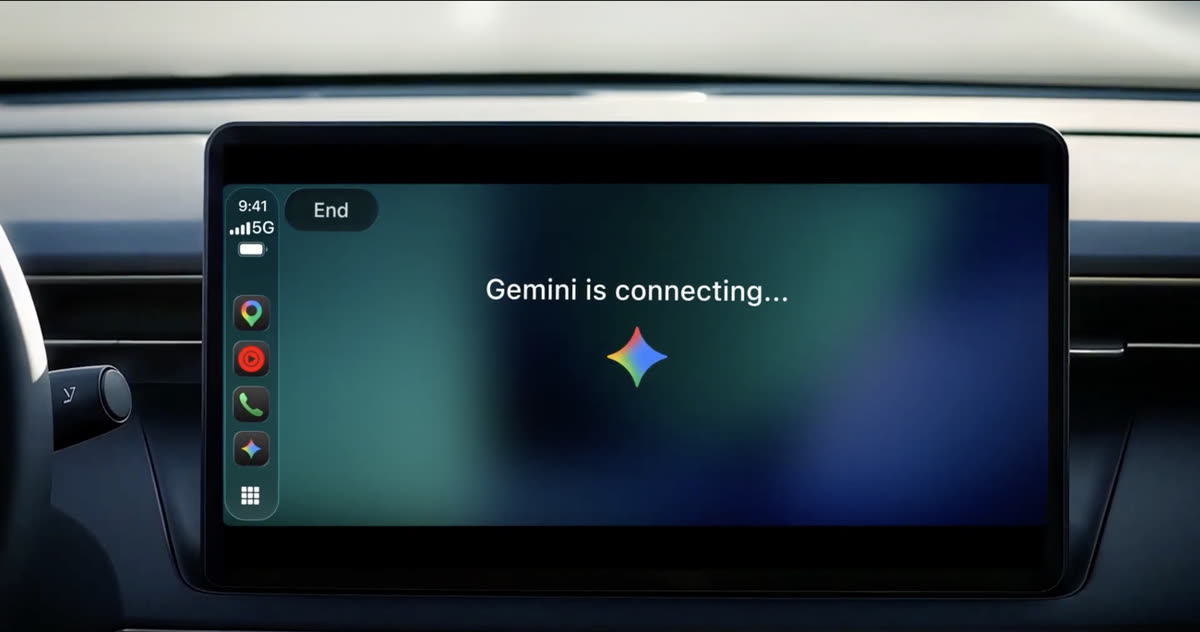
Gemini comes to Apple CarPlay: iPhone drivers can now talk to Google's AI hands-free
Gemini CarPlay is rolling out worldwide. How to turn on Gemini Live in your car, what it can and can't do, and why it doesn't replace Siri.
Patch Tuesday November 2026: Microsoft fixes over 1,000 flaws and an Outlook bug used in attacks
Patch Tuesday November 2026: Microsoft fixed 1,094 flaws, including an Outlook zero-day used in attacks. What it does and how to update Windows and Office.