Apple opens a US study of how people use AI for health, with OpenEvidence answers
- Apple has launched the Apple Health AI Usage Study, a US research app that studies how people use conversational health AI.
- Answers come from OpenEvidence with linked clinical citations; Apple says study data will not be used to train AI models.
- Up to 200,000 adults can join if they have an iPhone 15 Pro or later; TechCrunch says Apple's plans for Health or Siri are unclear.
- 200,000Participants Apple will acceptUp to, across the US
- 12+ monthsHow long the study will runPer TechCrunch and Mint
- 21+Minimum age to take partUS only
- 24 hoursOpenEvidence keeps query dataThen deleted, per TechCrunch
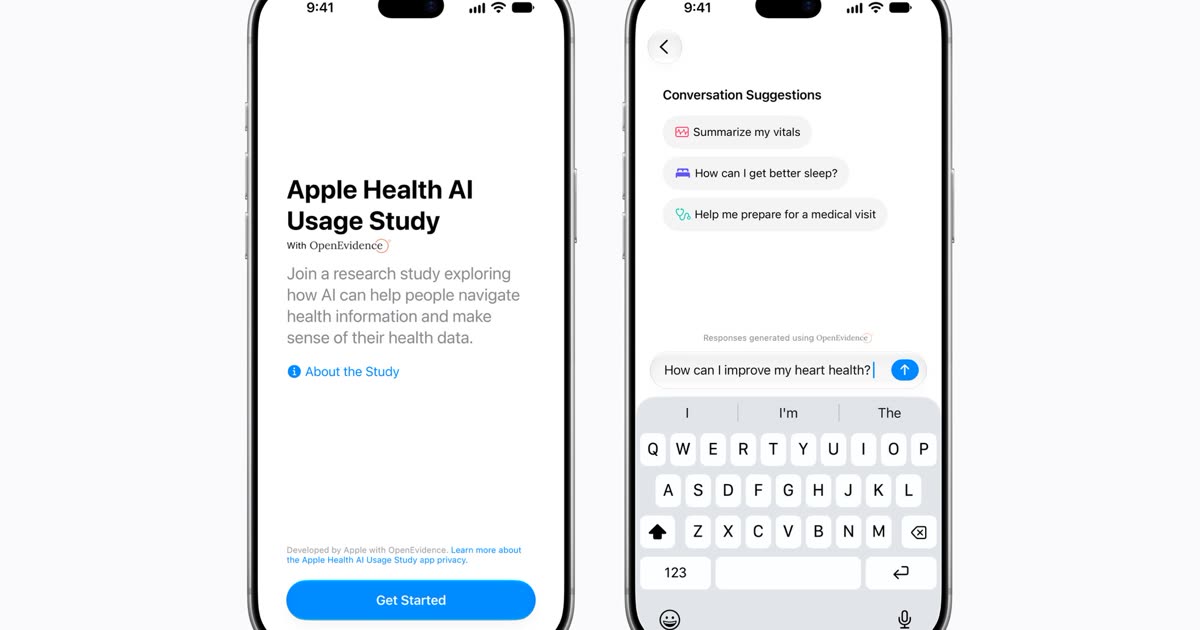
Apple wants to know how people use AI when they worry about their health. It has opened the Apple Health AI Usage Study, a research app for up to 200,000 adults in the US, to find out.
The study is open in the US. Apple calls it a virtual study “designed to advance the understanding of how people interact with conversational health AI tools.” In practice, Apple is testing with clinical sources first. It has not said whether it will build a health chatbot of its own. That suggests Apple wants evidence before it ships anything, and a study of more than 12 months means that evidence will take time.
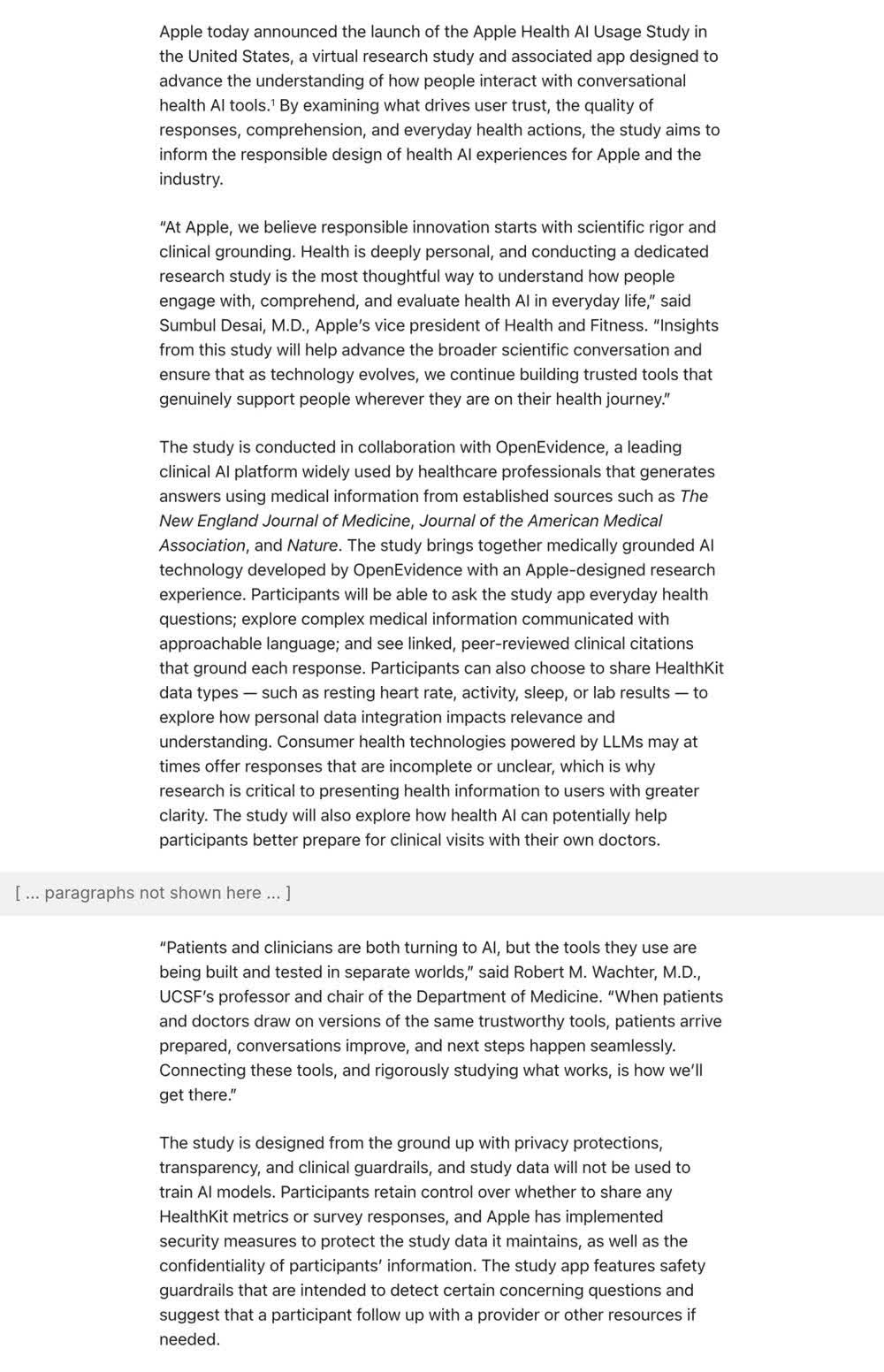
Excerpt of Apple’s announcement of the study, from the Apple Newsroom. Image: Apple
How the Apple Health AI Usage Study works, and who can join
Apple says it will look at “what drives user trust, the quality of responses, comprehension, and everyday health actions.” The answers come from OpenEvidence, which Apple calls “a leading clinical AI platform widely used by healthcare professionals.” It draws on sources such as The New England Journal of Medicine, the Journal of the American Medical Association and Nature.
Participants ask everyday health questions. Answers are written in plain language. Each one links to published medical research, so you can check where it came from. People can also choose to share HealthKit data: resting heart rate, activity, sleep and lab results. Apple says the study will also explore how health AI could potentially help people prepare for visits with their own doctors.
Up to 200,000 people aged 21 or older can join across the US. They need an Apple Intelligence-enabled iPhone (iPhone 15 Pro or later) running iOS 26 or later, and download the study app from the App Store. TechCrunch and Mint report the study will run for more than 12 months, with answer ratings, feedback and monthly surveys.
What Apple says it will protect, and what stays unclear
Sumbul Desai, M.D., Apple’s VP of Health and Fitness, said: “Health is deeply personal.” She called a dedicated research study “the most thoughtful way to understand how people engage with, comprehend, and evaluate health AI in everyday life.”
On privacy, Apple says study data will not be used to train AI models, and participants control whether to share HealthKit metrics or survey responses. TechCrunch and Mint report that data is anonymised before it goes to a secure third-party cloud provider. They also say Apple told them OpenEvidence deletes query and response data within 24 hours. The app also has safety checks: if a question sounds worrying, it can point the person towards a doctor or other help. Apple is clear that this is a research tool. It does not diagnose or treat illness, and it is no substitute for a doctor.
Apple is also frank about limits. It says health tools built on LLMs “may at times offer responses that are incomplete or unclear.” That, it says, is why research matters. Robert M. Wachter, M.D., chair of medicine at UCSF, is quoted in Apple’s release. He said patients and clinicians both turn to AI, “but the tools they use are being built and tested in separate worlds.”
TechCrunch’s view is that “it’s not clear if Apple wants to release AI-powered answering to its Health app or Siri yet.” Apple says the findings will inform health AI design. It has not said they will lead to a product.
If you live outside the US, or want to join
The app is US-only, and Apple has not given a date for anywhere else, so we will not guess one. Apple says it wants the results to inform health AI design “for Apple and the industry,” so what it learns may matter beyond the US.
If you qualify, the study app is on the US App Store. Like the rest of Apple Intelligence, it needs a recent iPhone. You decide whether to share HealthKit data or survey answers, so share only what you are comfortable with. For anything urgent or worrying, talk to a doctor.
Why a careful study is better than a quick launch
The good is real. Clinical citations let people check answers, guardrails aim to catch worrying questions, and Apple says study data stays out of AI training. Asking people how they trust and understand answers is a sensible place to start.
The worries are just as real. An app is not a doctor, and Apple itself says answers can be incomplete or unclear. The study is US-only and needs a newer iPhone, so many people are left out. Apple has not said whether the findings will become a product. On balance, this looks like a careful, slow step, not a finished product. That is a reasonable way to approach health.
The finding to watch is simple: do people understand the answers, and do they take better care because of them? The study runs for more than a year, so expect no verdict soon.
Prefer to watch? Follow us on YouTube
The tech stories that matter, explained in plain words. Subscribe so you never miss one.
Quick answers
What is the Apple Health AI Usage Study?
It is a virtual research study and app in the US that looks at how people use conversational health AI tools. Apple says it examines trust, response quality, comprehension and everyday health actions.
Who can join the Apple health AI study?
Apple says up to 200,000 people aged 21 or older across the US can take part. They need an iPhone 15 Pro or later with Apple Intelligence turned on, running iOS 26 or later.
What does OpenEvidence do in the Apple study?
OpenEvidence provides the health answers. Apple says it draws on sources such as the New England Journal of Medicine, JAMA and Nature, and each answer links to the research behind it.
Will Apple use my data to train AI?
Apple says study data will not be used to train AI models. Participants choose whether to share HealthKit data or survey answers.
Words to know
- HealthKit
- Apple's system for storing health data on an iPhone, such as sleep, activity and heart rate.
- LLM
- A large language model, the kind of AI that writes answers in everyday language.
- Peer-reviewed
- Checked by other experts in the field before a study is published.
Sources (3): every key fact checked against at least two
Related stories

ChatGPT Wallet lets OpenAI's AI agents buy things for you, with your fingerprint as the last step
ChatGPT Wallet lets OpenAI's agents complete purchases once you approve them. Who gets it first, how it protects your card, and what is still unclear.

Senate Banking chair asks Jensen Huang and Howard Lutnick to testify over Nvidia and national security
Nvidia Senate hearing: Senator Tim Scott asks Jensen Huang and Howard Lutnick to testify on national security and chip exports. What we know, what's next.

Google's Gemini 4 Hydrogen brings a faster, cheaper Gemini 4 to Search, the free app and developers
Gemini 4 Hydrogen is Google's fast everyday model, now in Search, the Gemini app and the free API tier. Its price, who gets it and what Orchestrator does.