Developing story
YouTube will add estimated TV co-viewers to view counts, and says creator pay is unchanged
- YouTube is rolling out co-views: an estimate of how many people watch together on a TV, now added to public view counts.
- It applies to long videos, Shorts and Live on TV only, and only to new views. Old counts do not change.
- YouTube says creator pay is unchanged. Trade site PPC Land notes YouTube has not published a margin of error.
- 1bn+Hours of TV watching a dayYouTube's own figure
- 1.0Co-view rate, mobile and desktopno co-views counted there
- 0Effect on ad revenueYouTube says none
- May 2027Old private metric retiredexport your data before

Picture a family of four on one sofa, watching one YouTube video on the living-room TV. Until now, that counted as one view. YouTube is changing that: on 16 November it said it is rolling out YouTube co-views, an estimate of how many people watch together on a TV, added to the public view count.
YouTube says it is doing this because people now watch more than 1 billion hours of YouTube on TVs every day, according to its Creator Insider video. The platform’s view counter has been reworked before. This time the number you see under a video will include an estimate, not only a count.
What YouTube co-views add to the number
The estimate covers long videos, Shorts and Live streams, but only for viewing on a TV screen. Viewing on mobile and desktop is left out. YouTube’s help page says the change begins in November 2026, and the video describes it as rolling out, so not everyone will see it at once.
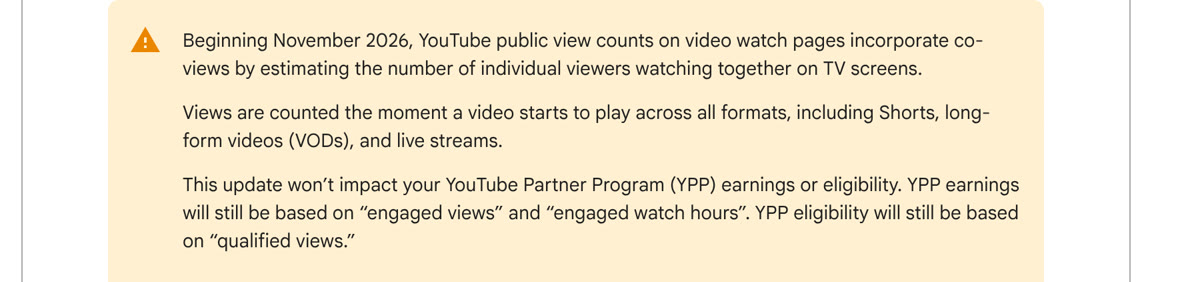 YouTube’s help page on view counts, from YouTube Help. Image: YouTube
Past totals will not be recalculated. From now on, any new TV view of a video, even an old one, is counted with its co-viewers.
YouTube Studio gets a new metric called co-view rate, in the Device Type breakdown. Creators can take the total and divide it by the co-view rate to see what they would have had without co-views. Mobile and desktop always show 1.0.
YouTube will close the older, private “views (co-viewed)” metric in Studio in May 2027. Anyone who wants its history has until then to download it.

How a TV audience gets estimated, and what is not published
YouTube says it “doesn’t use devices, cameras, microphones or anything like that.” Instead, YouTube says, it uses a statistical model from Google research scientists. The model draws on patterns such as audience demographics and when people watch, and YouTube says it checks the results against industry panel data. YouTube has not published the model itself.
That leaves open questions. PPC Land, a trade site, argues that YouTube has not published a margin of error or a typical co-view rate. It also notes the estimate comes from YouTube itself, not an outside measurer. That is PPC Land’s view, not YouTube’s. YouTube has not said in what countries the change applies, and neither Engadget nor PPC Land found a list.
If you watch, make videos or buy ads on YouTube
If you only watch, nothing needs doing. You may simply see bigger numbers on videos that are popular on TVs.
If you make videos, YouTube says co-views do not affect ad revenue or Partner Program thresholds. YouTube’s help page says earnings stay based on “engaged views” and “engaged watch hours”, and eligibility on “qualified views”. The Creator Insider video adds that AdSense payouts are unaffected. Watch Time will match the updated counts, while Thumbnail Impressions, Click Through Rate and Average View Duration are unchanged. Android Authority says it is unclear whether the bar to qualify for monetisation will change, and has asked Google.
If you buy ads, one line in YouTube’s help page matters: “TrueView views are billable, and YouTube public views are not billable.” YouTube’s ad business is large: our report on Alphabet’s third-quarter results put YouTube ads at US$11.2 billion in the quarter. Beyond that, ad billing is not addressed in the sources we found. In our reading, the public count and billing are separate things, so ask your YouTube contact before treating the new number as a measure of paid reach.
Why a bigger number needs a clear label
In our reading, the idea is reasonable. A TV is often a shared screen, and counting one person for a whole family undercounts a real audience. YouTube says it wants to align with how TV networks estimate the people exposed to content, and creators pitching to brands may welcome that.
The other side is also fair. A public number that mixes counted views with estimated ones is harder to compare, and PPC Land notes this is the third change to the public counter in about 20 months. In our view, the change is sensible if YouTube shares more about accuracy, and if the new co-view rate in Studio is easy to use.
On balance, this is a careful step with a clear benefit for creators who are watched on TV, and a fair request for more detail. Nothing about money changes, according to YouTube.
A bigger number only helps if people can trust it. What to watch is whether YouTube shows how close its estimate gets.
Prefer to watch? Follow us on YouTube
The tech stories that matter, explained in plain words. Subscribe so you never miss one.
Quick answers
Will my YouTube view count go up?
Only if people watch on a TV. YouTube adds an estimate of extra viewers for new TV views. Mobile and desktop views are not changed.
Does it change how much creators earn?
YouTube says no. Its help page says Partner Program earnings stay based on engaged views and engaged watch hours, and eligibility on qualified views.
How does YouTube know how many people watch on a TV?
It does not know. It estimates with a statistical model built by Google research scientists. YouTube says it uses no devices, cameras or microphones.
Are old view counts changed?
No. Past totals are not recalculated. Only new TV views are counted this way, including new views of older videos.
Words to know
- Co-view
- An estimate of extra people watching the same video together on one TV.
- Statistical model
- A method that estimates a number from patterns in data, instead of counting each person.
- Partner Program (YPP)
- YouTube's programme that lets creators earn money from their videos.
- Panel data
- Viewing figures gathered from a chosen group of households, used by the TV industry.
Sources (7): every key fact checked against at least two
- Creator Insider (YouTube): New! Co-Views Included in Public YouTube View Counts
- YouTube Help: View counts
- YouTube Help: Metrics in YouTube Analytics
- Engadget: YouTube will start boosting public view counts when you watch on a TV
- Android Authority: YouTube co-views on TV
- PPC Land: YouTube adds estimated TV co-viewers to public view counts
- Digital Trends: YouTube is making view counts bigger, but creators aren't getting any richer
Related stories

Nvidia earnings: a $115.8 billion quarter, and a forecast that leaves China data center sales out
Nvidia earnings for Q3: revenue hit $115.8 billion, up 103% in a year. Its Q4 outlook of $130 billion assumes no China data center sales. What it means.

Chase outage leaves customers locked out, while other US banks see spikes in complaints
A Chase outage left customers unable to log in or move money on 16 November 2026. Here is what Chase says, which banks had problems, and what is unknown.

Bessent says Nvidia must hire an outside CEO and answer export compliance questions within 10 days
Nvidia CEO search: Treasury Secretary Scott Bessent says the board must look outside and answer export compliance questions in 10 days. What we know.