Developing story
The US now wants a licence for AI chips in some overseas data centres, and five more countries need one
- Since 19 November, the US requires a licence to ship advanced AI chips to data centres abroad that rent large amounts of computing to China-linked firms.
- Indonesia, Malaysia, Singapore, Thailand and Brazil now need licences too; US-headquartered buyers are exempt if the exporter files monthly reports.
- Comments are open until 18 January 2027. Nvidia has reportedly paused some server shipments to the region; it has not confirmed this.
- 12 millionAggregate TPP triggerBIS rule text
- 5Countries newly needing licencesBIS rule text
- 90 daysTo hold a licence, China-facing sitesBIS rule text
- 18 Jan 2027Public comment deadlineSimpson Thacher; rule text

Picture a data-centre operator in Johor or Jakarta who ordered racks of servers this year. The money is committed and the building is ready, and now there is one more thing to wait for: a licence from Washington. That is the position some operators face under new AI chip export rules, which the US Commerce Department’s Bureau of Industry and Security (BIS) announced on 16 November. The rule was published and took effect on 19 November.
It closes what US officials call a loophole. Until now, a company in China could not buy the most advanced chips, but it could in some cases rent them in a data centre in a third country. The rule says existing limits “cannot be circumvented through remote computing arrangements”, as AP quotes BIS. The same rule formally cancels the Biden-era AI Diffusion Rule. It follows pressure from Congress: the House passed the Remote Access Security Act in January, and Senator Maria Cantwell urged action in a letter on 15 November.
What the AI chip export rules ask of data centres
A licence is now needed to send advanced chips to any data centre worldwide that gives more than 12 million “aggregate TPP” of computing to companies headquartered in China, Macau or another Country Group D:5 nation. TPP is a measure of chip power, and the rule counts it across one site or linked sites. Indirect access counts too, such as training models for those firms.
What 12 million equals is not stated in chips. Outside estimates differ: about 760 Nvidia H100s according to CNAS, around 750 by other law-firm readings, and as few as 200 of the newest GPUs according to Gibson Dunn. Treat them as estimates, not official figures.
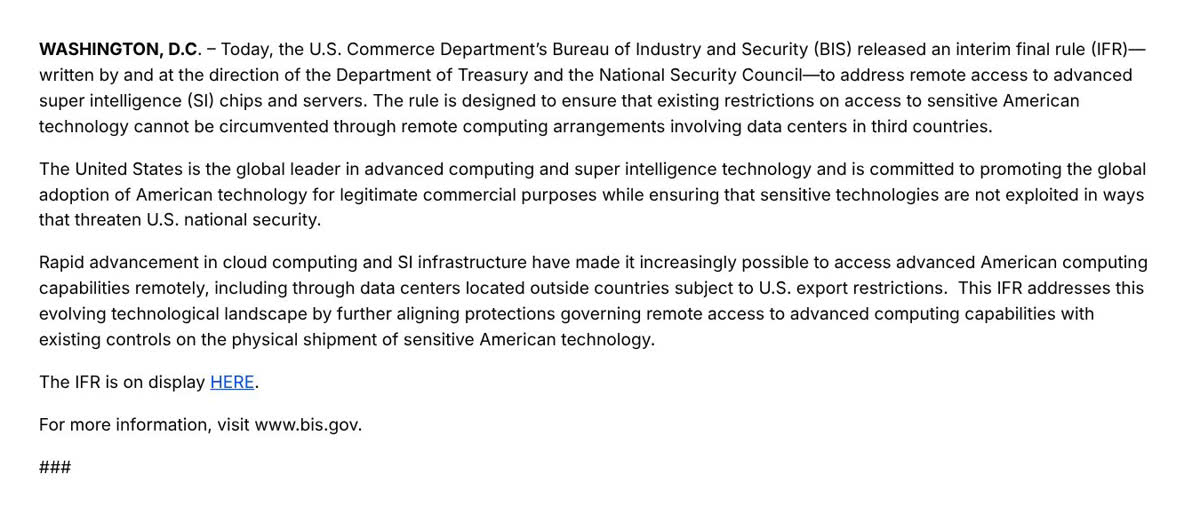 The full BIS press release of 16 November 2026. Read it on bis.gov. Image: Bureau of Industry and Security
Official US texts now say “super intelligence (SI)” where they once said AI, which is why that phrase appears in the release. Here, we keep to “AI”.
Five countries are newly listed as higher-risk for diversion: Indonesia, Malaysia, Singapore, Thailand and Brazil. Buyers headquartered in the US are exempt there if the exporter files monthly reports. Systems that only rank or suggest products and content, like shopping or social feeds, are exempt. Data centres inside the US are not covered, since this is an export rule.
Where the reactions split
The Semiconductor Industry Association welcomed the end of the old Diffusion Rule and a “more targeted approach”. China’s foreign ministry spokesperson, Guo Jiakun, called the move “typical economic coercion and long-arm jurisdiction”. Singapore’s trade and digital ministries said in a joint statement they are “studying the details of this new measure carefully”. Malaysian minister Johari Abdul Ghani said the country wants clarity from Washington.
Questions remain. Lawyers at WilmerHale note that “significant volume” is undefined. CNAS analyst Michelle Nie Duncan says the threshold looks well balanced, but that training split across several clouds could stay under it.
Reported, not confirmed: On 26 November the Financial Times, citing three people familiar with the matter, reported that Nvidia told manufacturing partners to stop shipping AI servers to Malaysia, Singapore, Thailand and Indonesia. The Wall Street Journal reported the same day that Nvidia asked partners to pause shipments; TechCrunch, summarising the Journal’s report, said the pause is for an unspecified period while Nvidia checks whether regional partners meet US export rules. Nvidia, Dell and Supermicro have not commented publicly.
If you rent, build or buy cloud compute
Companies in the five listed countries should expect new questions about who owns them and who their customers are. Contracts may change, and a customer that refuses to share ownership details is treated as a warning sign. Sites already serving China-linked firms need a licence in hand by about 17 February.
The AI chip export rules can still move: comments are open until 18 January 2027. For background, see our reports on Trump’s threatened tax on US firms building data centres abroad, the Nvidia H200 chips and China, and how Asian tech stocks reacted to data-centre worries.
A tighter rule, with room to adjust
In our reading, this rule has a fair logic and a real cost. Closing the cloud route makes the existing US export controls on China harder to sidestep. But honest operators in Southeast Asia and Brazil now face paperwork and uncertainty, and the BIS release does not say how fast licences will be processed.
The likelier outcome is a period of adjustment, with clarifications and some changes after public comment. On balance, it is a meaningful tightening of the chip export restrictions already in place, but its real effect depends on how licences are handled.
The dates to watch are 18 January, when comments close, and mid-February, when China-facing sites need a licence in hand.
Prefer to watch? Follow us on YouTube
The tech stories that matter, explained in plain words. Subscribe so you never miss one.
Quick answers
What are the new AI chip export rules?
If a data centre anywhere sells more than 12 million aggregate TPP of computing to firms headquartered in China, Macau or other D:5 countries, chips sent to it need a US licence.
Which countries need a licence for US AI chips now?
Indonesia, Malaysia, Singapore, Thailand and Brazil. US-headquartered buyers there are exempt if the exporter files monthly reports to BIS.
Can Chinese companies still rent US AI chips in the cloud?
Only below the threshold or with a licence. Chips inside US data centres are not covered, because the rule governs exports.
When do the rules take effect?
They took effect on 19 November 2026. Comments are open until 18 January 2027, so details could still change.
Words to know
- Aggregate TPP
- Total processing performance: a measure of the combined computing power of chips at a site.
- D:5
- Country Group D:5 is a US export-control list of countries of concern. It includes China.
- Interim final rule
- A rule that takes effect at once, while the public can still comment and the agency can change it.
Sources (18): every key fact checked against at least two
- Bureau of Industry and Security: BIS Issues Rule Addressing Remote Access to American Super Intelligence Technology (16 Nov 2026)
- Bureau of Industry and Security: interim final rule text, RIN 0694-AK50
- Simpson Thacher: BIS issues rule restricting remote access to advanced AI chips
- Ashurst Perkins Coie: BIS issues interim final rule restricting remote access to advanced US AI chips
- Gibson Dunn: BIS expands advanced computing controls to address data center remote access
- WilmerHale: US government restricts remote access to advanced AI chips and rescinds the AI Diffusion Rule
- CNAS: Unpacking the remote access rule
- Semiconductor Industry Association: statement (16 Nov 2026)
- Nextgov: Commerce Department moves to close AI chip loophole
- TechCrunch: coverage of the remote access rule
- AP via BNN Bloomberg: Trump administration moves to block China from indirect access to American AI technology
- People's Daily: China's foreign ministry response (17 Nov 2026)
- Al Jazeera: US moves to block China's remote access to AI chips
- The Star: Singapore studying new US rules on AI chip exports
- The Star: Malaysia seeks US clarification on AI chip restrictions
- TechCrunch: Nvidia hits pause on chip shipments to Southeast Asia (26 Nov 2026)
- The Wall Street Journal: Nvidia Tells Partners to Pause Shipments to Southeast Asia (26 Nov 2026)
- Reuters via KELO: Nvidia halts server shipments to four Southeast Asian countries, FT reports
Related stories

SAP is preparing at least 10,000 job cuts, Bloomberg reports; SAP has not confirmed it
SAP layoffs 2026: Bloomberg reports the software maker is weighing at least 10,000 job cuts. SAP has not confirmed it. Here is what is known so far.
· 3 min read

Nvidia agrees to pay $290 million to end a 2018 investor suit over crypto mining
Nvidia class action lawsuit: the chipmaker agreed to pay $290M to settle a 2018 investor suit over crypto mining. First court hearing: 4 Feb 2027.
· 4 min read

Amazon Autos is coming to the UK in early 2027, with Hyundai first in line
Amazon Autos UK launches in early 2027, its first market outside the US. Hyundai is the first new-car brand; you reserve online and finish at a dealer.
· 4 min read