Developing story
Nvidia agrees to pay $290 million to end a 2018 investor suit over crypto mining
- Nvidia has agreed to pay $290 million in cash to settle a 2018 investor class action over how it reported crypto-mining demand for its gaming chips.
- Nvidia denies any wrongdoing. A federal judge must still approve the deal, with a preliminary hearing set for 4 February 2027.
- It covers people who bought Nvidia stock between 10 Aug 2017 and 15 Nov 2018. Claims cannot be filed yet, so watch for scams.
- $290MCash settlementCourt filing, Dkt 304
- 14%Share of $2.059B claimed max damagesPlaintiffs' expert, Dkt 304
- 28.5%Alleged 2-day share drop, Nov 2018Dkt 304 allegation; Cointelegraph
- 4 Feb 2027Preliminary approval hearingCourt filing, Dkt 304
In November 2018, as demand from crypto miners fell away, Nvidia cut its sales outlook. Its shares fell 28.5% over two trading days, investors’ lawyers say, and a shareholder lawsuit followed in December. Nearly eight years later, Nvidia has agreed to pay $290 million in cash to end it. Nvidia denies any wrongdoing.
The deal was filed in a California federal court on Tuesday 24 November. The Nvidia class action lawsuit accuses the chipmaker of understating how much of its gaming-chip sales went to crypto miners. No money is paid until a judge approves the deal.
The Nvidia class action lawsuit: what the $290 million settlement says
The case is In re NVIDIA Corporation Securities Litigation, in the Northern District of California. The investors’ lawyers filed an unopposed motion, a request Nvidia does not fight, asking the judge for preliminary approval: the first okay that lets notices go out. A hearing is set for 4 February 2027.
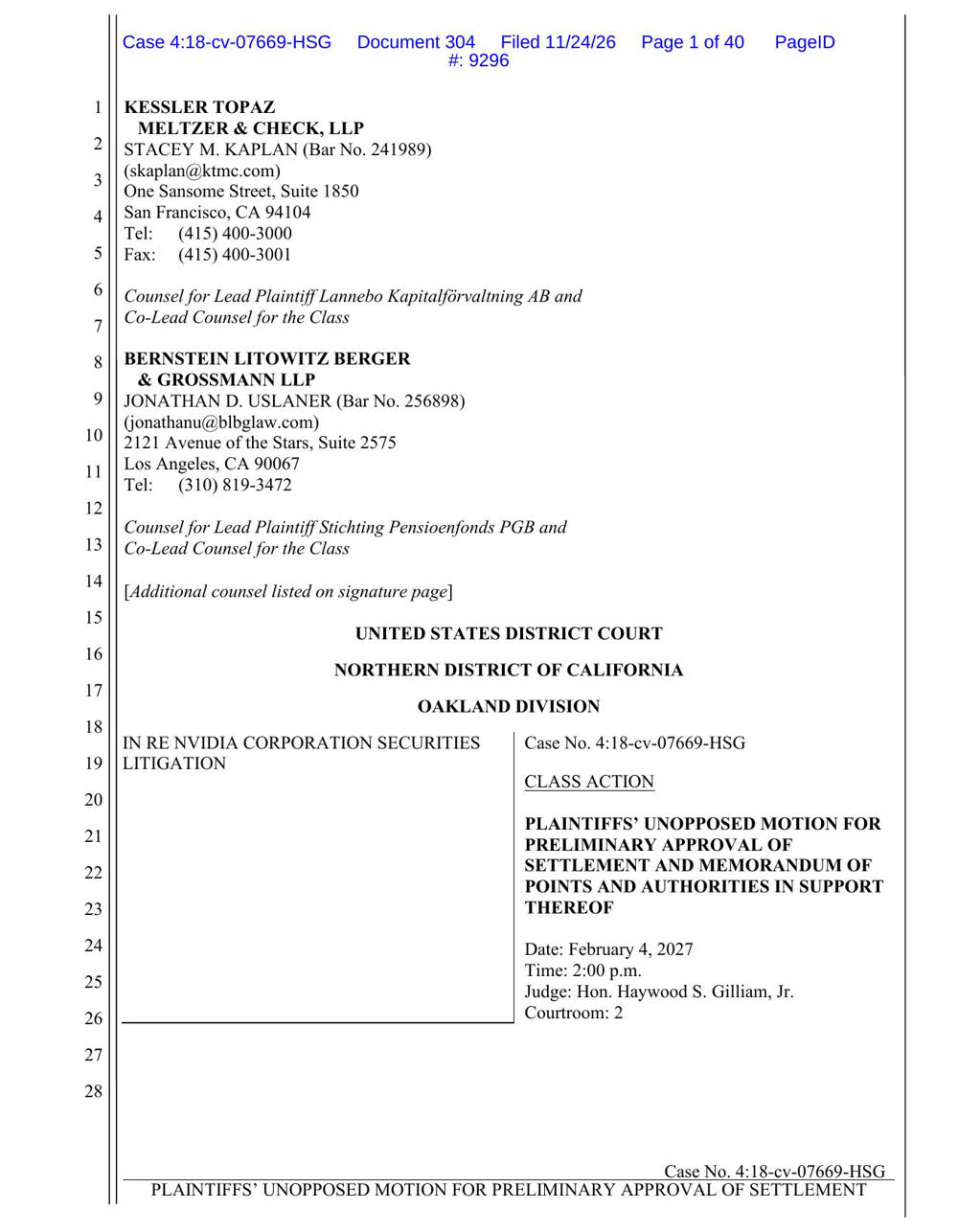 The first page of the motion filed on 24 November 2026 (Document 304). Read the full motion as a PDF. Image: US District Court filing (via BLB&G)
The class covers people and firms that bought Nvidia common stock between 10 August 2017 and 15 November 2018 and were damaged, the filing says. The motion puts the maximum damages, as estimated by the plaintiffs’ expert, at $2.059 billion, so $290 million is about 14% of that. The lawyers plan to ask for fees of up to 21.4% of the fund, about $62 million.
Plaintiffs’ lawyers say it would be the seventh-largest investor class action settlement in that court since 1995. That is their claim, not an independent ranking.
What investors say Nvidia left out
The plaintiffs allege that Nvidia and its chief executive, Jensen Huang, did not disclose how much 2017 and 2018 GeForce sales came from crypto miners. They say the full picture came out with the outlook cut on 15 November 2018. These are allegations, and the defendants deny them.
Nvidia has argued in court that its internal estimates of chip sales to miners were not reliable enough to publish, and that investors already knew crypto was driving gaming sales, according to the filing. In 2022 the SEC found separately that Nvidia failed to disclose crypto’s role in gaming growth in two quarterly reports. Nvidia paid a $5.5 million penalty, neither admitting nor denying the findings.
Two appeals, nearly eight years, and who pays
A district court dismissed the case in 2021. The Ninth Circuit revived it against Nvidia and Huang in 2023, and in December 2024 the Supreme Court dismissed Nvidia’s appeal as “improvidently granted”, which left the revival in place. The class was certified in March 2026.
TheStreet quotes an Nvidia spokesperson thanking its insurers “in helping wrap up this legacy matter”, and reports insurers fund most of the sum. That comes from press reports only; the settlement papers say Nvidia pays or causes the money to be paid. The filing came days after Nvidia’s board reinstated Jensen Huang as CEO.
If you owned Nvidia in 2017 or 2018, what to watch
Only buyers in that window are covered. If you bought later, you are not part of this class.
Nobody can file a claim today. If the judge grants preliminary approval, the proposed plan has JND Legal Administration send notices within 20 days, with claim forms due about 90 days after that. You do not need to “join”. Be wary of any site or message that asks for a fee or your bank details before an official notice arrives. The filing names www.NVIDIASecuritiesLitigation.com as the planned settlement website; check there or the court record, not links in unsolicited messages.
A small bill after a long fight
In our reading, this deal has a good side and a hard side. For investors, a payout after nearly eight years and two appeals is a real result. But the claims administrator expects about 1 million to 1.2 million claims, the filing says, so after fees and costs many individual investors may receive a small share. For Nvidia, $290 million is modest beside the $115.8 billion in revenue it reported in its latest quarter, so the cost is easy to absorb.
The wider lesson is about disclosure: investors judge a company not only on how much it sells, but on who is buying and whether that demand will last. On balance, this closes an old chapter for Nvidia rather than changing its business today, and it is not final until the judge says so.
The date to mark is 4 February 2027. If the judge agrees, the notices will tell eligible investors what to do next.
Prefer to watch? Follow us on YouTube
The tech stories that matter, explained in plain words. Subscribe so you never miss one.
Quick answers
Did Nvidia admit wrongdoing?
No. The settlement papers say each defendant denies any wrongdoing.
Who is covered by the Nvidia class action lawsuit?
People and firms that bought Nvidia common stock between 10 August 2017 and 15 November 2018 and were damaged, according to the court filing.
How do I join the Nvidia class action lawsuit?
You do not sign up. The class is already defined. If the judge gives preliminary approval, an administrator will send notices and open a claim process.
Can I file a claim today?
No. Claims open only after the court acts. Be careful with any site or message that asks for a fee or your details now.
Who pays the $290 million?
The settlement says Nvidia pays or causes it to be paid. Nvidia has said its insurers help, according to TheStreet.
Words to know
- Class action
- One lawsuit brought for a large group of people who say they were harmed in a similar way.
- Class period
- The dates in which a person must have bought the stock to be covered.
- Preliminary approval
- A judge's first okay of a deal, which lets notices go out. Final approval comes later.
- Unopposed motion
- A request to the court that the other side has agreed not to fight.
- Improvidently granted
- The Supreme Court's phrase for ending a case it agreed to hear, without ruling on the main question.
- Opt out
- To leave the class so you can bring your own claim.
Sources (9): every key fact checked against at least two
- US District Court, N.D. Cal., via BLB&G: Plaintiffs' Unopposed Motion for Preliminary Approval, Dkt 304 (24 Nov 2026)
- US District Court, N.D. Cal., via BLB&G: Stipulation and Agreement of Settlement, Dkt 304-1 (24 Nov 2026)
- SEC: SEC Charges NVIDIA Corporation with Inadequate Disclosures about Impact of Cryptomining (6 May 2022)
- US Supreme Court: NVIDIA Corp. v. E. Ohman J:or Fonder AB, No. 23-970 (11 Dec 2024)
- Bernstein Litowitz Berger & Grossmann (plaintiffs' co-lead counsel): release on the settlement (25 Nov 2026)
- Bloomberg Law: Nvidia settles investor suit over crypto mining for $290 million
- The Block: Nvidia $290 million settlement, crypto mining class action
- Cointelegraph: Nvidia agrees to $290M settlement over crypto mining revenue disclosures
- TheStreet: Nvidia settles 8-year-old investor suit for $290M
Related stories

Amazon Autos is coming to the UK in early 2027, with Hyundai first in line
Amazon Autos UK launches in early 2027, its first market outside the US. Hyundai is the first new-car brand; you reserve online and finish at a dealer.

Flipkart CEO Kalyan Krishnamurthy steps down after more than 11 years; Balaji Thiagarajan to lead for now
Flipkart CEO Kalyan Krishnamurthy will step down. Walmart's Chris Nicholas says his last day is 4 December; a successor is due in the coming weeks.
Huawei found guilty on 10 of 12 counts in Brooklyn, but cleared of racketeering
Huawei trial verdict: a Brooklyn jury found Huawei guilty on 10 of 12 counts but not guilty of racketeering. Sentencing is set for 14 Sept 2027.