Thousands of Lovable-built apps left personal data readable without a login, researchers find
- Hamburg security firm Crissy Field found 24,664 Lovable-built websites that sent database records on page load without a login.
- Email addresses appeared in tables on 7,403 of them (30%), but the researchers say this is not a confirmed leak rate.
- The cause is missing access rules in the backend database, not a hack of Lovable; the researchers advise a review before real customer data goes in.
- 159,041Lovable projects foundDec 2025 to Sep 2026
- 24,664Sites sending data, no loginOf 34,545 using Supabase
- 7,403Sites with email records30% of those sites
- 1,000+ID document recordsIncl. passport numbers
Imagine you sign up for a ticket, a restaurant order or a tenant portal, and hand over your email, phone number and address. You trust that only the business can see them. A new security study suggests that, for thousands of small apps, that trust was not backed by a lock.
A study of Lovable data exposure by Crissy Field, a security firm in Hamburg, found that 24,664 websites built with the AI app builder Lovable sent database records to any visitor on page load, with no login. The work was done with the German newspaper Handelsblatt, which reported first findings on 2 November.
This is a story about a lock that was never fitted, not a break-in. As vibe coding grows, with more people building apps by describing them in plain words, who checks the doors?
How Lovable data exposure was measured across 24,664 sites
Lovable is a Swedish startup in Stockholm, founded in 2023 by Anton Osika and Fabian Hedin. It turns plain-language descriptions into web apps and is aimed at people with little or no programming experience. Cybernews reports it has delivered more than 50 million projects, with 1.2 million new ones each week.
Crissy Field looked at the database service Supabase. Using the public Common Crawl archive, it identified 159,041 Lovable projects from December 2025 to September 2026. Of these, 34,545 used Supabase, and 24,664 sent database records on page load without a login.
With further read-only requests using the same API key, the team found records with email addresses in 10,560 tables across 7,403 of those websites (30%). The researchers did not publish how to reach the data, and we do not describe it here.
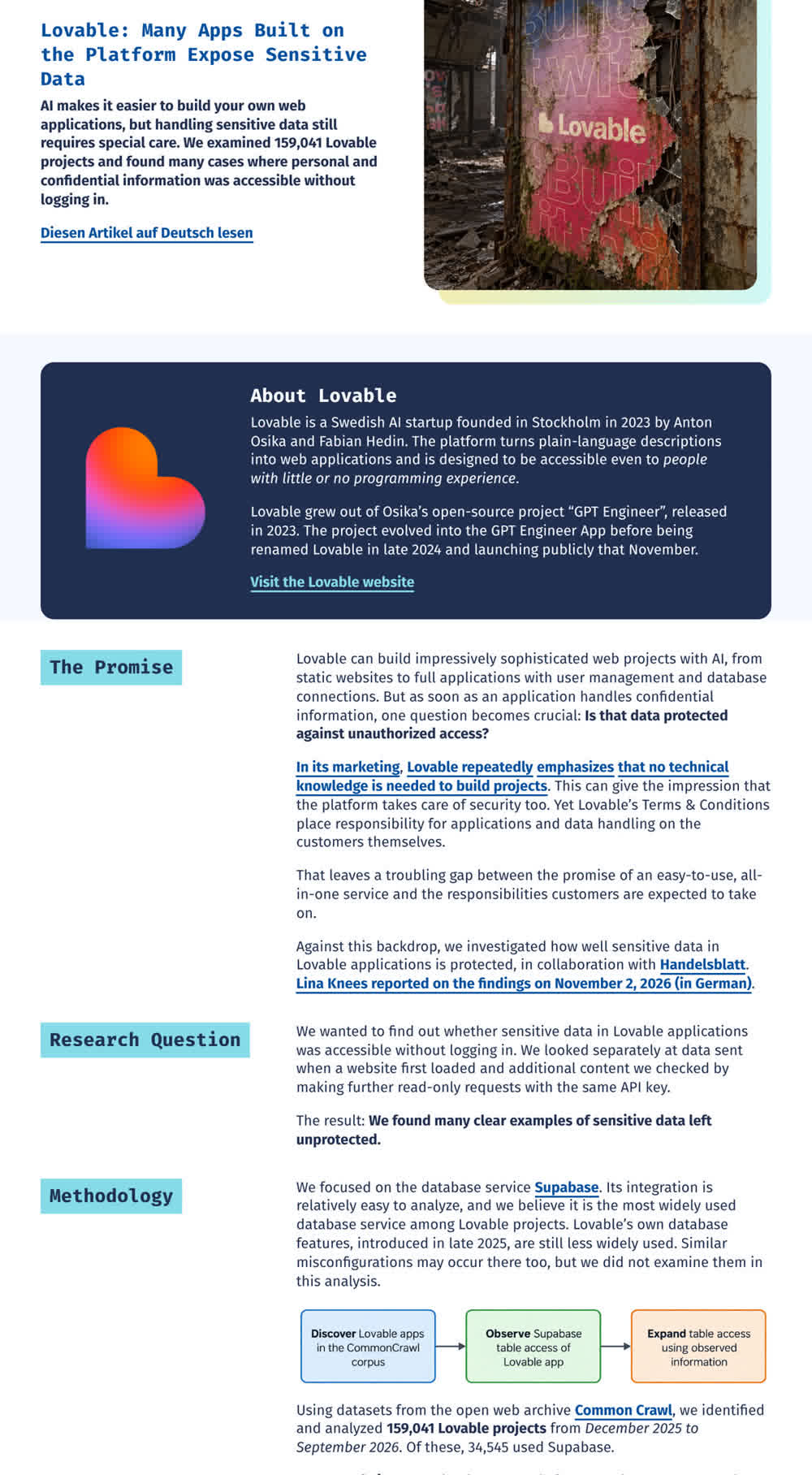 The report as published by Crissy Field. Image: Crissy Field
What was readable, and what the numbers do not prove
The examples are sobering. A German lifestyle forum exposed more than 80,000 profiles and more than 200,000 chat messages. Event organisers and restaurants exposed tens of thousands of ticket and food sales records. A property management company exposed AI-generated summaries of internal emails. A service provider exposed more than 1,000 records with identity document details, including passport numbers. No business is named in the report.
The limits matter just as much. Some email addresses may be public contacts or test data. The 30% figure “should not be read as a confirmed data leak rate”, the researchers say. The Common Crawl sample is not representative of all Lovable apps. Lovable’s own database features, introduced in late 2025, were not examined. And the team “could not establish whether any of it had been misused.”
Lovable’s view, and why both sides can be right
According to Cybernews, Lovable describes the issue as a known, industry-wide configuration problem around Supabase. Trending Topics reports that Lovable sees no vulnerability in its AI. Lovable’s terms also place responsibility for applications and data handling on its customers, the report notes, while its marketing stresses that no technical knowledge is needed.
Cybernews traces the cause to missing or unconfigured Row Level Security rules, the database rules that decide who may read which record. Handelsblatt contacted Lovable with the findings.
If you built an app this way, or only use one
If you built an app with Lovable, or another AI builder on Supabase, and it holds customer data, the researchers’ advice is plain: before real data goes in, review access permissions, interfaces and the separation between user accounts, and repeat the review after significant changes. They add that automated checks are no substitute for a professional security assessment. We will not guess at settings steps here.
If you only use small sites, you cannot easily tell how one was built. The researchers name phishing, ticket fraud and identity theft as risks, so stay alert to unexpected messages that use your details.
A fair reading: easy tools, old responsibilities
The good is real. Tools like this let people with no coding background build useful things, and many of those apps may be perfectly safe. The researchers themselves say access mistakes “can happen in any application, whether written by people or built with AI.”
The worry is just as fair. Ease of building moves faster than the habit of checking. In our reading, a platform that says no skills are needed and terms that put responsibility on the customer leave a gap, and ordinary people fall into it. On balance, the likelier fix is shared: clearer defaults from builders, and a review from builders’ customers before they collect anyone’s data. The researchers put it this way: an easy tool “does not remove the need for an expert review.”
The next question
Whether any exposed data was misused remains unknown. What to watch is whether affected businesses close the gaps, and whether AI builders make safe access rules the easy default.
Prefer to watch? Follow us on YouTube
The tech stories that matter, explained in plain words. Subscribe so you never miss one.
Quick answers
Was Lovable hacked?
No. According to Cybernews, the cause is missing or unconfigured Row Level Security rules in the apps' own backend databases, not a hack of the Lovable platform.
Do 30% of Lovable apps leak data?
No. The researchers say the 30% figure should not be read as a confirmed data leak rate. Some email addresses may be public contacts or test data.
What is Row Level Security?
It is a database rule that decides which rows of data each user may read. If it is missing or unconfigured, a database can hand records to people who should not see them.
Was any of the data misused?
The researchers could not establish whether any of it had been misused.
Words to know
- Supabase
- A database service many apps use to store their data.
- Row Level Security
- Database rules that control who can read each record.
- Common Crawl
- A public archive of web pages, used here to find Lovable projects.
- Vibe coding
- Building software by describing it in plain language and letting AI write the code.
Sources (3): every key fact checked against at least two
Related stories

AWS Emulator puts a free copy of AWS on your computer, and AWS says AI agents wrote every line
AWS Emulator is a free, open-source copy of AWS that runs on your own computer. AWS says AI agents wrote all of its code and no person reviewed it.
Microsoft 365 outage hits Outlook and Teams as servers become unexpectedly unavailable
A Microsoft 365 outage on 12 November cut access to Outlook, Teams and Copilot for about a day. What happened, what Microsoft says caused it, what to do.

Apple Support Community closing on 20 November: the help forum is already read-only
Apple Support Community closing: Apple's user help forum shuts on 20 November and takes no new posts. What we know, and where to get Apple support now.