Iceberg A-81, a slab of Antarctic ice the size of a city, slows at the edge of South Georgia
- Iceberg A-81, which broke off Antarctica's Brunt Ice Shelf in January 2023, has drifted about 2,300 km to the edge of South Georgia's underwater shelf.
- NASA puts it at about 1,550 km²; the EU's Copernicus, citing the US National Ice Center, says about 1,340 km² in mid-October.
- It may ground on the shelf or drift past. Nobody knows yet, and the effect on penguins and seals is still an open question.
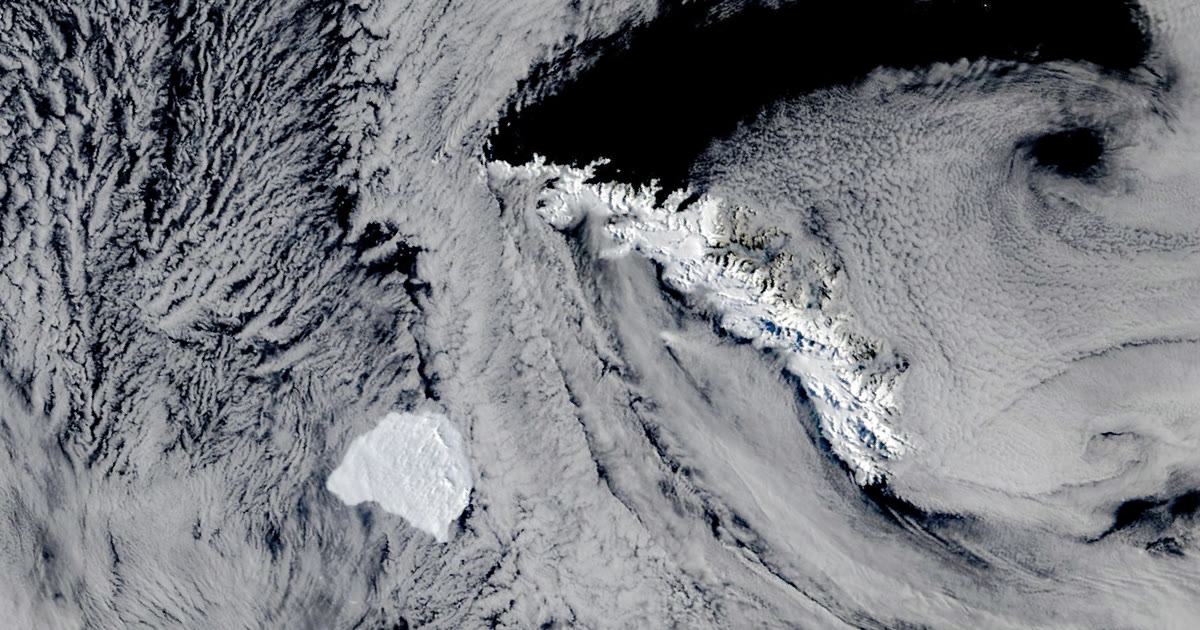
On 20 October, a NASA satellite over the South Atlantic caught a long white slab under swirling cloud. It was Iceberg A-81, and after more than three and a half years adrift it had almost stopped, right at the edge of the shallow seabed around South Georgia, a remote island famous for its penguins and seals.
This is the second giant iceberg South Georgia has slowed in two years. Whether A-81 runs aground there, like the record-breaking A-23A did in 2025, or slips past into open ocean is not yet known. Scientists, ship crews and wildlife watchers are all waiting to see.
From the Brunt Ice Shelf to the South Atlantic
A-81 is a Brunt Ice Shelf iceberg. It broke away from that floating shelf on Antarctica’s Weddell Sea coast in January 2023, NASA’s Earth Observatory and the EU’s Copernicus programme both report.
The break was slow to come. NASA says a rift called Chasm 1 was fairly stable for about 35 years, began growing again around 2012, and only let go in 2023. The berg then spent more than three years riding the Weddell Gyre, a clockwise ocean current, along the coast. It reached the tip of the Antarctic Peninsula by May 2026, then turned north into the Scotia Sea. South Georgia lies about 2,300 km (1,400 miles) north-north-west of where it started.
So where is the A81 iceberg now? On 20 October, NASA’s Terra satellite showed it at the edge of the island’s underwater shelf. Its progress had slowed and it seemed to be “bumping along” that edge, according to Jan Lieser of Australia’s Bureau of Meteorology and Christopher Shuman, a retired University of Maryland scientist, as cited by NASA. Copernicus, which writes the name A81, had already pictured it south-west of the island on 14 October, alongside a smaller berg called D32.
Two satellites, two sizes, and an honest gap
How big is it? The sources differ, and we should say so. NASA describes A-81 as roughly 1,550 km² (about 600 square miles), close to the area of Greater London (about 1,570 km²). Copernicus, citing the US National Ice Center, puts it at about 1,340 km² in mid-October.
Our reading, not an official explanation: the gap most likely comes from different dates and methods, and icebergs shed ice as they travel. It is not the largest iceberg South Georgia has met; A-23A was far bigger.
Will the iceberg ground at South Georgia, and what about wildlife?
The A-23A iceberg at South Georgia is the obvious comparison. It ran aground on the shelf in 2025 and later broke apart, NASA notes.
At the time, scientists warned that a grounded berg could block penguins and seals from their feeding grounds. But Andrew Meijers, an oceanographer at the British Antarctic Survey, also noted that melting icebergs release nutrients that can feed the local food chain, CBC News reported. National Geographic recalled that an earlier berg, A38, grounded there in 2004 with heavy losses for wildlife. The effect, in other words, can cut both ways, and it depends on where a berg stops.
For A-81, there is no official word yet that it has grounded, and no wildlife assessment. Big bergs and their broken pieces can also be a hazard for ships, a risk both Wisevoter and National Geographic have flagged on this route. Here, that is a possibility, not a forecast.
How anyone can follow a city of ice for free
The images behind this story come from free public satellites: NASA’s Terra and the EU’s Copernicus Sentinels. Copernicus says its data help track icebergs and understand ice in the Southern Ocean.
You can look too. NASA built its picture with data from Worldview, a free NASA map website. Find South Georgia, pick a recent date, and you may spot A-81 when the clouds clear. Open data is a good habit, much as the archive of NASA’s retired Swift observatory stays free for anyone.
Why this drift is a reason to watch, not to worry
On balance, A-81 is not a sign of disaster. NASA calls calving “a normal part of the life cycle of ice shelves”. We should not pin this single iceberg on climate change, and the sources do not.
Still, there are good reasons to pay attention. NASA says the Brunt Ice Shelf, home to the British Antarctic Survey’s Halley Research Station, shed A-74 in 2021, A-81 in 2023 and A-83 in 2024. And ice in Antarctica is changing in other places, from the warm seawater under Thwaites Glacier to ice cliffs that break off faster than models assumed. Calm attention, not alarm, is the right response.
The next satellite passes will show whether South Georgia holds A-81 or lets it go. Behind it, A-83 is already drifting north along the same road.
Prefer to watch? Follow us on YouTube
The tech stories that matter, explained in plain words. Subscribe so you never miss one.
Sources (5): every key fact checked against at least two
- NASA Earth Observatory: A-81 Reaches South Georgia, Image of the Day (27 October 2026)
- EU Space / Copernicus: Two Antarctic icebergs drift thousands of kilometres towards South Georgia, Image of the Day (19 October 2026)
- Wisevoter: Icebergs drift toward South Georgia Island (20 October 2026)
- CBC News: World's biggest iceberg appears to have run aground near remote British island (5 March 2025)
- National Geographic: The world's largest iceberg is on a collision course with vital penguin sanctuary
Related stories

Harvard study: 403 US data centers used up to as much electricity as Michigan
Data center electricity consumption, estimated: a Harvard-led study of 403 US hyperscale sites finds 68 to 99 TWh in a year, near Michigan's use.

Vulcan rocket fails 10 minutes into flight, and 40 Amazon Leo satellites do not reach orbit
Vulcan rocket failure on 15 November: ULA's rocket suffered an anomaly 10 minutes in and did not deliver 40 Amazon Leo satellites to orbit.

A flash of laser light briefly lines up the hidden electric order inside a quantum crystal
Auburn physicists used laser pulses to briefly line up tiny electric regions in a quantum ferroelectric metal, for about a trillionth of a second.