AMD's AI chip sales nearly double, and it expects a US$17 billion quarter as Helios racks ship
- AMD's sales rose 45% to a record US$13.4 billion in July to September, as its data centre business nearly doubled to US$8.5 billion.
- It expects about US$17 billion next quarter as its new Helios AI server racks start running at customers including Meta, Microsoft, OpenAI and Oracle.
- Gaming chip sales fell 40%, free cash flow dropped to US$554 million, and a US$1.1 billion charge tied to customer warrants hit official profit.
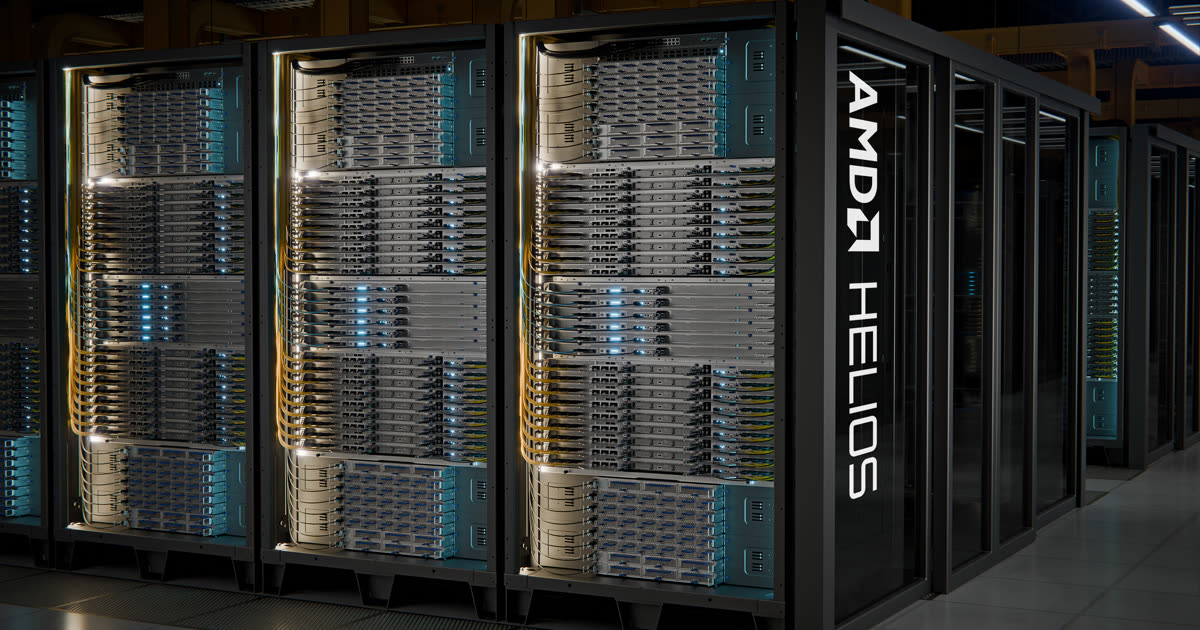
A year ago, AMD’s data centre chips brought in about US$4.3 billion a quarter. This summer they brought in almost twice that. Behind the number are AI systems at some of the world’s largest tech companies, now running on AMD chips, not only on Nvidia’s.
The AMD earnings for July to September, released on 3 November, were the best in the company’s history. Sales rose 45% to US$13.4 billion. AMD also forecast about US$17 billion for the next three months, well above what analysts expected. Its shares rose more than 7% in after-hours trading, according to Investing.com and CNBC.
AMD earnings: where the record US$13.4 billion came from
AMD’s own release gives these figures for its third quarter:
- Data Center: US$8.5 billion, up 97% on a year ago, a record. This covers Instinct GPUs, the chips that train and run AI models, and EPYC server processors.
- Client (PC chips): US$2.9 billion, up 7%, helped by Ryzen laptop processors.
- Gaming: US$773 million, down 40%. AMD’s release does not give a reason.
- Embedded chips, built into other machines: US$1.1 billion, up 29%.
- Profit: adjusted earnings were US$2.09 a share, up 74%. Analysts had expected about US$1.94, according to Investing.com. Official net profit nearly doubled to US$2.4 billion.
“We delivered a record quarter with revenue exceeding the high end of our guidance as Data Center segment sales nearly doubled year-over-year,” said Lisa Su, AMD’s chair and chief executive.
So the AMD data center revenue now makes up almost two-thirds of the company. That is the clearest sign yet that AMD has become an AI company.
The Helios bet behind a 27% jump in one quarter
The AMD Q4 guidance is about US$17 billion, plus or minus 3%. That would be 66% more than a year ago and 27% more than this quarter. Investing.com says analysts had expected about US$16.23 billion.
Most of that rise rests on Helios, AMD’s complete AI server rack. Instead of selling single chips, AMD now sells a whole cabinet of them: Instinct MI450 GPUs and new EPYC “Venice” processors, built to work together. AMD says customers including Meta, Microsoft, OpenAI and Oracle are already running AI models on the first Helios systems. Su said AMD expects growth “to accelerate further” as it scales Helios and Venice production.
Two numbers deserve a closer look. Free cash flow, the cash left after running the business and investing in it, fell to US$554 million, from US$1.53 billion a year earlier, as AMD built up stock and waited to be paid by customers. And official profit carried a US$1.1 billion charge from warrants, rights AMD gave certain customers to buy its shares later. The charge moves with AMD’s share price. AMD leaves it out of its adjusted figures.
If you build with AI, buy a PC or own the shares
For businesses that rent AI computing, more supply from a strong second maker matters. In our analysis, real competition usually brings more choice and, over time, better prices. AMD also released ROCm 10, its free software that lets developers run AI tools on AMD chips.
For PC buyers, AMD’s laptop chip sales grew, so new Ryzen models are selling. For gamers, a 40% fall in gaming sales is a number to watch, not yet a story to explain.
For savers, AMD is a large part of many technology funds. The shares had more than doubled in 2026 before this report, then fell 17.5% in October during a wider sell-off in AI stocks, according to Investing.com. This is not investment advice.
Strong demand, but the hard part is shipping
On balance, this is a strong report. AI demand is real, AMD beat its own forecast, and its customer list now includes the biggest buyers of AI computing. For anyone comparing AMD stock vs Nvidia, this quarter suggests AMD is becoming a second main supplier of AI chips, not just the alternative. Intel’s data centre sales also jumped last week, so the demand is not AMD’s alone.
There are fair cautions. A 27% jump in one quarter depends on building and delivering complex racks on time. Memory makers such as SK hynix say supply will stay tight for years, and every Helios rack needs that memory. Customer warrants can cost shareholders more as the stock climbs. And big AI buyers are spending at a pace that worries some investors, as Meta’s growing AI commitments show. The likelier outcome, in our view, is strong growth with some bumps in delivery, not a smooth line.
The quarter that tests the promise
When AMD reports October to December early next year, the test is simple. If sales reach about US$17 billion and free cash flow recovers, Helios will have passed its first real test. If not, investors will ask whether demand or supply was the limit.
Sources (5): every key fact checked against at least two
- AMD Investor Relations: AMD Reports Third Quarter 2026 Financial Results (3 Nov 2026)
- SEC: AMD 8-K Exhibit 99.1, third quarter 2026 results (3 Nov 2026)
- Investing.com: AMD stock jumps after hours as quarterly results, revenue guidance beat estimates
- Investing.com: AMD Q3 2026 slides: data center surges 97%, record earnings beat
- CNBC: AMD Q3 earnings report 2026 (3 Nov 2026)
Related stories
Canva layoffs: a restructure touches 22% of staff as growth slows
Canva layoffs: 1,271 people, 22% of staff, face job cuts, new roles or moves to hubs as growth slows. What we know, what we don't, and what to watch.

Apple Q4 2026 earnings: a record year, but memory costs and iPhone Duo supply soften the holiday outlook
Apple Q4 2026 earnings: revenue rose 12% to US$114.5bn to cap a record year, but memory costs and iPhone Duo supply cloud the holiday outlook.
Marvell agrees a $115bn deal for laser maker Lumentum, betting AI will run on light
The Marvell Lumentum deal is a $115bn all-stock bet that AI data centres will move from copper to light. Why both stocks fell, and what to watch.