SMIC earnings: China's top chipmaker posts a record quarter, and its co-CEO sees AI chips tight until 2028
- SMIC, China's biggest contract chipmaker, made a record US$3.19 billion in July to September, up 33.9% on a year ago.
- Its gross margin reached 29.9%, above its own forecast, and its factories ran 97.3% full; it expects sales to grow 4% to 6% next quarter.
- Co-CEO Zhao Haijun said he expects AI chip supply to stay tight through 2027 and perhaps rebalance only in 2028; that is his forecast.
- $3.19bnQ3 revenueRecord; up 33.9% on a year ago
- 29.9%Gross marginAbove its own 26-28% forecast
- 97.3%Factory utilisationUp from 93.7% in Q2
- 4-6%Q4 revenue growthCompany forecast, vs Q3
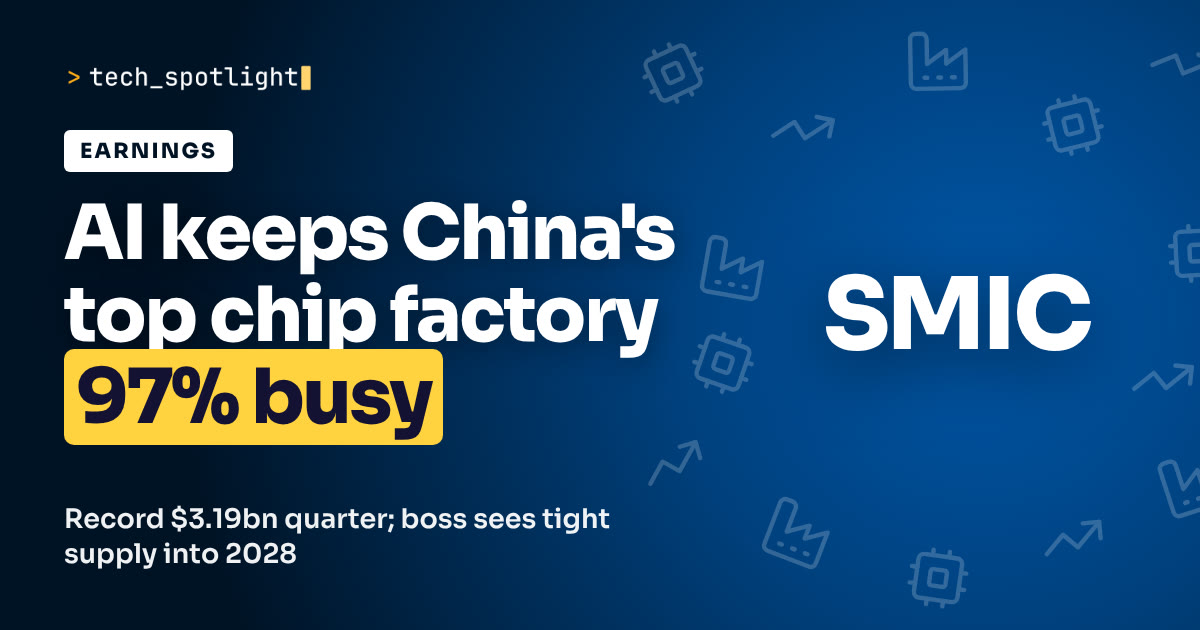
Almost every machine SMIC owns is now busy. In July to September, China’s biggest contract chipmaker ran its factories at 97.3% of capacity, and the reason, its bosses say, is artificial intelligence.
The SMIC earnings, released on 12 November, show record quarterly revenue of US$3.19 billion, up 33.9% on a year ago. On the call with analysts the next day, co-CEO Zhao Haijun said he expects AI chip supply to stay tight through 2027, and perhaps to rebalance only in 2028. That is his forecast, not a promise.
The AI boom is usually told through Nvidia and TSMC. This report suggests it now reaches much further: into the power chips, memory and controllers that every AI server needs, made in a country where the newest chipmaking tools are hard to buy.
SMIC earnings: a record $3.19 billion and nearly full factories
SMIC’s own results release gives these SMIC Q3 figures:
- Revenue: US$3,190.0 million, up 6.1% on the quarter before. Analysts had expected about US$3.09 billion, according to Investing.com.
- Gross margin: 29.9%, up from 25.3% in the second quarter and well above SMIC’s own forecast of 26% to 28%.
- Profit for owners: US$428.4 million.
- Utilisation: 97.3%, up from 93.7%. Monthly capacity is now 1,116,750 wafers (counted in 8-inch equivalents).
- Customers: 90.8% of revenue came from China.
By use, consumer electronics brought in 40.6% of sales, industrial and car chips 19.3%, computers and tablets 18.3%, smartphones 14.3%, and connected devices 7.5%.
Unaudited figures from SMIC's quarterly results releases. Source: SMIC quarterly results releases (HKEX and smics.com)
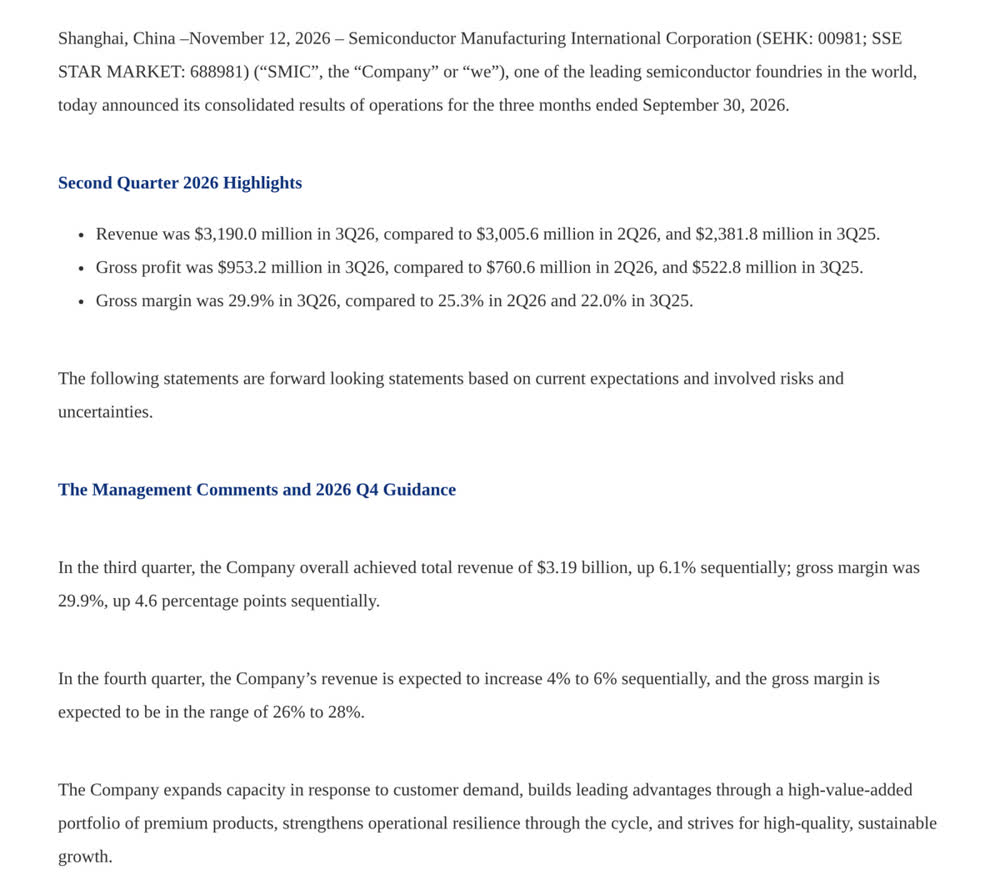 SMIC’s third-quarter results release, from the opening to its guidance, as published on smics.com on 12 November. Image: SMIC
A chip crunch the co-CEO says could last until 2028
For the last three months of the year, SMIC expects revenue to grow 4% to 6% and its margin to fall back to 26% to 28%. On the call, Zhao said he expects full-year 2026 revenue above US$12 billion, according to the call transcript and mlq.ai.
Why so tight? Zhao pointed to data-centre building and to companies setting up their own smaller AI facilities, the South China Morning Post reports. The Post also says tighter US limits on China’s access to advanced US processors could push Chinese firms further towards home-grown chipmakers.
Not every part of the business is strong. Smartphone chips fell 8% on the quarter, according to the transcript, while car and industrial chips rose 26%. Zhao also said depreciation, the yearly cost of new machines, will rise about 30% in 2026, and that long waits for equipment may make spending on new factories uneven.
What a tight chip market means for your next phone or car
Most readers will never buy a SMIC chip directly, but they buy things with chips inside. When the factories that make basic power and memory chips are nearly full, those parts can cost more or take longer to arrive. In our analysis, that pressure tends to show up first in cars, home appliances and cheaper phones, where makers have little room to absorb higher costs.
For anyone watching SMIC stock, the Hong Kong shares rose about 5% on 13 November, according to Investing.com. This is not investment advice.
Strong demand, with growth now limited by space
On balance, this is a strong quarter. SMIC beat its own forecast and grew faster than analysts expected. It sits in the same AI wave that gave TSMC another record quarter, and that has led SK hynix to expect a memory shortage lasting even longer.
There are fair cautions. With factories 97% full, analysts quoted by BigGo say future growth depends on adding new capacity, and Zhao himself warned that equipment can be slow to arrive. Rising depreciation will press on margins, as the lower Q4 forecast already shows. And with more than 90% of its sales in China, SMIC rises and falls with one market and its trade rules. The likelier outcome, in our view, is steady growth set by how fast SMIC can build, not by demand.
The next test comes in February
SMIC’s next results are expected around February. If revenue lands in its 4% to 6% range and new capacity arrives on time, Zhao’s view of a tight market into 2028 will look more like a plan than a hope.
Prefer to watch? Follow us on YouTube
The tech stories that matter, explained in plain words. Subscribe so you never miss one.
Quick answers
What is SMIC?
SMIC (Semiconductor Manufacturing International Corporation) is China's largest contract chipmaker. It makes chips that other companies design.
How much did SMIC earn in Q3 2026?
Revenue was a record US$3.19 billion and profit for its owners was US$428.4 million, according to SMIC's results release of 12 November.
How long will the AI chip shortage last?
SMIC co-CEO Zhao Haijun said on the earnings call that he expects supply to stay tight through 2027 and perhaps rebalance in 2028. That is his forecast, not a certainty.
Did SMIC stock go up after the results?
Its Hong Kong shares rose about 5% on 13 November, according to Investing.com. This is not investment advice.
Words to know
- Foundry
- A factory that makes chips designed by other companies.
- Wafer
- A thin disc of silicon on which many chips are made at once.
- Gross margin
- The share of sales left after the direct cost of making the product.
- Utilisation rate
- How much of a factory's capacity is in use.
- Guidance
- A company's own forecast for the next quarter.
- Depreciation
- Spreading the cost of expensive machines over several years.
Sources (10): every key fact checked against at least two
- HKEX: SMIC reports unaudited results for the three months ended September 30, 2026 (12 Nov 2026)
- SMIC: SMIC Reports 2026 Third Quarter Results (12 Nov 2026)
- SMIC: Fourth quarter 2025 results (10 Feb 2026)
- HKEX: SMIC second quarter 2026 results (13 Aug 2026)
- Investing.com: SMIC shares rise nearly 5% after third-quarter earnings beat estimates
- Investing.com: Earnings call transcript, SMIC Q3 2026
- South China Morning Post: China's SMIC sees AI computing crunch until 2028 (13 Nov 2026)
- BigGo Finance: SMIC third-quarter results
- Futu / WallStreetCN: SMIC's Q3 net profit attributable to owners
- mlq.ai: SMIC says AI chip supply will stay tight through 2027
Related stories

Nvidia's board is reportedly preparing to replace CEO Jensen Huang. No decision has been announced
Jensen Huang ouster: Nvidia's board is reportedly preparing to replace its CEO. What is official, what is reported and what to watch before 17 Nov results.

Jensen Huang resigns as Nvidia CEO; finance chief Colette Kress steps in while the board searches
Who is the new CEO of Nvidia? CFO Colette Kress is interim chief after Jensen Huang resigned. What Nvidia said, what is reported and what comes next.

Nvidia's board opens an independent investigation around CEO Jensen Huang, as shares fall and a lawsuit lands
Nvidia board investigation: what the board said about reports CEO Jensen Huang was targeted by a foreign intelligence effort, the lawsuit and what's next.