Google Play will show personal-account developers' addresses worldwide from 1 March 2027
- Every active Google Play developer must declare trader or non-trader status by 1 February 2027, wherever their apps are sold.
- From 1 March 2027, traders on personal accounts will have their address and phone number shown publicly on Google Play, to users everywhere.
- Developers outside the EEA and UK can declare as non-traders. Others get no opt-out on Google's page, and developers raise safety worries.
- 1 Feb 2027Deadline to declare trader statusGoogle Play Console Help
- 1 Mar 2027Public display of details beginsShown to users everywhere
- 27EU countries where Apple shows detailsApple's help page
Picture a solo developer selling a small budgeting app on Google Play from home. From 1 March 2027, the home address and phone number behind that app may be visible to every user. That is what the new Google Play trader status rule says for developers who sell on personal accounts.
The rule comes from consumer law in the EEA and the UK, but Google asks every developer worldwide to declare, and traders’ details will show to users everywhere.
Despite headlines about “Android developers”, this is a Play Store rule. It is not part of Google’s separate identity checks for sideloaded apps, which Google says use your data only to confirm who you are.
What Google’s page says about Google Play trader status
Under Google Play’s global developer policies, every active developer account must declare “trader” or “non-trader” by 1 February 2027, wherever its apps are distributed.
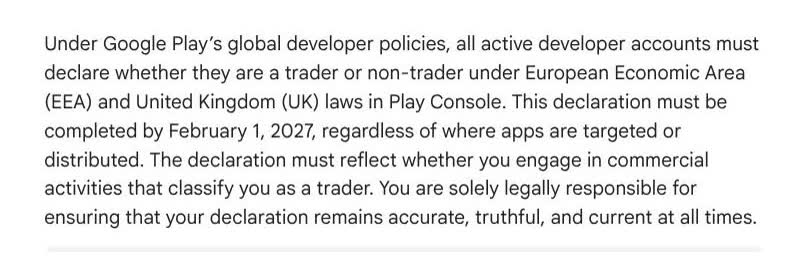
Google’s Play Console Help page on trader status. Source: Google Play Console Help. Image: Google.
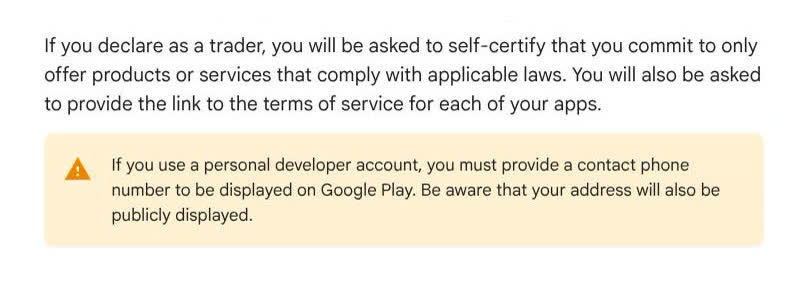
The same page warns personal accounts that their address will be shown. Source: Google Play Console Help. Image: Google.
Google defines a trader as anyone acting for a trade, business, craft or profession, such as with paid apps, in-app purchases or ads. Google’s page adds that developers who don’t distribute apps in the EEA or UK can declare as non-traders.
From 1 March 2027, users everywhere will see traders’ contact details, the D-U-N-S number in “App support” and a Terms of Service link if provided. For personal accounts, Google says you must give a phone number to display, and “your address will also be publicly displayed”.
Missing the deadline “may trigger enforcement”, including blocked app updates and removal from Play worldwide. Misstating your status can mean suspension. Google’s stated reason: its move to an “online marketplace” model in the EEA and UK from 1 March. Google’s page does not say what organisation accounts must show beyond the D-U-N-S number.
The worry: safety, scraping and a rule that travels
The Elec reports that South Korean indie developers call the change an invasion of privacy, and that critics say it clashes with the country’s data-minimisation principle. Android Authority quotes an Australian solo developer on the safety risk for people working from home, and a Reddit user on addresses being scraped in bulk. Both outlets question why a law covering EEA and UK users applies worldwide. Google had not replied to either at the time.
Apple, which has been tightening its own App Store rules, takes a narrower approach on its help page. It shows a trader’s address, phone and email only when the app is offered in the 27 EU countries, and lets individuals use a P.O. box with proof. Google’s page describes no such option. Reported, not confirmed: The Elec says Google does not accept P.O. boxes, and Android Authority relays the same from a developer quoting Google support.
If you make apps, what to do before 1 February
- Check whether you are a trader. If your apps aren’t offered in the EEA or UK, Google says you can declare as a non-trader. If they are and your app earns money, you are likely a trader.
- Weigh what each answer costs you. A non-trader label tells EEA and UK users that consumer rights do not apply to you. A trader label brings public contact details.
- Think about an organisation account. Reported, not confirmed: Android Authority relays a developer’s claim that the address must match your verified home address, so a business address may mean registering a company with a D-U-N-S number. This is not Google’s advice; check Play Console first.
- Declare in Play Console before the deadline.
If you only use apps, from March you will see more about who sells to you, and contact details to reach them. In the EEA and UK, the seller’s name will replace Google in “Offered by”.
Transparency against safety: where we land
In our reading, both sides have a point. Knowing who sells you an app helps with refunds, complaints and trust. But a public home address is a different thing from a company name, and solo makers are the people least able to absorb harassment. When Google updated its privacy policy on Gmail and Photos data and ads, the change applied only to people who chose to connect their apps. For traders on personal accounts, this rule offers no such choice.
A fairer fix, in our reading, would be a middle road: business addresses, or Apple-style limits on where details show. Google’s page offers neither, so developers should plan for the rule as written.
The first date that matters is 1 February, when every developer must have declared. After that, watch for whether Google answers the privacy worries before details start showing on 1 March.
Prefer to watch? Follow us on YouTube
The tech stories that matter, explained in plain words. Subscribe so you never miss one.
Quick answers
What is trader status on Google Play?
It is a declaration of whether you earn money from your apps as a business, under EEA and UK consumer law. Every active Google Play developer account must make it by 1 February 2027.
Will Google Play show my address publicly?
If you are a trader on a personal account, yes. Google says your address will be publicly displayed and you must give a phone number to show. This starts on 1 March 2027.
Can I hide my address on Google Play?
Google's page offers no opt-out for traders. If you don't distribute apps in the EEA or UK, Google says you can declare as a non-trader. Otherwise, declare honestly: Google warns that misstating your status can lead to account suspension.
What is the difference between a trader and a non-trader?
A trader acts for a trade, business or profession, for example with paid apps, in-app purchases or ads. A non-trader is a hobby or non-commercial developer, and EEA and UK users are told consumer rights do not apply to them.
Words to know
- Trader
- Someone who sells or earns money as a business or profession, not as a hobby. It is an EU and UK legal term.
- D-U-N-S number
- A nine-digit business ID from Dun & Bradstreet.
- EEA
- The European Economic Area: the 27 EU countries plus Iceland, Liechtenstein and Norway.
- Sideloading
- Installing an app from outside the Play Store.
Sources (7): every key fact checked against at least two
- Google Play Console Help: Trader status declaration
- Google Play Console Help: Policy announcement, 29 October 2026
- Android Developers Blog: Boosting trust and transparency in Google Play (12 Jul 2023)
- Apple App Store Connect Help: EU Digital Services Act trader requirements
- The Elec: Google to publish developers' details worldwide (25 Nov 2026)
- Android Authority: Google is forcing developers to publish addresses online (26 Nov 2026)
- Engadget: Google will soon share Android developers' addresses publicly
Related stories
Air Force Cloud One reportedly hacked: what we know, and what the Air Force won't say
Reuters reports hackers got into Air Force Cloud One, and a US official told NBC News the same. The Air Force will not comment. Here is what is known.
· 4 min read
Allstate outage drags on: customers locked out of the app and website for days
The Allstate outage began 23 November 2026. Here is what the insurer says, what customers report, how to pay a bill, and what is still unknown.
· 3 min read
UK benefits agency DWP hit by cyber incident: payments continue, but many online services are offline
The DWP cyber incident has taken UK benefit sites offline. Payments continue, and missed appointments won't bring sanctions. Here is what we know.
· 3 min read